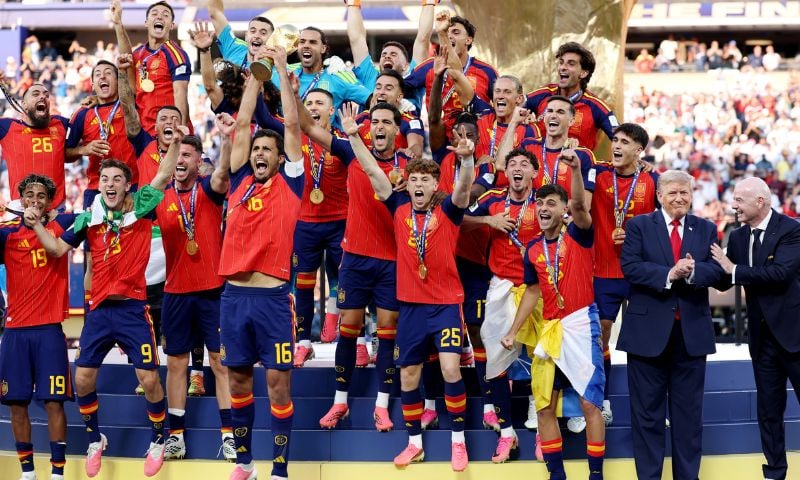
ISLAMABAD: Spain’s captain Rodri stood ready to lift the World Cup after defeating France and Argentina. Teammates reached out. The world watched.
But Donald Trump refused to move from the podium. His administration had just halted US trade with Spain over military spending and the Iran war. FIFA President Gianni Infantino, a Trump ally, had to awkwardly guide him aside.
This World Cup will be remembered for more than its champion.
Exorbitant ticket prices, officiating changes, and mandatory hydration breaks could define the tournament’s legacy. Here’s a look at what will—and won’t—stick ⬇️
— Front Office Sports (@FOS) July 21, 2026
When Rodri finally raised the trophy, the moment captured not just Spanish glory, but the politics that defined World Cup 2026.
🏆 SPAIN ARE THE 2026 FIFA WORLD CUP CHAMPIONS! 🇪🇸
Spain lifts the trophy after defeating defending world champions Argentina in the 2026 FIFA World Cup Final 🌎 pic.twitter.com/6Hb53LSCMs
— MayaRisser (@MayaRiser) July 20, 2026
What world learns from the tournament
The tournament offered starkly contrasting lessons about football’s role in the modern world.
On one hand, it demonstrated the sport’s enduring ability to unite. Kansas City embraced Algeria with open arms. Boston became a Scottish enclave of joy. Even defeated fans sang, chanted, and danced in celebration of the beautiful game. Cape Verde delivered heroic performances. Norway made a historic quarterfinal run. Jordanians, Iraqis, and Haitians found pride in mere participation.
FIFA World Cup 2026’s legacy in North America – winning hearts and minds 🇺🇸🇨🇦🇲🇽🏟️⚽
🗣️🎙️Listen and watch the full FIFA Podcast with FIFA Vice President and @Concacaf President Victor Montagliani and @MLS Commissioner Don Garber on the following… pic.twitter.com/W5xUXDZgGp
— FIFA Media (@fifamedia) July 20, 2026
Yet equally prominent was football’s weaponisation for division. Iranian fans faced abuse and Islamophobic chants from anti-government activists. The US imposed arbitrary travel restrictions on Iran’s team. When Iran failed to progress, Department of Homeland Security Secretary Markwayne Mullin openly celebrated: “I might’ve sung a song or two or maybe even danced a happy dance.”
Read Also: Ten Takeaways from the 2026 World Cup
The tournament became, as one Palestinian American fan in New York told media, a “political summit” with Trump centre stage, where Palestinian and Israeli flags flew among supporters, and where the president reportedly intervened to reverse USA striker Florian Balogun’s suspension, though the intervention proved futile as America suffered a 4-1 defeat to Belgium.
The Americanisation question
FIFA’s decision to bring the World Cup to a nation that stood as a global exception in never fully embracing football came with a price. The sport’s governing body allowed the US to “put its own twist” on the world’s game.
The World Cup may be remembered less for its winner than for the question it left hanging over the game: how much of soccer’s American makeover will survive? https://t.co/sqMwkTRoUc
— ChippewaHeraldSports (@ChpHeraldSports) July 20, 2026
Mid-half hydration breaks, used primarily to show commercials. Championship rings for winners. Half-time shows that echoed the NFL experience. For many spectators, these additions represented an unwelcome attempt to Americanise a sport cherished for its purity and simplicity.
Accessibility paradox
Perhaps the most profound lesson emerged from what was lost.
Football’s universal appeal has always rested on accessibility. All you need is a ball. Anyone, anywhere, rich or poor, young or old, can play. That abundance of play makes it easy to watch.
Read Also: Spain Beat Argentina in Extra Time to Win World Cup, Shatter Messi’s Dream
In World Cup 2026, however, watching became a privilege of wealth. Tickets ranged from hundreds to hundreds of thousands of dollars, systematically excluding working-class fans.
The 2026 FIFA World Cup was meant to celebrate global unity, but visa barriers, unequal treatment, and selective freedoms have sparked questions about who truly gets to participate in the “world’s game.” A thought-provoking piece by Prof. Akram Saqib.
— The Friday Times (@TFT_) July 21, 2026
The Los Angeles Stadium, hosting several matches, sat just kilometres from mechanic Juan Cortes’s shop. “I wish they would help us out, so people like us, who are into the game and have the passion for their teams, were able to go see our idols play,” Cortes told media at the tournament’s start. “It’s not every day I get to see a World Cup in my country.”
Read Also: Why Boos Greeted Trump and Infantino at World Cup Trophy Ceremony
The same mirage appeared in the final. International fans believed the match was in New York due to the city’s skyline backdrop. In reality, the New York New Jersey stadium sits in suburban New Jersey, surrounded by car parks and motorways, inaccessible by foot, an arduous journey for city dwellers.
While FIFA described the 2026 World Cup as its most inclusive tournament, human rights groups argue the event was overshadowed by visa denials, border detentions and immigration enforcement in the United States.
The Sport & Rights Alliance said the off-field realities raised… pic.twitter.com/qIgD2zVfZe
— insidethegames (@insidethegames) July 20, 2026
A view from Pakistan’s fan
For Pakistani football fanatic Sheroze Ali, World Cup 2026 was a tournament of extremes, unforgettable highs and unsettling lows. “Other than Pakistan’s Trionda giving me that ecstatic feeling, this World Cup was indeed massive in all terms compared to the past,” Ali reflected.
But his praise came with sharp criticism.
There is a 13minute video compilation on Argentina’s thuggery and attempt to rob Spain in yesterday’s World Cup finals.
No class. No sportsmanship.
Just nasty brutal senseless behaviour.0 shots in 90mins.
The worst ever team in a World Cup final. pic.twitter.com/Anj9NfzH8n— OurFaveOnlineDoc 🇬🇧 🇳🇬 (@OurFavOnlineDoc) July 20, 2026
“This World Cup has shown biases, politicisation of a beautiful game, and last but certainly not least, in the final, Argentina seemed more focused on targeting Spanish players to injure them rather than scoring goals,” he said.
Ali reserved special appreciation for the match referee, who, he noted, “with his composed character, managed the high-octane final brilliantly.”
Argentina’s World Cup heartbreak turns into a full-blown brawl after the final whistle.
Video shows Argentina’s Leandro Paredes shoving Spain’s Eric Garcia to the ground before knocking over Spain midfielder Gavi as players, substitutes, and coaches from both teams rush in to… pic.twitter.com/Z3185yWw6T
— Fox News (@FoxNews) July 20, 2026
What remained unchanged
Despite the political controversies, despite the commercialisation, despite the accessibility barriers, the World Cup still delivered its magic.
Me encanta esta imagen.
El hermano menor de Yamal lo encontró en el campo de fútbol, corrió hacia él emocionado y se abrazaron 🥹 pic.twitter.com/vEwl0oTFzx
— MindBodyIsLife (@MindBodyIsLife) July 20, 2026
Teenage sensation Lamine Yamal announced himself on the biggest stage. Veterans like Lionel Messi defied time itself, performing as if in their mid-20s. Unsung heroes, Spain’s Marc Cucurella and Pedro Porro, rose to decisive moments while bigger stars in the German and Portuguese squads faded.
The tournament produced near-misses, late comebacks, individual heroics, heartbreak, and entertainment that will echo through decades.