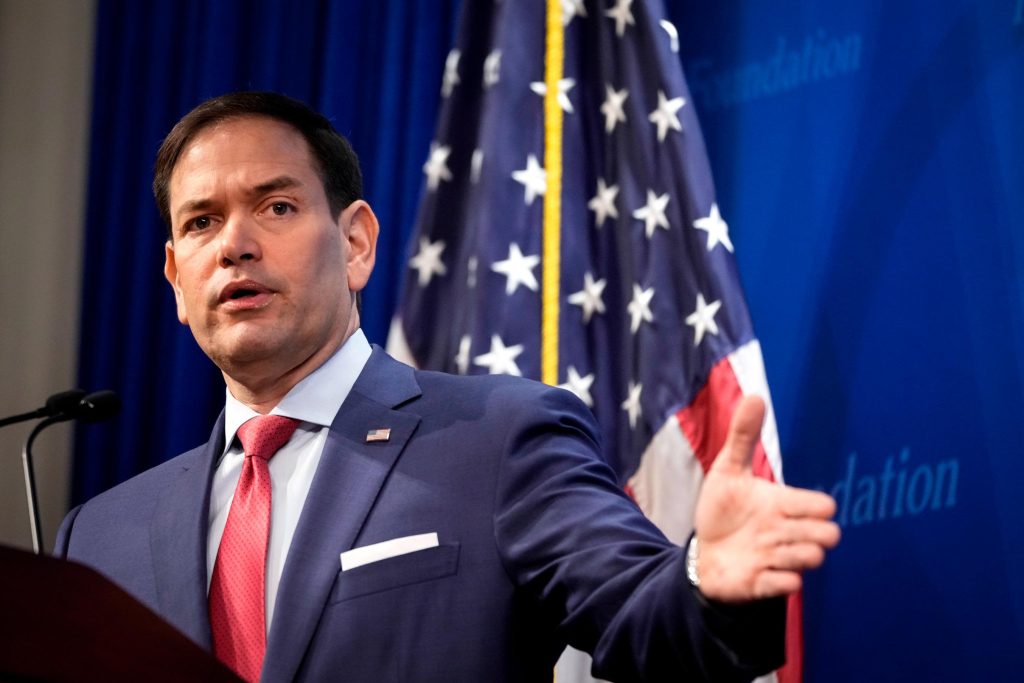



WASHINGTON: US Secretary of State Marco Rubio said on Thursday there were “some good signs” that a possible agreement with Iran could be reached, as mediator Pakistan intensified diplomatic efforts to end the US-Iran conflict through dialogue and diplomacy.
Rubio said Washington remained open to diplomacy with Iran, while warning that other options were available if talks failed.
“I believe the Pakistanis will be travelling to Tehran today. So hopefully that’ll advance this further,” Rubio told reporters on Thursday.
“The president’s preference is to do a good deal, that’s his preference. It’s always been his preference,” Rubio told reporters.
“There are some good signs, but … I don’t want to be overly optimistic.”
A ceasefire on April 8 halted the war launched weeks earlier by the United States and Israel, but negotiation efforts have so far failed to yield a lasting peace agreement.
A war of words has replaced open conflict but the impasse continues to weigh on the world economy, leaving everyone from investors to farmers in painful states of uncertainty.
Rubio voiced hope that Pakistan’s ongoing diplomatic efforts would advance diplomacy on ending the US-Iran war, saying there has been progress.
Rubio also warned that any move by Iran to impose tolls in the Strait of Hormuz would make a deal “unfeasible”.
.@SecRubio on Iran: “@POTUS‘s preference is to do a good deal… I’m not here to tell you that it’s going to happen for sure, but I’m here to tell you that we’re going to do everything we can to see if we can get one. If we can’t get a good deal, @POTUS has been clear — he has… pic.twitter.com/dhah7hSlvV
— Rapid Response 47 (@RapidResponse47) May 21, 2026
A ceasefire on April 8 halted the war launched weeks earlier by the United States and Israel, but negotiation efforts have so far failed to yield a lasting peace agreement.
A war of words has replaced open conflict but the impasse continues to weigh on the world economy, leaving everyone from investors to farmers in painful states of uncertainty.
“It’s right on the borderline, believe me,” Trump told reporters Wednesday. “If we don’t get the right answers, it goes very quickly. We’re all ready to go.”
He said a deal could come “very quickly” or “in a few days”, but warned Tehran would have to provide “100 percent good answers”.
Rubio also criticised NATO allies for their refusal to help Trump’s war against Iran.
“He’s not asking them to commit troops. He’s not asking them to send their fighter jets in. But they refuse to do anything,” he said.
“We were very upset about that.”
Tensions over the Strait of Hormuz remained central to the conflict.
Iran’s Islamic Revolutionary Guard Corps (IRGC) said 31 vessels transited the Strait of Hormuz in the past 24 hours “with the coordination and security of the IRGC Navy”, according to a statement carried by the semi-official Tasnim News Agency.
Meanwhile, US Central Command (CENTCOM) said 94 commercial vessels had been redirected from Iranian ports and four others disabled amid what it described as an American naval blockade, in a post on X.
As of May 21, CENTCOM forces have redirected 94 commercial vessels and disabled 4 while enforcing the blockade to prevent the flow of commerce into and out of Iranian ports. pic.twitter.com/A54jjxDaYE
— U.S. Central Command (@CENTCOM) May 21, 2026
The ceasefire halted the fighting but has not reopened the Strait of Hormuz, the vital waterway that normally carries about a fifth of the world’s oil and liquefied natural gas.
The future of Hormuz remains a key sticking point in negotiations, with fears growing that the global economy will feel more pain as pre-war oil stockpiles deplete.
Iran imposed a Hormuz blockade as part of its retaliation in the war, allowing only a trickle of vessels through in recent weeks while introducing a toll system.
Iran’s new body overseeing Hormuz said its claimed area of control extends to Emirati waters, drawing a sharp rebuke from Abu Dhabi.
Tehran’s chief negotiator Mohammad Bagher Ghalibaf on Wednesday accused Washington of seeking to restart the war, warning of a “forceful response” if Iran were to be attacked.
“The enemy’s movements, both overt and clandestine, show that despite economic and political pressure, it has not abandoned its military objectives and is seeking to start a new war,” Ghalibaf said.
Iran’s foreign ministry spokesman Esmaeil Baqaei said the Islamic republic was examining points received from Washington, while repeating Tehran’s demands for the release of its assets frozen abroad and an end to a US naval blockade.
Pakistan intensifies diplomatic efforts
Pakistan, which is playing a key role as a mediator, intensified diplomatic engagement as part of efforts to revive US–Iran talks.
Iranian President Masoud Pezeshkian met Pakistan Interior Minister Mohsin Naqvi in Tehran on Wednesday to discuss regional developments and ongoing indirect negotiations between Iran and the United States, Iran’s Fars news agency reported.
Iran Cautions of US, Israeli Plot to Divide Islamic Stateshttps://t.co/xjIiEvCaG8 pic.twitter.com/2ahlmo7pZi
— Fars News Agency (@EnglishFars) May 18, 2026
Both sides reviewed diplomatic consultations aimed at regional stability and security, and emphasised continued dialogue and cooperation.
Naqvi conveyed Pakistan’s position on supporting negotiations and mutual understanding, according to Iranian media reports.
Pezeshkian thanked Pakistan for its role in promoting regional stability.
Trump willing to wait
US President Donald Trump said on Wednesday that Washington was willing to wait a few days for Iran’s response on a possible agreement.
“I’m willing to wait a few days for the right answer from Iran. They are logical people,” Trump told reporters.
“If we don’t get the right answers, it will move very quickly. We are all ready to go,” he added.
.@POTUS on Iran: "It's right on the borderline, believe me. If we don't get the right answers, it goes very quickly. We're all ready to go. We have to get the right answers — it would have to be a complete 100% good answers." pic.twitter.com/LGFDQW4Z3h
— Rapid Response 47 (@RapidResponse47) May 20, 2026
Trump rejected suggestions that sanctions relief on Iranian oil exports had been offered, saying: “I’m not doing any relief until they sign an agreement.”
He said any deal would require “100 per cent good answers” from Tehran.
Iran reviewing latest US proposal
On Wednesday, Iranian Foreign Ministry spokesman Esmaeil Baghaei said Tehran had received a new US proposal through mediators and was reviewing it.
According to Iran’s Tasnim News Agency, Baghaei said Iran was “pursuing the path of negotiations with seriousness and good faith”, despite what he described as “strong and reasonable suspicion” about Washington’s intentions.
Iranian President Pezeshkian also reiterated that diplomacy remained open.
“All paths remain open from our side,” he wrote on X. “Mutual respect in diplomacy is far wiser, safer, and more sustainable than war.”
Russia and China call for diplomatic solution
Russia said the Iran crisis could only be resolved through diplomacy that takes Iranian interests into account.
Russian Foreign Ministry spokeswoman Maria Zakharova said only Iran should decide the fate of its uranium reserves, according to remarks at a briefing.
🔴 #LIVE: Briefing by Russian Foreign Ministry Spokeswoman Maria Zakharova on topical foreign policy issues https://t.co/g0poSOsDNv
— MFA Russia 🇷🇺 (@mfa_russia) May 21, 2026
China, meanwhile, confirmed that Pakistan’s Prime Minister Shehbaz Sharif would visit Beijing later this month.
A foreign ministry spokesperson said China would work with Pakistan to “make positive contributions to the early restoration of peace and stability in the Middle East”.