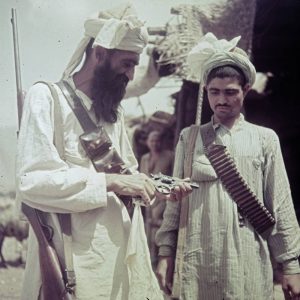
PESHAWAR, Pakistan: In his younger days, 72-year-old Farmanullah would turn up at weddings, funerals, or village jirgas with a China-made .30 bore pistol resting in a leather holster strapped across his chest — a symbol not just of protection, but of prestige.
The handmade leather belt, locally known as Kaash, hung diagonally from one shoulder, its cartridge loops displayed prominently like a badge of honour in the tribal belt’s deeply rooted gun culture.
Until the late 1990s, the public display of weapons was woven into the social fabric of parts of Pashtun society. Men attending jirgas or settling disputes often arrived armed, their holsters and rifles reflecting influence, authority, and social standing as much as personal security.
“Carrying weapons was considered a sign of respect, especially for those involved in jirgas and dispute resolution. But after 2000, education, stricter policing, and greater public awareness gradually discouraged the open display of firearms,” says Farmanullah, a resident of Hazarkhwani village on the outskirts of Peshawar near the Ring Road.
Rapid licence growth
Although public display of weapons had declined for years, the culture is re-emerging through social media influence and expanding civilian access to arms licences.
Between January 2024 and March 2026, more than 400,000 people across Khyber Pakhtunkhwa applied for arms licences in the province, while 314,855 applications were approved. So far, 277,029 licences for different categories of weapons have been issued, generating more than Rs3 billion in government revenue.
“Carrying weapons was considered a sign of respect, especially for those involved in jirgas and dispute resolution. But after 2000, education, stricter policing, and greater public awareness gradually discouraged the open display of firearms.” – Farmanullah, a local resident
Peshawar tops the list with 45,375 fresh licences, followed by Swat (21,219 licences), Mardan (18,467 licences), Swabi (14,952 licences), Charsadda (14,279 licences), Bannu (12,322 licences), Dera Ismail Khan (11,371 licences), Kohat (11,313 licences), Nowshera (9,819 licences), Mansehra (9,216 licences), Haripur (8,825 licences), Abbottabad (8,812 licences), Lower Dir (8,703 licences), Khyber (8,026 licences), Buner (7,023 licences), Malakand (6,992 licences), Lakki Marwat (6,119 licences), Hangu (5,791 licences), North Waziristan (5,655 licences), Karak (5,428 licences), Upper Dir (4,789 licences), Orakzai (4,724 licences), Bajaur (4,378 licences), and Kurram (3,878 licences).
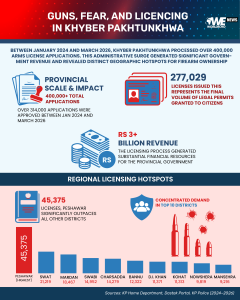
The remaining districts report comparatively lower figures: Lower South Waziristan (3,593 licences), Mohmand (3,432 licences), Shangla (3,165 licences), Battagram (2,341 licences), Tank (1,424 licences), Torghar (1,153 licences), Kohistan-II (1,089 licences), Kohistan-I (758 licences), Upper South Waziristan (776 licences), Lower Chitral (643 licences), Upper Chitral (504 licences), and Kolai-Palas (460 licences).
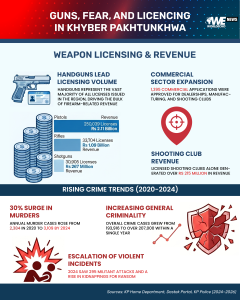
Official documents from the Home and Tribal Affairs Department show that pistol licences accounted for the largest share of applications and approvals. Authorities approved 250,039 pistol licences, generating over Rs2.11 billion in revenue. In addition, 33,704 rifle licences generated more than Rs1.09 billion, while 207 revolver licences brought in Rs2.75 million. Another 30,905 shotgun licences generated more than Rs267 million.
Unregulated arms market
The expansion of arms licensing extends beyond civilian ownership into commercial and institutional domains.
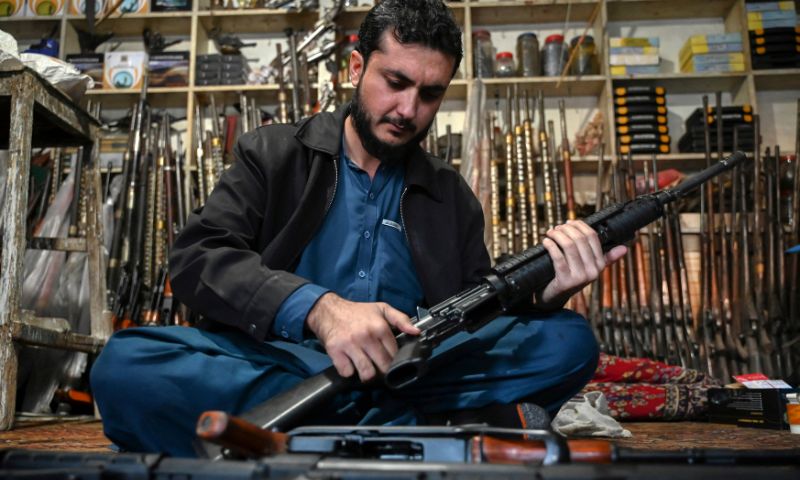
The Khyber Pakhtunkhwa Home and Tribal Affairs Department received 1,651 applications related to arms dealerships, weapons manufacturing and repair businesses, and shooting clubs. Of these, 1,395 have already been approved, while scrutiny of the remaining applications continues. Eight shooting clubs have also been licensed across the province, contributing more than Rs215 million in revenue.
Senior Home Department officials, speaking anonymously, point to regulatory loopholes in arms tracking systems. Imported weapons, they say, usually carry serial numbers linked to dealer-level records, making them traceable. However, locally manufactured weapons largely remain outside any standardised tracking system.
Dr Muhammad Ibrar, Assistant Professor of Criminology at the University of Peshawar, agrees with the Home Department officials.
He remarks that the lack of proper record-keeping has created a parallel and largely unregulated weapons market. Concerns have also emerged that legally licenced weapons are transported to other provinces, such as Punjab and Islamabad, for resale, while allegations persist that licence numbers are sometimes reused for other firearms, weakening oversight and accountability.
He notes, “firearms are often obtained for self-protection due to family feuds, terrorism-related fears, and personal disputes, while also functioning as symbols of status and power in certain communities. He warns that normalisation of weapons increases the likelihood of their use in everyday disputes, road rage incidents, and domestic conflicts.” – Dr Muhammad Ibrar, University of Peshawar
Similarly, an arms dealer in Darra Adam Khel — home to one of the largest unregulated arms manufacturing markets, located about 45 kilometres south of Peshawar — reveals that weapons are typically transported in bulk to Punjab and Sindh, and most of these consignments consist of locally manufactured firearms sold for profit. He requests anonymity due to the sensitive nature of the trade.
Burgeoning crime trends
The rapid increase in gun licensing comes at a time when crime and insecurity continue to rise across the province.
Data from the Pakistan Bureau of Statistics reveal that Khyber Pakhtunkhwa recorded 193,916 crimes in 2020, including 2,383 murders, 952 kidnappings for ransom, and 2,910 attempted murders. In 2021, overall crimes rose to 207,838 cases with 2,682 murders, 3,352 attempted murders, and 747 kidnappings for ransom.
More recent figures indicate a worsening trend. Murders increased from 2,384 in 2020 to 3,109 in 2024 — a rise of nearly 30 per cent — while kidnapping cases climbed from 952 to 1,211 during the same period. At the same time, the 295 militant attacks recorded in 2024 reflect an increasingly fragile security situation in the province.
Guns and social order
The parallel rise in violence and civilian access to firearms raises critical questions about whether people are arming themselves out of necessity and fear, or whether the state is facilitating and profiting from the gradual militarisation of society.
According to Dr Ibrar, the government’s arms licensing policy is partly driven by revenue generation, but it carries serious social consequences. He argues that widespread gun ownership in Khyber Pakhtunkhwa reflects insecurity, fear, cultural traditions, and declining trust in law enforcement.
He notes, “firearms are often obtained for self-protection due to family feuds, terrorism-related fears, and personal disputes, while also functioning as symbols of status and power in certain communities. He warns that normalisation of weapons increases the likelihood of their use in everyday disputes, road rage incidents, and domestic conflicts.”
State defence for licensing
A senior official from the Home and Tribal Affairs Department, speaking on condition of anonymity, defends the licensing system, arguing that obtaining an arms licence is a legal right and that the process includes scrutiny mechanisms to prevent criminals from acquiring weapons.
So far as the procedure is concerned, applicants first apply through the Dastak App, followed by biometric verification at a National Database and Registration Authority (NADRA) e-Sahulat centre, police verification, and submission of a stamp paper to the Deputy Commissioner before final approval by the Home Department. The average processing time for an arms licence application is approximately two months.
“Applicants undergo background verification through local police stations before licences are issued. Licencing has helped regularise firearm ownership while also generating substantial revenue for the government,” the official says.
He adds that the system has now been computerised, reducing fraud and making it easier for law-enforcement agencies to verify licences online during inspections and checkpoints.
Fear-driven weaponisation
Expansion of civilian gun ownership reflects a deeper governance challenge and weakening public trust in state protection mechanisms.
Dr Asif Gandapur, a psychiatrist at the Hayatabad Medical Complex in Peshawar, notes that while removing firearms entirely may reduce certain forms of violence, it does not eliminate crime altogether, as alternative weapons are often used. He adds that the perception of armed civilians can sometimes deter potential attackers, but argues that firearm familiarity is deeply embedded in local culture from an early age.
“Applicants undergo background verification through local police stations before licences are issued. Licencing has helped regularise firearm ownership while also generating substantial revenue for the government.” – An official of KP Home and Tribal Affairs Deptt.
“Research does not conclusively support the idea that complete disarmament guarantees peace. International crime patterns show firearm prevalence alone does not determine crime rates,” Dr Asif contends.
But Khyber Pakhtunkhwa Centre of Excellence on Countering Violent Extremism Director General Dr Qasim believes that large-scale licensing has contributed to rising crime and social tensions by increasing accessibility and visibility of firearms.
Eroding state control
The reclassification of high-powered firearms into the non-prohibited category has also raised broader concerns about the state’s monopoly over force. In most security frameworks, civilians are restricted from possessing weapons comparable to those used by law-enforcement agencies.
Police officials say that enforcement varies depending on circumstances, as similar categories of weapons are present both in civilian circulation and among law-enforcement personnel. They add that action is taken against individuals carrying heavy weapons when misuse is suspected, even if the weapons are licensed.
Police in Peshawar have recently reiterated that firearms must remain strictly regulated, stating that weapons should either remain under state control or be responsibly held by civilians within legal limits. “Licensed weapons are frequently used in various types of crimes,” says Capital City Police Officer Dr Mian Saeed.