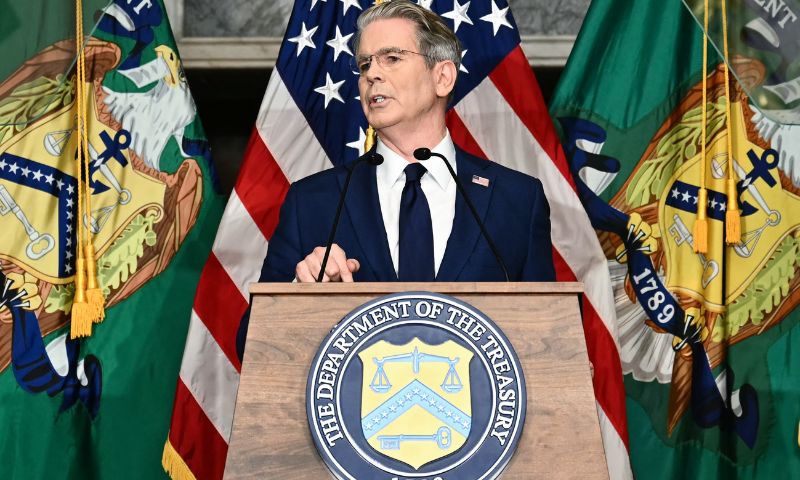
WASHINGTON: The United States on Monday launched what Treasury Secretary Scott Bessent called an “unprecedented” economic pressure campaign against Iran, targeting sectors and financial networks that Washington says sustain Tehran’s economy and warning countries and companies that continue doing business with Iran that they could face US sanctions.
Bessent said the campaign “Operation Economic Outcast” was launched on the orders of President Donald Trump and would seek to sever every economic lifeline supporting the Iranian government.
“In the Second World War, D-Day marked the historic beginning of a campaign with our allies to target and drive the enemy from its positions,” Bessent told reporters. “Today, in that same spirit, we are launching an economic onslaught against Iran’s financial connections around the globe.”
WATCH IN FULL: @SecScottBessent announces Operation Economic Outcast — a sustained campaign to sever every remaining economic lifeline of the Islamic Republic of Iran pic.twitter.com/ZTjuwdEa4b
— Rapid Response 47 (@RapidResponse47) August 24, 2026
The announcement comes almost six months into the US-Iran war.
Sectoral sanctions against Iran
The US Treasury Department said it had issued new sectoral sanctions targeting five areas of Iran’s economy: digital assets, technology, gold, aviation and shipping.
Bessent said the measures would expand the risk of secondary sanctions for entities that continue conducting business with Tehran.
The Treasury secretary also said his department was sanctioning 60 entities, individuals and vessels linked to Iran.
He said they had enabled the Iranian government to procure missile technology, conduct cyber operations and generate oil revenue.
Bessent warned that any entity facilitating money laundering on behalf of Iran would be removed from the US dollar system.
“Every country has a defined timeline to shut down activities we have identified,” he said. “If they do not take action, we will do so unilaterally through Treasury authorities.”
He added: “Any entity that facilitates money laundering on behalf of Iran will be removed from the US dollar system. The clock just started ticking.”
Bessent said no one was beyond the reach of US sanctions.
Washington warns Iran’s facilitators
Bessent said the United States had mapped the channels Tehran uses to evade sanctions and sell oil.
He accused countries and businesses of facilitating Iranian petroleum shipments, moving money through exchange houses and free-trade zones, providing aviation and shipping services and allowing Iranian-linked transactions through their banks.
“It is no longer acceptable to turn a blind eye to Iran’s activities,” Bessent said.
Also Read: Pakistan Stresses Implementation of Islamabad MoU to End US-Iran Conflict
He said President Trump was contacting world leaders and asking them to cease interactions with Tehran.
Countries that continued to facilitate Iran’s financial and economic activity would “share in the isolation” of the Iranian government, Bessent warned.
Bessent said the strength of the US economy allowed Washington to pursue the economic campaign alongside military operations.
He said the United States was “no longer managing the Iranian threat” but seeking to end it.
Iran now faced a choice between “complete global isolation and a subsistence economy” or a return to normalcy and an opportunity to rejoin the global economy, Bessent said.
Trump says Iran is ‘collapsing’
Trump said on Monday that Iran was “collapsing” as Washington moved to intensify economic pressure on Tehran.
“IRAN IS COMPLETELY COLLAPSING!!!” Trump wrote on social media.
— Rapid Response 47 (@RapidResponse47) August 24, 2026
The president has increasingly turned towards economic measures after almost six months of military conflict, amid domestic political pressure over the economic consequences of the war.
Bessent had earlier described the campaign as an “economic D-Day” in a Financial Times column and warned that countries continuing to enable Iran could become “global pariahs”.
Also Read: China Calls for Political Solution to End US-Iran Conflict
He also claimed that US military action had dismantled Iran’s military capabilities, destroyed nearly all of its military factories and buried its nuclear programme.
Iran rejected the US claims and portrayed the new financial campaign as evidence that Washington had failed to achieve its objectives militarily.
Deputy Foreign Minister Kazem Gharibabadi said the shift towards financial warfare contradicted US claims of victory.
“Your narrative doesn’t add up,” Gharibabadi said, questioning why Washington would need what he called the “largest financial invasion in history” if it had already achieved its objectives.