Key Points
- Hawk Fire burns more than 15,000 acres
- About 42,000 people ordered to evacuate
- Six injured as strong winds hamper firefighting
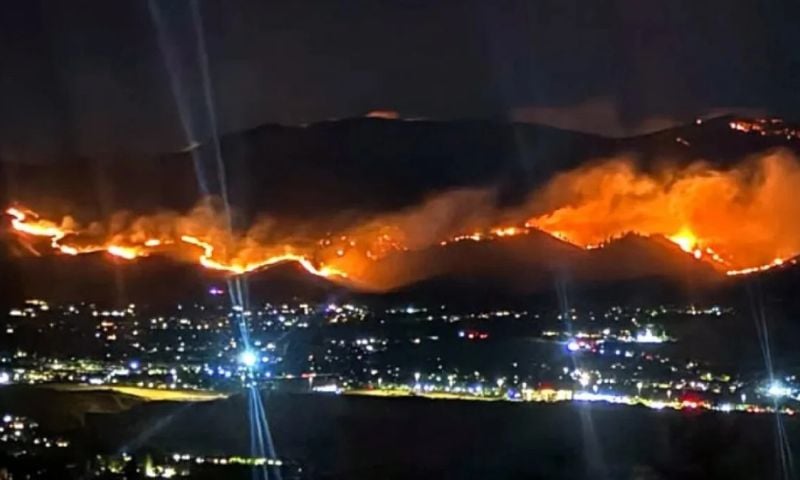
ISLAMABAD: A fast-moving wildfire in the western US state of Nevada has forced about 42,000 people to evacuate and left another 45,000 facing evacuation warnings as flames threatened communities around the city of Reno.
The Hawk Fire had burned about 15,040 acres (6,090 hectares) by Sunday evening with zero per cent containment, according to the National Interagency Fire Centre, as firefighters battled strong, shifting winds and extremely dry vegetation.
The fire, which began on Saturday near Hawk Meadow Trail northwest of Reno, expanded rapidly towards populated areas.
Local authorities said the evacuation orders and warnings affected roughly 90,000 people in total, although the number under mandatory evacuation was considerably lower than that figure.
Wildfire injurs six
At least six people have been injured, including three civilians and three first responders, according to authorities.
Wildfire has destroyed several structures, although officials said a complete assessment of property damage was not yet possible because many areas remained unsafe for inspection.
The blaze was confirmed to have been human-caused, but authorities have not disclosed what specifically started it. Fire officials said changing winds were making the fire particularly difficult to control, with flames moving in different directions as conditions shifted.
READ ALSO: US Wildfires Ravage Spokane, Hundreds of Structures Destroyed
Nevada Governor Joe Lombardo declared a state of emergency in Washoe County, where Reno is located, and authorised the deployment of National Guard personnel to assist with the emergency response. Hundreds of firefighters have been joined by additional crews and aerial firefighting resources.
More than 13,700 residences were reported to be inside the evacuation area by Sunday afternoon. Officials warned residents to leave promptly when ordered and to avoid entering evacuation zones, where roads were increasingly congested by people attempting to escape the fire.
The fire also disrupted transport and electricity supplies. US Route 395, an important north-south highway serving the region, was closed in parts of the affected area, and more than 10,000 electricity customers were reported to have lost power.
The blaze pushed towards the outskirts of Reno, a city near the Nevada-California border with a population of more than 260,000. Its proximity to a major urban area has raised concerns over homes, businesses, roads and other infrastructure as firefighters work to keep the flames away from densely populated neighbourhoods.
The University of Nevada, Reno, which lies near the threatened area, said on Sunday that its main campus was not inside the wildfire evacuation zone and would continue normal operations on Monday.
University officials said they were continuing to monitor the fire, smoke and guidance from local authorities.
The Reno-Tahoe International Airport also remained outside the evacuation zone and operational, according to earlier reports, although residents and travellers were advised to monitor emergency information because evacuation boundaries could change rapidly.
Firefighters have concentrated efforts on protecting residential areas and creating fuel breaks to slow the advance of the flames. Local reports said crews were working to keep the fire south of Cold Springs and north of Somersett, using bulldozers and other heavy equipment to establish defensive lines.
The fire’s rapid expansion is part of a broader wildfire threat across the western United States, where dry vegetation, high temperatures and strong winds can create conditions for fires to spread quickly. Nevada has already experienced hundreds of wildfires this year, with hundreds of thousands of acres burned across the state.
The Hawk Wildfire is also highlighting the growing challenge faced by communities located at the edge of fire-prone wilderness areas. Reno sits near the Sierra Nevada mountain range, where dry landscapes can allow wind-driven fires to move rapidly towards developed areas.
Authorities continued to urge residents in evacuation zones to leave immediately rather than wait for conditions to worsen. People outside mandatory evacuation areas were advised to remain prepared to leave, keep essential belongings ready and follow official emergency alerts.
As of Sunday evening in Nevada, the fire remained uncontained and firefighters were still confronting difficult wind conditions. Officials warned that the evacuation situation could change rapidly depending on weather and the direction of the flames.