


WASHINGTON: The United States Commission on International Religious Freedom (USCIRF) has again urged the US State Department to designate India as a “country of particular concern,” citing what it described as ongoing and systematic violations of religious freedom across the country.
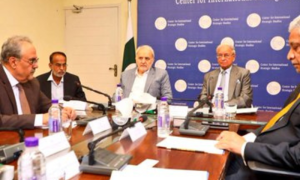
The issue was discussed during a hearing in Washington on Thursday, where commissioners, lawmakers, academics, and legal experts examined the situation facing religious minorities in India, including Muslims, Christians, Sikhs, and Dalits, as well as allegations of transnational repression targeting critics abroad.
USCIRF Chair Vicky Hartzler said India’s religious freedom conditions had continued to deteriorate.
“Our 2026 Annual Report, USCIRF once again recommended that the State Department designate India as a ‘country of particular concern’ for its ongoing, systematic, and egregious religious freedom conditions,” she said.
Hartzler alleged that authorities at the national, state, and local levels continued to facilitate or tolerate violations through discriminatory legislation, arbitrary detention of religious leaders, and failure to prevent attacks on minority communities.
She also pointed to anti-conversion laws enforced in several Indian states, saying 13 out of 28 states now implement strict legislation imposing severe punishments, including life imprisonment in some cases, for conversions from Hinduism to other religions.
USCIRF Vice Chair Asif Mahmood raised concerns over alleged transnational repression targeting minority communities and activists outside India.
“The Indian government has also targeted religious minorities and advocates beyond its borders, through acts of transnational repression,” he stated, referring to alleged surveillance, intimidation, and assassination attempts targeting Sikhs in North America.
US Representative Chris Smith criticized India’s Foreign Contribution Regulation Act (FCRA), warning that proposed amendments could increase state control over nongovernmental organizations and religious institutions.
“The government of India has long tolerated and, at times, facilitated serious rights violations against religious minorities, especially Christians, Muslims, and Sikhs,” Smith said.
He warned that proposed legal changes could place churches, schools, hospitals, and charitable institutions at risk of state expropriation if organizations lose or fail to renew foreign funding licenses.
Former US ambassador-at-large for global criminal justice Stephen Rapp said violence against minorities in India was becoming increasingly normalized.
“For the past decade, atrocities against minorities are showing signs of becoming less episodic, more normalised, where everyday violence and open calls to violence have become routine,” he said.
Rapp added that perpetrators were rarely held accountable, contributing to what he described as entrenched impunity.
Angana Chatterji, a scholar at the University of California, Berkeley, said religious pluralism in India was under growing strain.
“Under an authoritarian regime, freedom of religion is imperilled for minoritised communities,” she stated, alleging increasing polarization between majority and minority communities.
Raqib Naik, executive director of the Centre for the Study of Organised Hate, accused Indian authorities of carrying out large-scale abuses against Muslims and Rohingya refugees.
“State-led violence and dispossession against Muslims have reached an unprecedented scale,” he alleged, citing reported deportations of Bengali Muslims and Rohingya refugees.
Arjun Sethi also raised allegations of transnational repression targeting Sikh activists abroad.
He referred to the 2023 killing of Sikh leader Hardeep Singh Nijjar and an alleged plot targeting Sikh American activist Gurpatwant Singh Pannun in New York.
Sethi further alleged that Indian authorities routinely discriminate against Muslims, Christians, Sikhs, and Dalit communities, while suppressing dissent through legal and security measures.