WASHINGTON: The United States has announced a sweeping naval blockade targeting Iranian ports and vessels, marking a sharp escalation in tensions after high-stakes negotiations between Washington and Tehran ended without agreement in Islamabad.
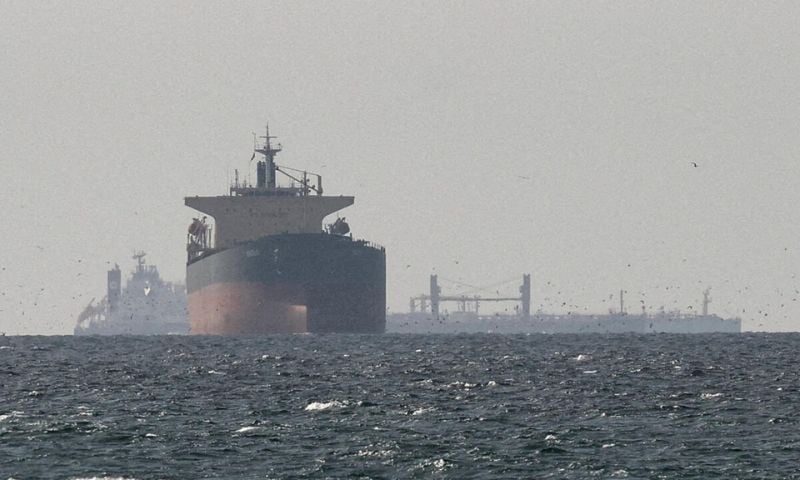
US President Donald Trump said on Sunday that the US Navy would immediately begin enforcing restrictions in and around the strategically vital Strait of Hormuz, through which roughly one-fifth of the world’s oil supply typically passes.
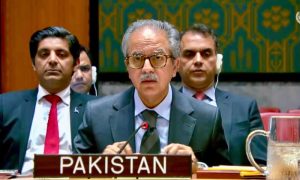
The directive follows Iran’s refusal to concede on key aspects of its nuclear programme during 21 hours of talks mediated in Pakistan.
According to the US Central Command (CENTCOM), the blockade will formally come into effect on April 13 at 10 a.m. ET, in accordance with the President’s proclamation, extending to Iranian ports and applying to vessels of all nationalities. However, ships travelling between non-Iranian ports will still be permitted to transit the waterway.
— U.S. Central Command (@CENTCOM) April 12, 2026
Trump, speaking on his Truth Social platform, warned that any vessel found to have paid tolls to Iran for passage through the strait would be subject to interception in international waters. He also issued a stark warning against any hostile action targeting US or commercial vessels.
President Trump on Truth Social: So, there you have it, the meeting went well, most points were agreed to, but the only point that really mattered, NUCLEAR, was not.
Effective immediately, the United States Navy, the Finest in the World, will begin the process of BLOCKADING any… pic.twitter.com/OtgoJyD8AI
— Donald J Trump Posts TruthSocial (@TruthTrumpPost) April 12, 2026
The announcement came shortly after US Vice President JD Vance concluded talks in Islamabad with a senior Iranian delegation led by Parliamentary Speaker Mohammad Bagher Ghalibaf. The negotiations – the highest-level direct engagement between the two sides since the 1979 revolution – ended without a breakthrough, though Washington described its proposal as a “final and best offer”.
While Trump acknowledged that discussions had made progress on several fronts, he said Tehran’s unwillingness to compromise on its nuclear ambitions had forced Washington to adopt a tougher stance.
Iran, for its part, has maintained that it has the right to impose transit charges in the strait, a claim rejected by Washington as unlawful. US officials argue that freedom of navigation remains a fundamental principle of international maritime law.
The blockade follows weeks of heightened tensions in the Gulf, where maritime traffic has already been severely disrupted. The strait had effectively been closed amid hostilities triggered by US and Israeli military operations against Iran, although limited commercial movement resumed after a fragile ceasefire.
US naval forces have recently conducted mine-clearing operations in the area, with warships transiting the strait to ensure safe passage. Despite this, shipping activity remains significantly below normal levels, with only a fraction of typical traffic recorded since the ceasefire took hold.
Analysts warn that the blockade could further unsettle global energy markets, as uncertainty grows over the security of one of the world’s most critical transit routes. The move also raises the prospect of renewed military confrontation if Iran responds to the US action.
Meanwhile, diplomatic efforts in the region continue, with separate talks expected between Israel and Lebanon in Washington in the coming days — underscoring the broader volatility across the Middle East.