
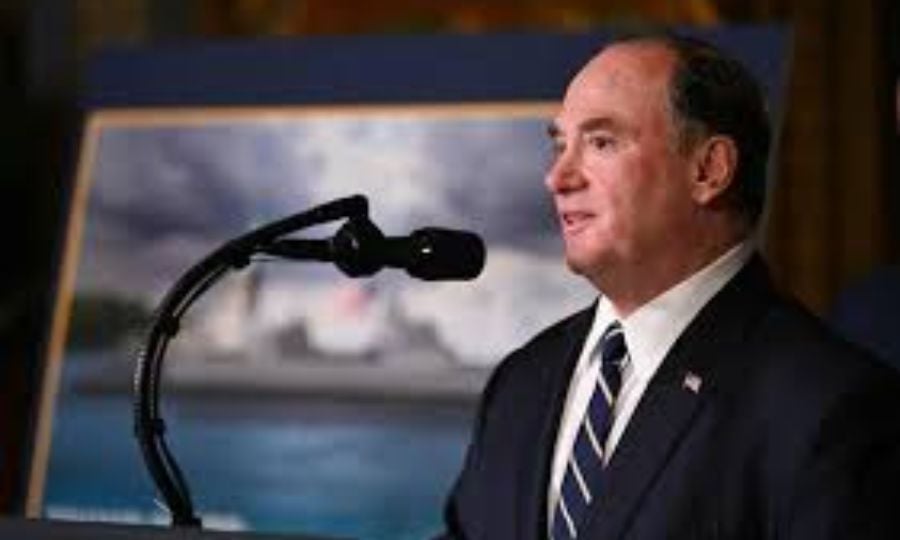



WASHINGTON: The United States Navy’s top civilian official, John Phelan, has abruptly stepped down, marking the first departure of a military service secretary during Donald Trump’s second presidency and the latest in a string of high-level defence leadership changes.
The Pentagon confirmed on Wednesday that Phelan is leaving his post with immediate effect, offering no explanation for the sudden move.
His departure comes at a critical juncture, with the US Navy actively enforcing a blockade on Iranian ports and targeting vessels allegedly linked to Tehran amid a fragile ceasefire in the ongoing conflict.
Taking over as acting Navy secretary is Undersecretary Hung Cao, a decorated Navy veteran with 25 years of service, including combat deployments.
Cao, who has previously mounted unsuccessful bids for the US Senate and House of Representatives in Virginia, is considered a staunch Trump ally.
According to AP, Phelan’s exit adds to a broader pattern of upheaval within the Pentagon leadership. Defence Secretary Pete Hegseth has overseen multiple dismissals since assuming office last year.
Among the most notable was the removal of General Randy George, the Army’s top uniformed officer, just weeks ago. Earlier actions also included the firing of Admiral Lisa Franchetti and General Jim Slife, as well as the dismissal of General Charles Q. Brown Jr. as chairman of the Joint Chiefs of Staff.
The abrupt nature of Phelan’s departure was underscored by his public engagements just a day earlier. On Tuesday, he addressed a major naval conference in Washington, outlining his strategic priorities, and held discussions with members of the House Armed Services Committee regarding budget proposals and shipbuilding plans.
A Pentagon spokesperson, Sean Parnell, confirmed the development via social media, stating that Phelan was “departing the administration, effective immediately”.
Phelan, a prominent financial executive and founder of Rugger Management LLC, had no prior military service or senior civilian defence role before his nomination in late 2024.
His appointment was widely viewed as an effort to bring an outsider’s perspective to Navy leadership. A major donor to Trump’s campaign, Phelan’s limited military exposure included advisory work with a non-profit supporting defence initiatives in Ukraine and Taiwan.
His exit comes during an intense operational phase for the Navy. Three US aircraft carriers are either deployed in or en route to the Middle East, while the administration has indicated readiness to resume hostilities with Iran should the ceasefire collapse.
Additionally, the Navy continues operations in the Caribbean targeting suspected drug trafficking vessels and was recently involved in the capture of Venezuelan leader Nicolás Maduro.
Cao’s appointment signals continuity in the administration’s ideological direction. A refugee from Vietnam during childhood, he built a distinguished military career, serving with special operations forces in Iraq, Afghanistan and Somalia before retiring as a Navy captain.
He later pursued academic work, including studies at the Massachusetts Institute of Technology and Harvard University.
In his political campaigns, Cao has been outspoken on defence and cultural issues, criticising COVID-19 vaccine mandates within the military and opposing diversity, equity and inclusion (DEI) programmes.
He has also expressed scepticism about US financial support for Ukraine, citing concerns over national debt and strategic resource allocation.
Since becoming Navy undersecretary, Cao has advocated for reinstating service members discharged for refusing COVID-19 vaccinations during the previous administration.
Phelan’s departure, coupled with the administration’s ongoing reshuffle of defence leadership, highlights a period of significant transition within the US military establishment, unfolding against the backdrop of rising global tensions and expanding operational commitments.