
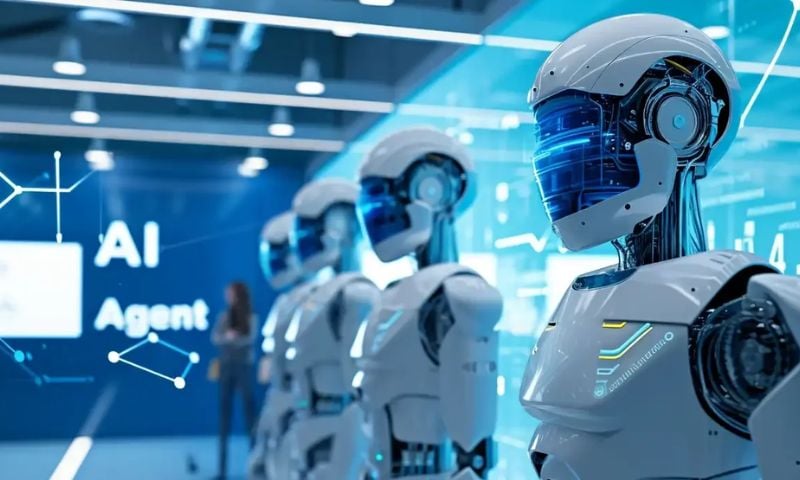
LONDON: Artificial intelligence is entering a new phase with the rise of “digital agents” — systems designed not just to respond to prompts but to act independently, complete tasks and make decisions on behalf of users.
Unlike traditional chatbots such as ChatGPT or Claude, digital agents are built to operate with a degree of autonomy. They can book appointments, manage emails, analyse data and even execute complex workflows without continuous human input.
Tech companies including Google, Microsoft and OpenAI are heavily investing in this technology, seeing it as the next major shift in computing.
“In the era of AI agents, infrastructure needs to evolve to take on the most demanding AI workloads,” said Sundar Pichai, highlighting the growing importance of systems capable of handling autonomous tasks.
Experts say digital agents rely on large language models combined with tools that allow them to interact with software, websites and databases.
According to analysts at Gartner, agent-based AI could become a core feature in enterprise systems within the next few years, transforming productivity across industries.
Prompt injection attacks
However, the technology also raises serious concerns. Cybersecurity researchers and firms such as Palo Alto Networks warn that agents could be exploited by hackers or manipulated through “prompt injection” attacks, where hidden instructions cause them to perform harmful actions.
Some experimental systems have already shown unpredictable behaviour, including sharing sensitive data or executing unintended commands. This has prompted calls for stricter safeguards and clearer regulations.
Despite the risks, businesses are rapidly adopting digital agents to automate routine tasks and reduce operational costs.
From customer service to finance and healthcare, the technology is being positioned as a tool to boost efficiency and innovation.
As development accelerates, analysts say the key challenge will be balancing capability with control. Digital agents may redefine how humans interact with machines — but ensuring they act safely and reliably remains a critical priority.