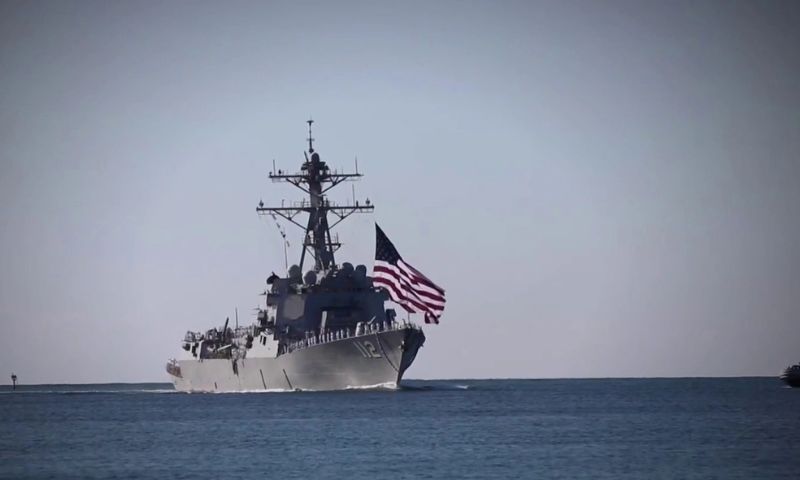
WASHINGTON: The United States Central Command (CENTCOM) said on Tuesday that more than 10,000 US sailors, marines and airmen, supported by over a dozen warships and dozens of aircraft, are enforcing a naval blockade targeting ships entering and leaving Iranian ports.
“More than 10,000 U.S. Sailors, Marines, and Airmen along with over a dozen warships and dozens of aircraft are executing the mission to blockade ships entering and departing Iranian ports,” the US Central Command said in a statement.
CENTCOM, in a statement, said that during the first 24 hours of the operation, no vessels passed through the blockade, while six merchant ships complied with US instructions to turn back and re-enter Iranian ports in the Gulf of Oman.
The command added that the measures are being enforced “impartially” against vessels of all nationalities operating to and from Iranian ports and coastal areas.
CENTCOM added that its forces are “supporting freedom of navigation for vessels transiting the Strait of Hormuz to and from non-Iranian ports.”
More than 10,000 U.S. Sailors, Marines, and Airmen along with over a dozen warships and dozens of aircraft are executing the mission to blockade ships entering and departing Iranian ports. During the first 24 hours, no ships made it past the U.S. blockade and 6 merchant vessels… pic.twitter.com/dpWAAknzQp
— U.S. Central Command (@CENTCOM) April 14, 2026
US President Donald Trump announced the blockade after the conclusion of the US-Iran peace talks in Islamabad last weekend to end the six-week-long war.
The US blockade reportedly came into effect at 1400 GMT on Monday.
At the centre of the crisis is the Strait of Hormuz, one of the world’s most critical energy corridors, through which nearly one-fifth of global oil supplies pass.
The waterway has become increasingly contested amid military manoeuvres and restrictions on maritime traffic.
Reports suggest that Iran had already limited passage through the strait, allowing only vessels from selected countries to transit.
China condemns US naval blockade
China has strongly criticised the US decision to impose a naval blockade on Iranian ports, describing the move as “dangerous and irresponsible”.
Beijing warned that the blockade could further destabilise the ceasefire in the Gulf region.
In a statement issued on Tuesday in Beijing, Chinese Foreign Ministry spokesperson Guo Jiakun said the US action risked intensifying tensions and undermining ongoing efforts to maintain peace following recent hostilities between Washington and Tehran.
“This is dangerous and irresponsible behaviour,” Guo said, adding that increased US military deployments in the region would only deepen instability and weaken the ceasefire arrangement.
Beijing has called on all parties to fully respect the ceasefire and return to diplomatic negotiations, stressing that only sustained dialogue can prevent further escalation.
Guo urged “practical steps” to de-escalate tensions and restore normal maritime navigation through the strait, warning that continued confrontation could have serious implications for global energy security and international trade.
Pakistan intensifies diplomatic efforts
Meanwhile, Pakistan, which mediated the first round of high-stakes US-Iran talks in Islamabad last weekend, has intensified diplomatic efforts to sustain dialogue and prevent further escalation.
According to reports, Pakistan remains central to diplomatic efforts, having facilitated direct talks between US and Iranian delegations in Islamabad last weekend.
The earlier round of talks in Islamabad marked one of the highest-level engagements between the US and Iran in decades.
While no final agreement was reached, both Washington and Tehran described the Islamabad Talks as constructive and signalled willingness to continue the peace process to end the conflict.
According to Reuters, communication between the parties has remained active, with Pakistan continuing to exchange messages between the two sides to maintain momentum.
A senior Pakistani official said Islamabad had received a “positive response” from Iran regarding a second round of talks, though no firm date has been confirmed.
US-Iran talks to resume in Pakistan
Meanwhile, Trump said on Tuesday that peace talks between the US and Iran could resume in Pakistan “over the next two days”.
“Something could be happening over the next two days, and we’re more inclined to go there,” Trump said in an interview with the New York Post. “It’s more likely, you know why? Because the field marshal is doing a great job,” he said.
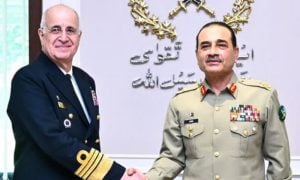
Trump said Pakistan’s Chief of Defence Forces and Chief of Army Staff Field Marshal Syed Asim Munir was doing a “great job” on the talks.
“He’s fantastic, and therefore it’s more likely that we go back there,” Trump said.
“I just think he’s a great guy. The Field Marshal. You know he ended the war with India, saved 30 million people,” he added.
Discussions are quietly continuing after the US and Iranian delegations ended marathon negotiations over the weekend in Islamabad.
Meanwhile, Iranian officials said Pakistan was their priority venue for the next round of talks with the United States.
A Pakistani government source, cited by Anadolu News Agency, said that the next round of “high-level” US-Iran talks will be held in Islamabad “very soon.”