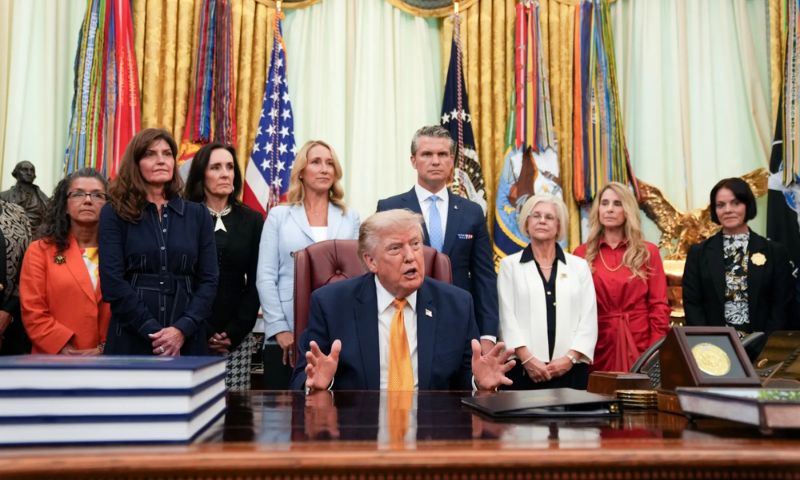
WASHINGTON: US President Donald Trump said on Monday that talks between the United States and Iran were “going on right now”, claiming Tehran had sought negotiations to avoid further military action as mediators intensified diplomatic efforts to permanently end the Middle East conflict.
Speaking to reporters in the Oval Office while signing executive orders, Trump said Iran had previously denied holding talks with Washington but was no longer doing so.
“We have many talks. They deny it. But they’re not denying it now,” Trump said. “When they’re talking, they don’t like saying that we’re talking.”
Trump claimed the United States had planned to strike Iran “very hard” a day earlier but that Tehran requested talks instead.
“We were to hit them very hard yesterday … and they called. Iran did not want to be hit. They said, ‘We want to talk’,” the US President said, adding that he had also received calls from the leaders of Saudi Arabia, the United Arab Emirates and Qatar.
The US president also described the conflict with Iran as “working out very well”.
President Trump Signs an Executive Order, Aug. 3, 2026 https://t.co/GcI81rbBZc
— The White House (@WhiteHouse) August 3, 2026
Trump expects Hormuz to open tomorrow
Trump said the Iran talks will “go quickly” and that the Strait of Hormuz will be open by tomorrow.
“It’s not very complex. We’re talking about the opening of the Strait [of Hormuz] and having it open, literally, by tomorrow, completely open. And that’s phase one,” he told reporters.
“Phase two is we’ll then talk about the nuclear capacity … basically the denuclearisation of Iran,” he added, noting that it “has to happen”.
Trump said that negotiating denuclearisation will “take a little while”.
Trump insisted that Iran will not impose fees on ships passing through the Strait of Hormuz.
Asked if Iran would be willing to return to fully free navigation through the Strait of Hormuz, Trump insisted that Iran will not charge vessels passing through the waterway.
“I’m not going to let them charge,” he said. “If anybody’s going to charge, we’re going to charge; we have total control. “We’re not talking about charging at all,” Trump added.
Trump said, “This is the last chance for them to sign a good document,” referring to Iran.
‘Deal, or total surrender’
Earlier, in a post on his Truth Social platform, Trump insisted that the US was engaged in talks with Iran despite Tehran’s repeated denials. He said Washington and Tehran were “in fact, talking of a solution” to longstanding disputes and warning that any outcome would be either “a Deal, or Total Surrender.”
Trump accused the Iranian leadership of being “unbelievably duplicitous,” alleging that Tehran had sought meetings with Washington while publicly maintaining that no negotiations were taking place.
“Whether Iran wants to admit it or not, we are, in fact, talking of a solution to a problem that they have caused, for decades,” the US President wrote.
Trump also dismissed Iran’s assertion that it was only holding discussions with Oman over the Strait of Hormuz, saying the strategic waterway was already under the control of the US Navy.
He claimed that “nothing gets through to Iran” unless the United States allowed it, adding that “nothing will get through, unless a Deal, or Total Surrender, is accomplished.”
The US president reiterated that Washington’s objective remained preventing Iran from acquiring a nuclear weapon, declaring: “IRAN WILL NEVER HAVE A NUCLEAR WEAPON!”
— Rapid Response 47 (@RapidResponse47) August 3, 2026
Trump’s remarks came after he said on Sunday that the United States would resume negotiations with Iran on Monday following the cancellation of a planned large-scale military attack, adding that regional countries believed a diplomatic breakthrough was within reach.
Also Read: Trump Says US, Iran Are Engaged in Talks Despite Tehran’s Denials
Iran, however, has continued to reject Trump’s claims. Foreign Ministry spokesman Esmaeil Baqaei said on Monday that Tehran was not engaged in negotiations with the United States and that its current talks were only with Oman on securing passage through the Strait of Hormuz.
“We are not currently negotiating with the United States. Our negotiations are with Oman to secure passage through the Strait of Hormuz,” Baqaei said during a weekly press briefing.
Pakistan continues mediation efforts
Iranian Foreign Ministry spokesperson Esmaeil Baqaei said that Pakistan continues to act as mediator between Iran and the United States. He said Qatar was also extending support whenever required during the negotiation process.
Pakistani and Qatari mediators are in contact with Washington and Tehran to finalise a date and venue for the resumption of direct US-Iran talks, Anadolu news agency reported, citing sources.
Islamabad and Doha are among the expected venues for the talks, according to the sources cited by Anadolu.
On Sunday, an Iranian lawmaker said that mediators are making fresh efforts to revive the Pakistan-brokered Islamabad Memorandum of Understanding (MoU) that halted the war between the US and Iran in June.
Pakistan and Qatar are mediating between the US and Iran to permanently the Middle East conflict through dialogue and diplomacy.
Hassan Ghashghavi, spokesman for the Iranian parliament’s National Security Commission, said mediators were continuing efforts to revive the agreement, which was brokered by Pakistan and Qatar and signed following talks held in Islamabad.
“There is an effort underway to revive the 14-point Islamabad agreement, particularly by the mediators,” Ghashghavi said in a video interview.
“They know that the main issue and, in fact, the key to the matter right now is the issue of the Strait of Hormuz, so yes, there is an exchange of views,” he added.
Pakistan, Iran foreign ministers discuss developments
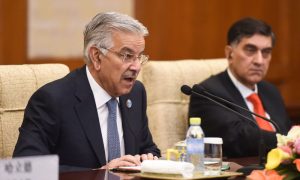
On Monday, Pakistan’s Deputy Prime Minister and Foreign Minister Ishaq Dar held a telephonic conversation with his Iranian counterpart Seyyed Abbas Araghchi and discussed regional developments as mediators have intensified a diplomatic push to end the Middle East conflict.
“They exchanged views on regional and international developments, including the deteriorating situation in Occupied East Jerusalem,” the Foreign Office statement said on Monday.
Ishaq Dar, during the call, also invited Foreign Minister Araghchi to visit Pakistan at his earliest convenience.
Deputy Prime Minister/Foreign Minister Senator Mohammad Ishaq Dar @MIshaqDar50 spoke today with the Foreign Minister of Iran, Seyyed Abbas Araghchi.
They exchanged views on regional and international developments, including the deteriorating situation in Occupied East… pic.twitter.com/KHA2I5OctV
— Ministry of Foreign Affairs – Pakistan (@ForeignOfficePk) August 3, 2026
Islamabad MoU framework
The Islamabad MoU was brokered by Pakistan and Qatar following negotiations in Islamabad after months of military confrontation between Washington and Tehran.
Under the Islamabad MoU, the US and Iran committed to halt military operations, reopen the Strait of Hormuz to commercial shipping and negotiate a comprehensive agreement covering Iran’s nuclear programme, US sanctions and a permanent ceasefire within 60 days.
Pakistan and Qatar subsequently co-mediated the first round of high-level negotiations in Lucerne, Switzerland, on June 21.
The talks were attended by US Vice President JD Vance and Iranian Parliament Speaker Mohammad Bagher Ghalibaf.
Pakistan’s mediation efforts
Pakistan has played a central mediating role between the United States and Iran since brokering a ceasefire on 8 April and hosting high-level talks between the two sides in Islamabad on 12 and 13 April.
Pakistan has repeatedly urged both countries to honour the Islamabad MoU and continue diplomatic engagement.
The first round of Pakistan- and Qatar-mediated negotiations under the agreement was later held in Lucerne, Switzerland, on 21 June.
The talks were attended by US Vice President JD Vance and Iranian Parliament Speaker Mohammad Bagher Ghalibaf.
Following the negotiations, Pakistan and Qatar announced significant progress in diplomatic efforts, while Washington eased certain sanctions on Tehran.
The latest diplomatic activity comes amid months of heightened tensions between Washington and Tehran.