Key Points
- Iran seeks end to US economic blockade in return
- Deal could ease pressure on Pakistan’s energy supplies
UNITED NATIONS: US and Iranian negotiators are exploring a phased arrangement to reopen the Strait of Hormuz in exchange for lifting Washington’s economic blockade on Tehran, according to sources familiar with ongoing talks on the sidelines of the United Nations General Assembly in New York.
The emerging proposal centres on the strategic waterway and efforts to find a way out of the nearly seven-month US-Iran conflict, with both sides examining reciprocal steps rather than an immediate comprehensive settlement.
Under the arrangement being discussed, Iran would restore navigation through the Strait of Hormuz. At the same time, the United States would ease economic restrictions on Tehran.
The US could potentially allow Iran access to frozen assets, international media reported, citing Iranian, regional and Western diplomatic sources.
International media quoted senior Iranian officials saying the crisis could end in stages with the US lifting the blockade and Iran reopening the Strait of Hormuz.
The negotiations face a major obstacle because neither side wants to surrender its principal leverage without securing reciprocal concessions.
READ ALSO: Pakistan PM Stresses Implementation of US-Iran Islamabad MoU for Regional Peace
Iranian President Masoud Pezeshkian has already made it clear that Iran does not want an atomic weapon, while Tehran would not surrender its right to peaceful nuclear development.
Ahead of the Iranian President’s arrival in the US for the UNGA, President Donald J. Trump expressed the American openness to negotiate a peaceful settlement to the Middle East conflict
Washington has used sanctions and economic restrictions to pressure Iran. Likewise, Tehran has retained control over access to the waterway through which a major share of global oil and gas shipments normally passes.
The US-Iran conflict trajectory
The conflict began on February 28 after the breakdown of diplomatic efforts and the outbreak of hostilities involving the United States and Iran.
Pakistan immediately called for restraint, a return to diplomacy and a negotiated settlement, warning that further escalation would threaten peace and stability across the region.
Islamabad subsequently moved beyond calls for restraint and took a direct facilitation role between Washington and Tehran.
Prime Minister Shehbaz Sharif called for an immediate ceasefire and invited the two sides to hold peace talks in Islamabad. The United States and Iran accepted the invitation, with their delegations travelling to Pakistan for intensive negotiations in April.
Pakistan’s deputy prime minister and foreign minister, together with the chief of defence forces, helped mediate several rounds of negotiations between the two sides.
The talks produced a ceasefire framework and opened the way for further diplomatic engagement.
The Islamabad process later developed into the Islamabad Memorandum of Understanding signed in June.
Pakistan continued to facilitate implementation of the agreement, including subsequent high-level and technical-level talks involving the United States, Iran and mediators from Pakistan and Qatar.
The Pakistan-Qatar process also set out a roadmap for further negotiations and a communication mechanism to support safe passage for commercial vessels through the Strait of Hormuz.
Pakistan has maintained contact with both Washington and Tehran even after the peace process encountered setbacks.
The Foreign Office said in September that Islamabad had brought the United States and Iran together after decades without direct face-to-face engagement, leading to the Islamabad talks and eventually the Islamabad MoU.
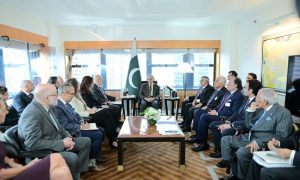
Prime Minister Shehbaz said in New York this week that Pakistan remained focused on mediating an end to the conflict and had not lost hope in further progress. He described Pakistan as a sincere and honest mediator between Iran and the United States.
For Pakistan, the New York diplomacy offers another opening to convert its mediation role into practical progress on Hormuz, regional stability and an eventual durable US-Iran settlement.