WASHINGTON: The United States said its naval blockade of Iranian ports will not disrupt shipping through the Strait of Hormuz to and from non-Iranian destinations, as US President Donald Trump warned that any Iranian attack boats approaching the blockade would be “eliminated”.
The United States Central Command said the blockade, which came into effect on Monday, would be enforced against vessels entering or leaving Iranian ports in the Arabian Gulf and Gulf of Oman, but would not obstruct ships transiting between non-Iranian ports.
“The blockade will be enforced impartially against vessels of all nations entering or departing Iranian ports and coastal areas, including all Iranian ports on the Arabian Gulf and Gulf of Oman,” US Central Command said, adding it would begin at 1400 GMT on Monday.
The US military added that the measures would be applied impartially to vessels of all nationalities.
— U.S. Central Command (@CENTCOM) April 12, 2026
In a social media post, Trump warned that any Iranian attack boats that approach the US naval blockade he has ordered around the country’s ports will be destroyed.
The US President said the bulk of Iran’s navy had already been destroyed during the war, but that if any of what he said were Tehran’s few remaining “fast attack ships” approach the American naval blockade “they will be immediately ELIMINATED”.
“Warning: If any of these ships come anywhere close to our BLOCKADE, they will be immediately ELIMINATED,” Trump said, adding that the rest of Iran’s navy had been “completely obliterated.”
The US military would be “using the same system of kill that we use against the drug dealers on boats at Sea,” the president said, referring to air strikes on alleged narcotics boats off the coast of Venezuela.
US imposes blockade on Strait of Hormuz, Iranian ports
A US blockade of Iran’s ports and a partial blockade of the Strait of Hormuz, a chokepoint for shipments of oil, fertilizer and other vital goods, began at 10 a.m. EDT, CBS News reported.
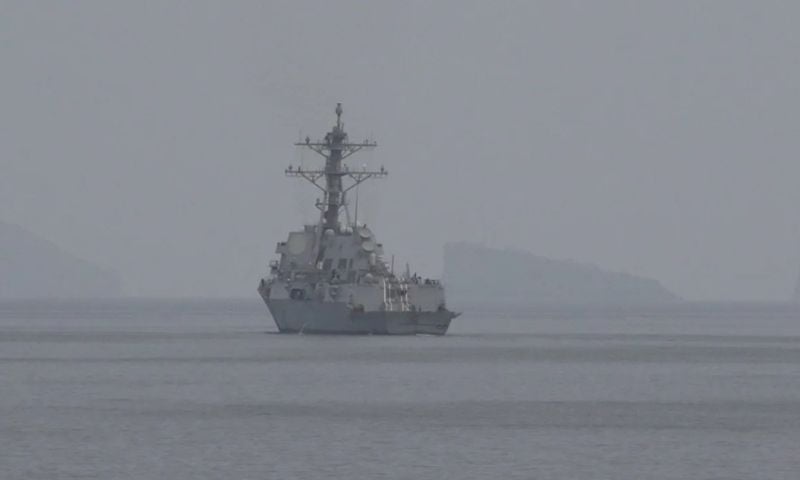
The US blockade is now in effect, with over 15 warships deployed in the Middle East, a senior US official said.
The US official said that the force includes an aircraft carrier, destroyers, and an amphibious assault ship, enabling boarding operations and control of commercial shipping routes.
US Central Command said that USS Tripoli (LHA 7) conducted night flight operations while sailing in the Arabian Sea.
“Tripoli is designed without a traditional well deck, which allows for more F-35B Lightning II stealth fighters, MV-22 Ospreys, helicopters, and extra maintenance space,” the US military stated.
USS Tripoli (LHA 7) conducts night flight operations while sailing in the Arabian Sea. Tripoli is designed without a traditional well deck, which allows for more F-35B Lightning II stealth fighters, MV-22 Ospreys, helicopters, and extra maintenance space. During peak operations,… pic.twitter.com/zjQO1nOcmK
— U.S. Central Command (@CENTCOM) April 13, 2026
On Sunday, Trump, in a Truth Social post, said that he had instructed the Navy to “seek and interdict every vessel in International Waters that has paid a toll to Iran,” and that the US would begin “destroying the mines the Iranians laid in the Straits.”
“Any Iranian who fires at us, or at peaceful vessels, will be BLOWN TO HELL!” he added.
The threat sparked swift condemnation from Iran and other world leaders.
Iran’s Revolutionary Guard said the strait remained under Iran’s “full control” and was open for non-military vessels, but military ones would get a “forceful response,” two Iranian news agencies reported.
Trump’s threats follow the conclusion of Pakistan-mediated Islamabad Talks between the US and Iran over the weekend without reaching a final agreement.
Vice President JD Vance, who headed the US delegation, said the main sticking point came down to Iran refusing to give up its nuclear ambitions.
The US military currently has the USS Abraham Lincoln aircraft carrier, 11 destroyers and the USS Tripoli amphibious group operating in the Middle East, which could be part of the naval blockade in the Strait of Hormuz, the Navy told CBS News.
The USS Gerald Ford and other destroyers are deployed in the Mediterranean.
US Central Command on Sunday said two guided-missile destroyers – the USS Frank E. Peterson and the USS Michael Murphy – crossed through the Strait of Hormuz “as part of a broader mission to ensure the strait is fully clear of sea mines previously laid by Iran’s Islamic Revolutionary Guards Corps.”
Global criticism of US blockade
China criticised the US plan. “The Strait of Hormuz is an important international trade route for goods and energy, and maintaining its security, stability, and unimpeded flow is in the common interest of the international community,” foreign ministry spokesman Guo Jiakun said, urging Iran and the US not to reignite the war.
Among Washington’s NATO allies, much criticised by Trump for their reluctance to follow him to war, Spain’s Defence Minister Margarita Robles said the planned naval blockade “makes no sense”.
“It’s one more episode in this whole downward spiral into which we’ve been dragged,” she said.
And in a BBC radio interview, UK Prime Minister Keir Starmer said Britain would not join the blockade, adding the UK “is not getting dragged in”.
French President Emmanuel Macron said that France and Britain would host a conference with countries prepared to join a “peaceful multinational mission” to secure the strait, but it would be “strictly defensive” and only operational once circumstances permit.
Pakistan continues efforts to end conflict
Pakistan’s Prime Minister Shehbaz Sharif said on Monday that Islamabad remains fully engaged in diplomatic efforts to resolve issues between the US and Iran, following Pakistan-mediated talks in Islamabad over the weekend.
“Today, the ceasefire still stands. As I am talking to you, matters that are not resolved, full efforts are underway to resolve them,” PM Sharif said in a televised address to the federal cabinet.
Pakistan emerged as a key mediator in the US-Iran war after PM Sharif mediated a two-week ceasefire between Washington and Tehran on April 8.
Delegations from Washington and Tehran then arrived in Islamabad and held negotiations for over 20 hours at PM Sharif’s invitation over the last weekend. However, the negotiations could not result in a final agreement despite progress.
He added that Pakistan’s efforts had helped sustain the ceasefire, while work continued to bridge remaining differences.
US-Iran talks in Islamabad
Pakistan-mediated talks between the US and Iran concluded in Islamabad on Sunday after more than 21 hours of intensive negotiations, with all sides signalling that diplomatic engagement would continue.
Following the talks, Pakistan urged both countries to maintain a “positive spirit” and uphold the ceasefire.
Pakistan’s Deputy Prime Minister and Foreign Minister Ishaq Dar reaffirmed Islamabad’s commitment to facilitating dialogue, stressing that diplomacy must continue despite the absence of a breakthrough.
“We hope that the two sides continue with the positive spirit to achieve durable peace and prosperity for the entire region and beyond,” Dar said, adding that adherence to the ceasefire remained critical.
He said Pakistan would remain actively engaged in supporting future negotiations between Washington and Tehran.
‘Final and best offer’
US Vice President JD Vance said the talks were substantive but fell short of an agreement.
“We’ve made very clear what our red lines are… and they have chosen not to accept our terms,” he told reporters in Islamabad.
Vance said Washington had presented what it described as a “final and best offer” and would await Iran’s response.
He reiterated that the US objective remained ensuring that Iran does not develop nuclear weapons or the capability to rapidly acquire them.
“We need to see an affirmative commitment… not just now, but for the long term,” he said.
Iran emphasises ‘good faith’
Iranian Parliament Speaker Mohammad Bagher Ghalibaf struck a cautiously constructive tone following the talks, saying Tehran had entered negotiations in good faith but remained sceptical due to past experiences.
“Before the negotiations, I emphasised that we have the necessary good faith and will, but… we have no trust in the opposing side,” he said in posts on X.
He said Iranian officials had presented forward-looking proposals.
Ghalibaf also expressed appreciation for Pakistan’s role in facilitating the engagement, thanking the country for its efforts.