NEW DELHI: India and the United States (US) have reached a consensus on a roadmap for defense industry cooperation in the coming years, marking a crucial step towards enhancing India’s defense manufacturing capabilities.
The move comes as Washington seeks to strengthen its ties with India and views deeper military-to-military and technology partnerships with the world’s largest democracy as a vital counterbalance to China’s growing influence in the region. Additionally, the United States aims to reduce India’s reliance on Russia for defense supplies.
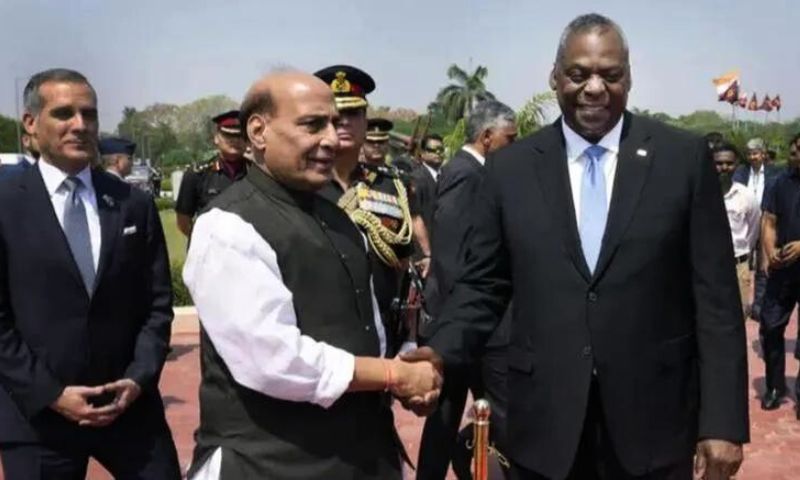
The roadmap was finalized during a meeting between visiting US Defense Secretary Lloyd Austin and Indian Defense Minister Rajnath Singh. This agreement holds great significance as the United States maintains stringent controls over the sharing or sale of domestic military technology to other countries.
The US Embassy in New Delhi stated that the roadmap seeks to transform the paradigm of defense sector cooperation between the two nations. It aims to expedite technology collaboration and co-production in areas such as air combat, land mobility systems, intelligence, surveillance, and reconnaissance, munitions, and the undersea domain.
The roadmap includes specific proposals that could grant India access to cutting-edge technologies. Austin and Singh have also committed to reviewing regulatory barriers that hinder closer industry-to-industry cooperation.
India Traditionally Relies on Russia for Military Supplies
India, being the world’s largest arms importer, traditionally relies on Russia for approximately half of its military supplies. However, it has been increasingly diversifying its sources by procuring from countries like the United States, France, and Israel. New Delhi also seeks partnerships with global defense manufacturers to produce arms and military equipment in India for both domestic consumption and exports.
The Biden administration is expected to approve a deal that would enable General Electric Co (GE.N) to manufacture jet engines in India to power Indian military aircraft.
During their meeting, Austin and Singh discussed measures to enhance information sharing and explore new initiatives for improved maritime cooperation, particularly in the undersea domain.
Austin emphasized the importance of the US-India defense partnership, highlighting the rapidly changing global landscape. He cited challenges such as China’s bullying and coercion, Russian aggression, and transnational issues like terrorism and climate change. According to Austin, democracies must unite around common interests and shared values in the face of these challenges.