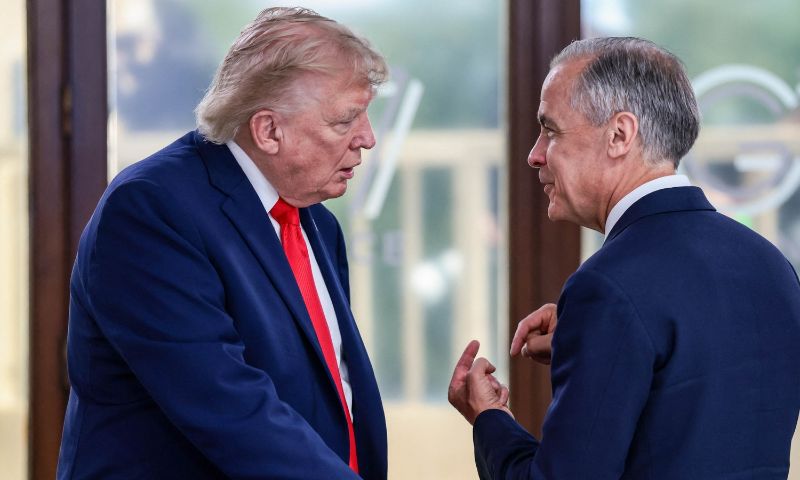
WASHINGTON: The United States and Canada fell deeper into a trade war on Saturday as new tariffs took effect following the collapse of talks, with both sides trading blame and warning of higher costs for businesses and consumers.
Each side blamed the other for the collapse of negotiations in Washington late Friday, leading the US to impose 50 percent tariffs on $20 billion worth of Canadian goods and Canada setting September 8 as the start of its retaliatory tariffs.
US President Donald Trump’s import taxes will hit about 5 percent of what Canada ships to the United States every year, ranging from hockey sticks to tongue depressors. Canadian Prime Minister Carney said Ottawa would respond with targeted tariff protection for industries exposed to the new US duties, including some steel products. He also mentioned the dairy, appliance, agricultural equipment, pulp and paper and electronics sectors.
Prime Minister Carney accused Washington of using “economic integration as a weapon” and said, “its signature was written in pencil.”
Resorting to the language of battle, he said his country had been “attacked” by the new American tariffs. “You’re at war when you get attacked,” he said, adding that Canada had the reserves, resilience and plan to respond.
But to Trump’s chief trade negotiator, Jamieson Greer, the US was compelled to act after a year of retaliation by its long-time partner.
“We’ve said enough, and so we’ve taken countermeasures. Our interest is in protecting American workers and protecting American supply chains,” the U.S. trade representative told “Fox & Friends Weekend.”
‘Unacceptable demands’ and favourable terms
Carney said Canada had been willing to drop remaining retaliatory tariffs on steel, aluminum and autos if the US substantially lowered its own, and to encourage provinces to restore US alcohol sales. But he said Washington’s final demands went too far. “They asked too much and offered too little,” Carney said.
Also Read: US, Canada Fail To Reach Trade Pact As Trump Tariffs Take Effect
Greer said the Republican administration was offering to cut tariffs on steel, autos and lumber, “things that are sensitive for them. And they’ve always had the best deal, and they still would have an even better deal, but they didn’t want that.”
As a result, he said, “We’re moving forward with measures that respond to Canadian retaliation.”
Carney said the US added last-minute terms that would have reduced tariff relief for Canadian-made vehicles, restricted Canada’s ability to strike trade deals with other countries and weakened protections for language, culture and sovereignty.
He said such demands were “unacceptable.”
The breakdown in negotiations marked a sharp reversal from two days earlier, when officials from the two countries sounded as if they were headed toward a compromise.
A typically cooperative alliance
The political impact will likely be even bigger than the economic fallout. The countries sold each other $880 billion worth of goods and services last year.
The tariffs were initially supposed to kick in at 12:01 a.m. Wednesday. Trump extended the deadline for three days to allow talks to continue, but the countries could not reach an agreement in time.
The US and Canada have wrangled for decades over trade, poking each other over sore spots such as Canadian softwood lumber imports and US access to Canada’s protected dairy market.
Also Read: Canada Hits Back with New Tariffs After Trade Talks with US Fail
Somehow, they still managed to remain friends, allies and trading partners. Canadian soldiers fought alongside Americans in Afghanistan after 9/11. The 5,525-mile US-Canada border is undefended, and nearly 330,000 people and $2 billion worth of goods cross it every day; 800,000 Canadians live in the United States.
Trump’s approach to dealing with Canada marks an extraordinary departure from the traditionally cooperative relationship between the two countries. Trump has imposed tariffs on Canadian goods in a push to bring manufacturing back to the United States and made inflammatory comments about turning Canada into America’s 51st state.
Carney said Canada had recognised that “America has changed” and that the two countries would “not return to our old relationship.”
Depression-era trade penalties
Trump has made tariffs the centrepiece of his second-term economic agenda. Last year, he imposed double-digit import taxes on almost every country, justifying them by declaring the long-standing US trade deficit a national emergency.
The Supreme Court in February ruled that he had overstepped his authority. The justices struck down the trade penalties and set the stage for the federal government to pay refunds to importers.
So Trump has looked for other legal authority to justify tariffs.
To punish Canada, he reached back to the Great Depression, invoking Section 338 of the Tariff Act of 1930 to threaten 50 percent tariffs on products that account for about 5 percent of Canadian exports to the United States.
Nearly a century ago, with the US and world economies in collapse, Congress passed the 1930 tariff law, imposing taxes on imports from around the world.
Section 338, which has never been used before to impose tariffs, authorises the president to slap import taxes of up to 50 percent on imports from countries that have discriminated against US businesses. No investigation is required to justify the levies. Nor is there any limit on how long they can stay in place.
The rift comes as the United States, Mexico and Canada are trying to renew a trade agreement that Trump negotiated in his first term and once praised as a triumph.
The United States has begun formal talks with Mexico over revamping the US-Mexico-Canada Agreement, known as USMCA. But talks with Canada have not begun and escalating trade conflict casts doubt on whether they will.