NEW DELHI: The International Service for Human Rights (ISHR) has urged UN human rights experts to investigate the unlawful use of metallic pellet guns against protesters during a youth-led demonstration in New Delhi, accusing Indian law enforcement of an assault on the right to peaceful assembly.
In a submission to the UN Special Rapporteurs on freedom of peaceful assembly and association and on torture and other cruel, inhuman or degrading treatment, ISHR called for an investigation into the use of pellet-firing weapons during the July 20 march organised by the Cockroach Janta Party (CJP).
ISHR said protesters were subjected to baton charges, electric shocks, batons embedded with nails and tear gas. It said police also fired rounds of pellets, seriously injuring peaceful demonstrators. According to the organisation, police themselves reported that at least 60 protesters were injured.
India: Law enforcement use of metallic pellet guns at ‘Cockroach Party’ protest a brazen violation of human rights
ISHR has urged UN human rights experts on freedom of assembly and torture to publicly address the unlawful use of metallic pellet guns by India’s security forces… pic.twitter.com/ua4lVfoni1
— ISHR (@ISHRglobal) August 17, 2026
“The Indian law enforcement response to this protest and the egregious use of metallic pellet-firing weapons was entirely disproportionate and a wanton assault on the right to assemble peacefully,” ISHR Executive Director Phil Lynch said.
ISHR’s submission was based primarily on Indian and international media reports, social media posts, a public interest litigation case filed before India’s Supreme Court on July 27, international human rights treaties and guidance, UN reports and material from international non-governmental organisations.
Use of pellet weapons against students
ISHR said metallic pellets should not be classified as “less lethal” weapons and argued that they cannot lawfully be used for civilian crowd control.
The organisation called on the UN experts to issue a public statement on the use of pellet guns during the march and urge India to comply with its international human rights obligations.
It also called on Indian authorities to conduct an impartial investigation, provide effective remedies to victims and hold those responsible for deploying pellet guns accountable.
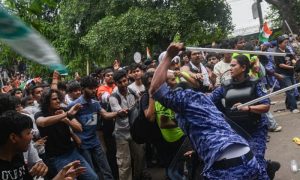
ISHR further urged India to introduce legislation, guidelines or policies expressly banning the use of pellet guns in such circumstances.
The organisation said the use of pellet-firing weapons during peaceful assemblies should be regarded as an unlawful use of force and could amount to torture or cruel treatment.
Also Read: India’s ‘Cockroach’ Movement Hints at Fresh Protest to Challenge PM Modi’s Govt
“Their use during peaceful assemblies signals a disdain for the rights and even the physical integrity of those being targeted,” Lynch said.
Concerns over use of shotguns in IIOJK
ISHR said Indian security forces had a history of using pellet-firing shotguns during protests, particularly in Indian Illegally Occupied Jammu and Kashmir (IIOJK).
It cited two reports issued by the UN Office of the High Commissioner for Human Rights in 2018 and 2019. Those reports described pellet-firing shotguns as among the most dangerous weapons used in Indian Illegally Occupied Jammu and Kashmir and called on authorities to end their use.
ISHR said the response to the July protest also conflicted with India’s international human rights commitments.
The organisation cited Articles 7 and 21 of the International Covenant on Civil and Political Rights. Article 7 prohibits torture and cruel, inhuman or degrading treatment, while Article 21 protects the right of peaceful assembly.
It also cited the UN’s 2020 Guidance on Less-Lethal Weapons in Law Enforcement, which states that metal pellets “should never be used”.
Youth movement protests against corruption, inequality
The protest was organised by the Cockroach Janta Party, a youth movement established in May in response to remarks by India’s Chief Justice comparing unemployed young people to “cockroaches”.
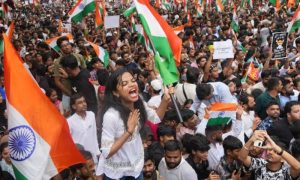
The movement has campaigned against corruption and inequality, particularly in the education sector.
It became involved in protests following the cancellation on May 12 of the National Eligibility cum Entrance Test, or NEET, a nationwide examination used for admission to medical colleges.
The cancellation followed allegations that examination questions had been leaked. The move affected more than two million candidates who were required to retake the examination.
The controversy also led to the deaths by suicide of about a dozen students.
The government did not engage with the protesters for several weeks despite hunger strikes by students and a prominent educationist.
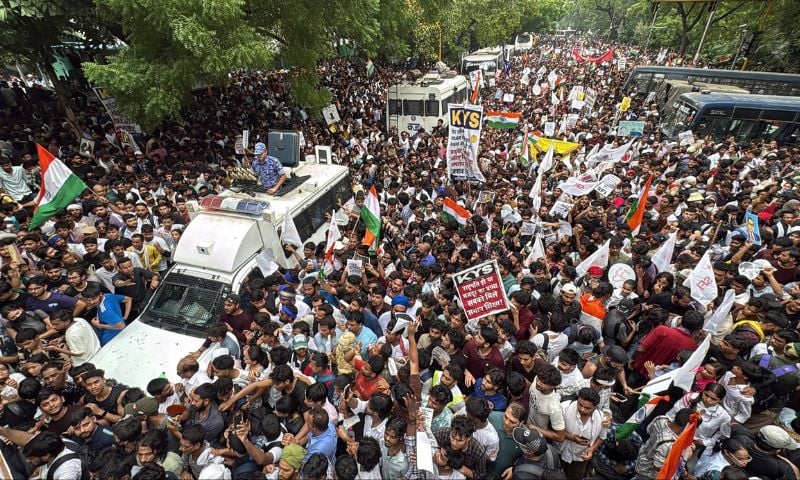
The CJP subsequently called the “Sansad Chalo”, or “March to Parliament”, for July 20.
Thousands of people gathered at New Delhi’s Jantar Mantar despite a police ban. Law enforcement responded with grave violence, while the protest had been largely peaceful.