NEW DELHI: India’s Gen Z “Cockroach” movement on Wednesday hinted at another protest campaign, saying “Season 2” of its Jantar Mantar movement would begin soon, signalling a possible return to street demonstrations against the government.
Abhijeet Dipke, founder of the satirical Cockroach Janta Party (CJP), made the announcement in a video statement after followers repeatedly asked when the next phase of the Jantar Mantar protests would begin. “Season 2 of ‘Jantar-Mantar’ is going to start very soon,” he said.
🚨: “Jantar Mantar Season 2 Coming Soon!”, CJP’s Abhijeet Dipke signals fresh protest to begin soon;
👇🏻: Read More
Cockroach Janata Party founder Abhijeet Dipke has announced that a fresh wave of protests, which he calls “Season 2 of Jantar Mantar,” will begin very soon.… pic.twitter.com/wKhujMGfzz
— The Truth India (@thetruthin) August 12, 2026
The announcement comes as the CJP prepares to launch a nationwide campaign focused on improving government schools in rural India. Dipke said the protest campaign would begin on August 15 from his village in Hingoli and called on parents, citizens and village leaders to participate.
Dipke also alleged that pressure had been placed on venues in Delhi to prevent a CJP volunteers’ meeting from taking place.
Cockroach Janata Party (CJP) founder Abhijeet Dipke on Wednesday announced that a similar protest on the lines of the student protest will begin soon, which he termed a “Season 2 of Jantar Mantar”. pic.twitter.com/WwjWjCvW9B
— JAMMU LINKS NEWS (@JAMMULINKS) August 12, 2026
In a social media statement, he said organisers had struggled to find a hall because venue owners told them they were under “pressure from above”. He said the youth group eventually secured a venue but that its owners received threats on the morning of the meeting.
Dipke accused the ruling Bharatiya Janata Party (BJP) of being behind the alleged pressure.
#WATCH | Delhi | Cockroach Janta Party (CJP) Founder Abhijeet Dipke says, “We were scheduled to hold our volunteers’ meet in Delhi today… We were looking for a hall, but no one would rent us one. Everyone kept saying there was pressure from above… We had managed to secure… pic.twitter.com/48OnCdwEdn
— ANI (@ANI) August 12, 2026
Dipke also accused unidentified people of being brought in to disrupt the meeting. He said CJP members were peacefully discussing plans to improve schools and prepare for the education campaign due to begin on August 15.
Dipke criticises PM Modi
The CJP emerged as a youth movement centred on education, employment and broader concerns among young Indians. Last week, Dipke criticised Prime Minister Narendra Modi over police action during a July 20 student protest at Jantar Mantar in New Delhi.
Speaking to ANI last week, Dipke demanded an apology for students who he said were injured during the police crackdown.
He also questioned whether cases filed against protesters would be withdrawn and raised concerns over reports that Rapid Action Force personnel had been issued pellet guns during the demonstration.
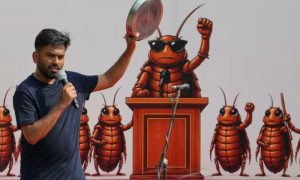
The July protests followed anger over the cancellation of a medical entrance examination after allegations of question-paper leaks.
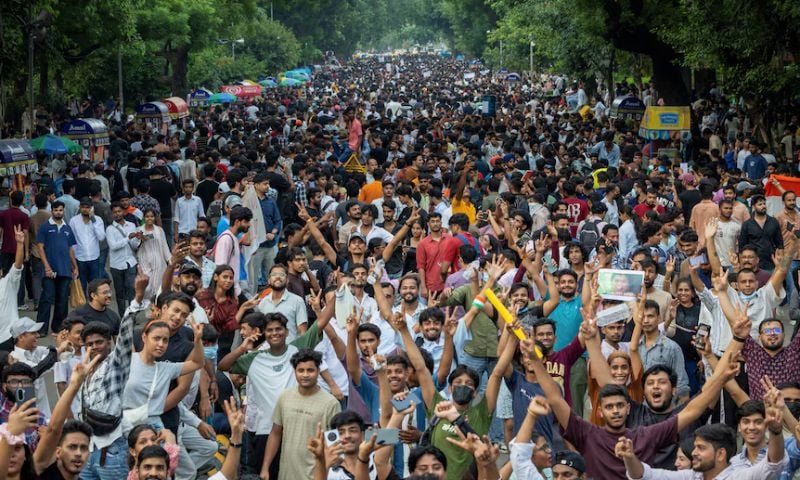
Thousands of students, parents and young people gathered near Jantar Mantar, according to the material provided.
The protests also reflected wider concerns over unemployment, graduate joblessness and problems in India’s higher education system.
Rise of the Cockroach Janta Party
The CJP was formed after a remark about unemployed young people being like “cockroaches”.
Dipke responded by asking on social media: “What if all the cockroaches come together?” He then established the Cockroach Janta Party, a satirical reference to the BJP.
Also Read: India’s Jharkhand Protests Continue Despite Exam Cancellations
The group rapidly built an online following and used social media to channel youth frustration over education and employment issues.
The movement emerged in the wake of controversy surrounding India’s National Eligibility-cum-Entrance Test (NEET), the medical school admission examination.
The examination affected nearly 2.3 million registered students and was cancelled following allegations of question-paper leaks.
India’s Central Bureau of Investigation launched an inquiry into the alleged leaks. At least 21 students had died by suicide by that stage.