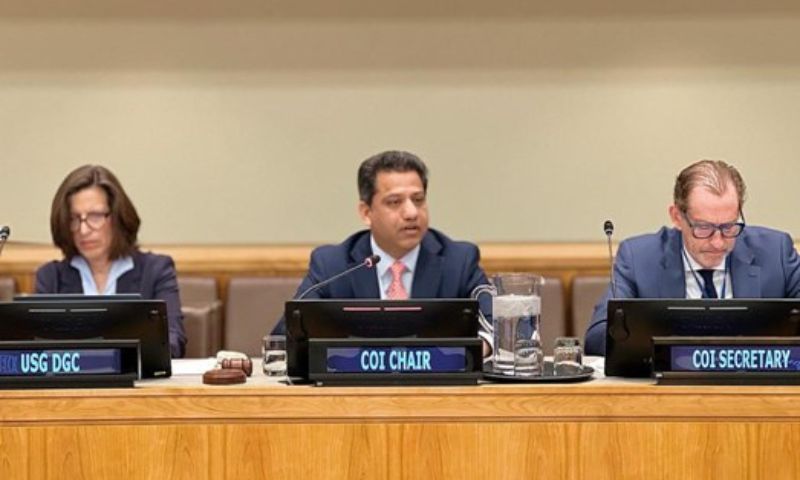
UNITED NATIONS: The responsibility to protect,’ or R2P, Pakistan has urged proponents to use it to defend the oppressed people of occupied Palestine and Indian-controlled Jammu and Kashmir.
Ambassador Aamir Khan, deputy permanent representative of Pakistan to the UN, on Monday, told the UN General Assembly, “Apart from its abuse, the concept of R2P has also led to the criticism that some powerful states have failed to invoke R2P by showing hesitancy either in condemning the massive human rights violations committed by so-called ‘strategic allies’ or by holding them accountable in the Security Council.”
Speaking in a debate on the responsibility to protect and the prevention of genocide, war crimes, ethnic cleansing, and crimes against humanity, the Pakistani envoy said that for more than seven decades, India had denied the right of self-determination to the Kashmiri people in violation of multiple resolutions of the Security Council prescribing a free and fair referendum.
He said India had deployed 900,000 troops and resorted to extra-judicial killings; forced abductions; collective punishments; and the incarceration of the All Parties Hurriyet Conference (APHC) political leadership.
To this end, he said, Pakistan has circulated a dossier with the evidence of 3,432 war crimes committed by India’s officials in Jammu and Kashmir while adding that Muslim persecution has become a “routine norm” for India.
On Saturday, during a visit of Indian Home Minister Amit Shah to Jammu and Kashmir, Ambassador Aamir Khan said that Indian Army personnel stormed into a Mosque in the Pulwama district of south Kashmir while Muslims were offering prayers and forced Muslims to chant “Jai Shri Ram” against their will.
Professor Gregory Stanton, the creator of Genocide Watch, has cautioned that a genocide of Muslims could very quickly occur in India after observing this hazardous pattern, it was noted. The Pakistani representative added, “The International community, especially the supporters of the R2P concept, must carefully analyze the devastating human rights situation occurring in India and the occupied territory of Jammu and Kashmir.”
(The idea of R2P is supported by three tenets: each State must safeguard its citizens; the international community must support States in doing so; and the international community must keep watch when a State is flagrantly failing to do so.)
According to Aamir Khan, the R2P philosophy calls for the world community to stand up for people in danger. Even so, its credibility as a sincere humanitarian ideology is weakened by its selective implementation, which is motivated by double standards and geopolitical reasons. “A more nuanced and balanced approach that avoids selectivity and promotes objectivity and impartiality is necessary,” the Pakistani ambassador continued. “To truly uphold the principle of accountability and protect vulnerable populations, it is also important to promote objectivity and impartiality.” An Indian delegate responded to Ambassador Aamir Khan’s sharp criticism of Indian policy, and a Pakistani representative swiftly countered it.
In exercising her right to reply, Kajal Bhat, a counselor in the Indian Mission to the UN, asserted that Jammu and Kashmir was a fundamental part of India, including its areas that are currently under Pakistan’s “illegal occupation,” and she went on to charge Islamabad with supporting terrorism.
The second secretary of Pakistan’s UN mission, Rabia Ijaz, refuted Indian assertions by arguing that the Indian representative failed to address the facts surrounding that country’s profoundly alarming history of human rights abuses and that Kashmir is an internationally recognized disputed territory, not a part of India. Ijaz continued, “India has used terrorism as a State policy against its neighbors.”
The Special Advisor to the Secretary-General on the Responsibility to Protect, George Okoth-Obbo, opened the discussion by introducing the “Report on the Responsibility to Protect and the Prevention of Genocide, War Crimes, Ethnic Cleansing, and Crimes against Humanity.” He emphasized that the argument is especially poignant because so many civilians are still caught up in violent conflicts and susceptible to genocide and war crimes. Since the globe echoed “never again” at the 2005 World Summit, the obligation to preserve is still crucial today.
Okoth-Obbo continued that the report underlines that development can build the conditions for sustainable peace. In underdevelopment, however, human rights abuses, conflict, societal inequalities, and poverty can be drivers of atrocity crimes.
This debate serves as a “reminder to us not to drift from our commitment, duty, and responsibility to protect,” he said, emphasizing that “the lives of millions depend on that responsibility being given meaning.”
The following discussion focused on whether the responsibility to protect is a principle or a concept, with several speakers stressing that it is a duty that sovereign States have by international law, while others emphasized the lack of agreement on its meaning and extent. —APP