Key Points
- India accused of exporting military components to Israel during Gaza war.
- India could face legal and individual criminal liability over Israel’s support.
- India seen breaching ICJ-linked obligations through defence ties with Israel.
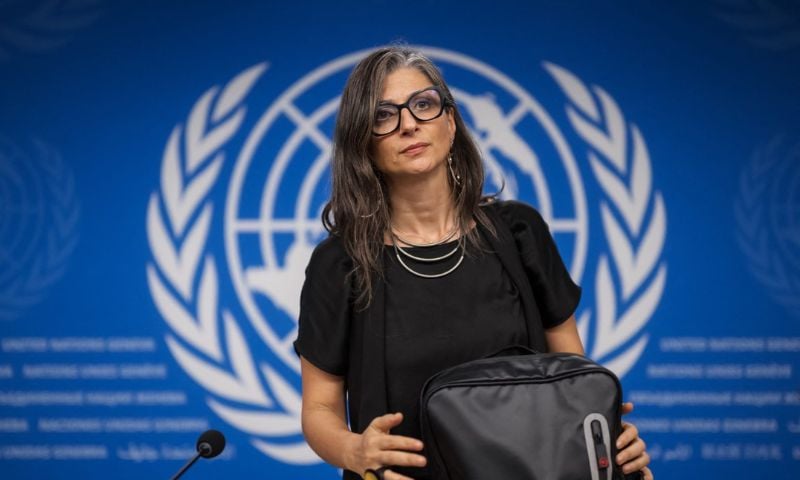
GENEVA: UN Special Rapporteur on the situation of human rights in the Occupied Palestinian Territories, Francesca Albanese, has said that India is “violating its obligations” under international law and could potentially “be facing responsibility” for its association with Israel during the ongoing conflict in Gaza.
In an interview with The Hindu, an Indian Newspaper, Albanese responded to questions regarding India’s legal and moral responsibilities in its engagement with Israel, particularly in relation to the war in Gaza.
She stated that international legal frameworks are clear, citing rulings of the International Court of Justice (ICJ), which has declared the occupation of Palestinian territories illegal and placed obligations on states to refrain from supporting such occupation.
“The International Court of Justice has declared the occupation illegal and imposed an obligation on states not to trade, not to transfer weapons, and not to buy weapons from a state accused of maintaining an illegal occupation,” she said.
Albanese further stressed that these obligations become even more significant in the context of what she described as “a genocide for which Israel is before the International Court of Justice”, adding that Israeli Prime Minister Benjamin Netanyahu faces accusations of war crimes and crimes against humanity.
“So, India is violating its obligations under international law and might even be facing responsibility,” she said, noting that in an ideal legal environment, states supporting actions harming Palestinians could face scrutiny under international law.
Her remarks referenced her report titled Torture and Genocide, presented at the 61st session of the UN Human Rights Council, in which she argues that third countries are enabling Israel’s alleged torture regime through the provision of weapons and other forms of support.
Albanese also referred to allegations that India has exported rockets, explosives, rocket motors, and other military components to Israel during the ongoing war in Gaza. According to reports, including those cited by Al Jazeera in June 2024, such exports continued during the conflict.
She also noted that India’s Supreme Court had dismissed a petition seeking to halt these exports during the Gaza siege.
Addressing Prime Minister Narendra Modi’s visit to Israel shortly before the escalation of the current conflict with Iran, Albanese remarked that both India and Israel share historical experiences shaped by British colonialism.
“India and Israel, or historical Palestine, have one thing in common: their territorial formations have been shaped by British colonial rule,” she said. “Both of them have emerged from British colonialism.”
She added that Israel now operates as a member of the international community and must comply with UN obligations, just as India does.
Albanese further argued that both countries are “contributing to the decay of the international system that our forefathers or foremothers painfully built,” warning that global legal structures are being undermined.
She pointed to emerging legal initiatives in countries such as Italy, where lawyers have reportedly begun proceedings against government officials linked to alleged complicity, stressing that “there is also criminal liability for individuals who authorise this kind of endeavour.”
Criticising what she described as a wider erosion of international law, Albanese said global figures including Donald Trump and Benjamin Netanyahu were “twisting the arm of the system”, normalising lawlessness on a systemic scale.
She also emphasised what she termed the moral responsibility of states, stating, “There is something as serious as legal responsibility, which is the moral responsibility of a country like India.”
While acknowledging India’s internal contradictions, she noted its historical legacy of anti-colonial struggle, describing its present position as “troubling” and suggesting it represented “a betrayal of that past”.
“It seems to me that India’s leaders have turned to the other side,” she added.
In her latest report, Albanese alleges that since October 2023, Israel has implemented systematic torture against Palestinians in detention facilities and across Gaza, which she described as a “vast torture camp”.
She stated that Israeli authorities have created what she called a “torturous environment” across the occupied Palestinian territory, aimed at breaking resistance, dignity, and sumud (steadfastness).
The report documents more than 18,500 arrests, including approximately 1,500 children, along with over 4,000 cases of enforced disappearance. It also highlights the use of surveillance technologies such as facial recognition systems and drones, which she says contribute to constant fear and spatial control.
Further allegations include obstruction of legal access through intimidation, alleged complicity by prison medical staff in falsifying records, and reported torture of over 50 UNRWA personnel, some of whom were questioned about their humanitarian work. Doctors, journalists, activists, and human rights defenders were also reportedly targeted.
According to the report, the scale and nature of alleged torture – including acts occurring outside formal detention – meet the threshold for genocide and are linked to a broader system of apartheid and settler colonialism.