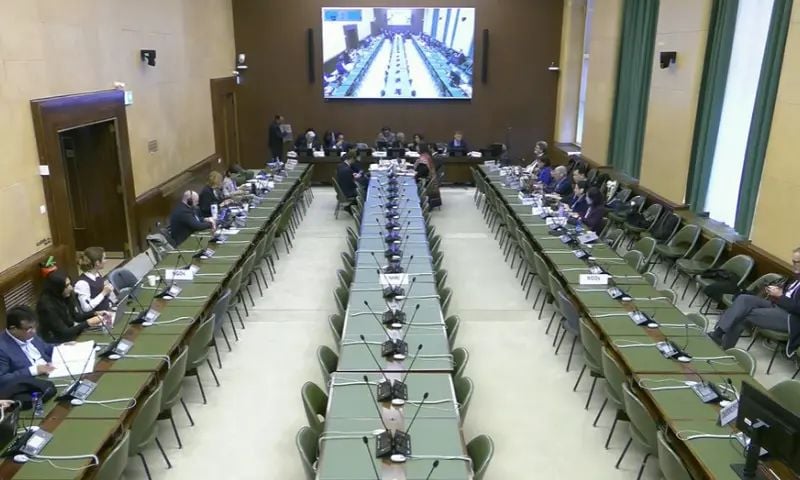
ISLAMABAD: The United Nations Committee on Economic, Social and Cultural Rights has welcomed Pakistan’s 2025 legislative amendment setting the minimum age of marriage at 18 for both males and females, while calling for stronger implementation of measures to eliminate child marriages and bonded labour.
The committee concluded its review of Pakistan’s second periodic report under the International Covenant on Economic, Social and Cultural Rights on Wednesday, examining the country’s progress in fulfilling its economic, social and cultural rights obligations.
Committee expert Michael Windfuhr, a member of the task force on Pakistan, welcomed the amendment to the Child Marriage Restraint Act 1929, but expressed concern over the continued high number of child marriages. He sought details about the effectiveness of measures taken to prevent the practice.
Another committee expert, Lazhari Bouzid, raised concerns over the prevalence of bonded labour in agriculture and the informal sector, particularly brick kilns.
He pointed out that construction companies and government agencies were reportedly contributing to the practice by purchasing bricks produced through debt bondage, and asked the Pakistani delegation to explain the measures taken to address the issue.
The committee also sought clarification on Pakistan’s efforts to rehabilitate communities affected by the devastating floods of 2022 and 2025, including the reconstruction of damaged homes, restoration of access to land and resources, and the number of people still displaced.
Pakistan outlines legislative and policy measures
In his opening remarks, Minister of State for Law and Justice and head of the Pakistani delegation, Barrister Aqeel Malik, said the country had introduced a range of legislative, policy and institutional measures since 2017 to progressively realise the rights enshrined in the covenant.
He said child marriage restraint laws had established 18 as the minimum marriage age for both boys and girls in Islamabad, Balochistan, Punjab and Sindh, while criminalising child, early and forced marriages.
Responding to concerns over bonded labour, the delegation said the Constitution prohibited slavery and all forms of forced labour, while the Bonded Labour System (Abolition) Act 1992 had abolished the practice.
It added that Punjab had documented more than 210,000 brick kiln workers and established district vigilance committees in several districts. Labour inspectors had identified more than 2,900 victims of forced labour during the previous year.
600,000 flood-damaged houses rebuilt
Regarding flood recovery, the Pakistani delegation said the government had established a National Emergency Operations Centre to focus on high-risk areas and launched a national flood protection programme.
The programme aims to protect vulnerable populations, eight million acres of agricultural land and 2.2 million housing units from flood-related risks.
The delegation said provincial governments were also implementing flood protection measures. Of the 2.1 million homes destroyed in the 2022 floods, around 600,000 had been rebuilt, while reconstruction of the remaining houses was under way.
In her concluding remarks, Julieta Rossi, committee expert and head of the task force on Pakistan, said the delegation had outlined the mechanisms established to implement economic, social and cultural rights, as well as the significant challenges facing the country.
She also highlighted the gaps between legislative progress and practical implementation, adding that the information provided would be reflected in the committee’s concluding observations, which Pakistan was expected to implement in good faith.
READ ALSO: Pakistan Urges UN Action Against Disinformation
Barrister Aqeel Malik said Pakistan remained committed to bridging the gap between constitutional guarantees and their practical realisation.
He said the country was moving towards the progressive realisation of covenant rights and had made considerable progress since its first review, despite existing constraints and challenges.
Malik expressed hope that the committee’s assessment would help pave the way for the full realisation of economic, social and cultural rights for all.
Committee Vice-Chair and acting chair of the dialogue, Asraf Ally Caunhye, thanked the Pakistani delegation for its participation in the constructive discussion and its commitment to protecting the rights enshrined in the covenant.
The Pakistani delegation included representatives of the Ministry of Law and Justice, the Ministry of Human Rights and Pakistan’s Permanent Mission to the United Nations Office at Geneva.