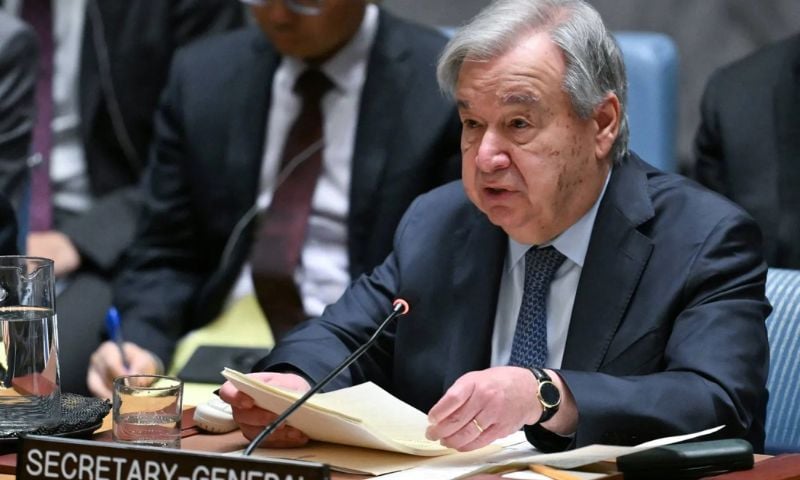



UNITED NATIONS: United Nations Secretary-General António Guterres warned on Wednesday of the risk of a return to “full war” in the Middle East, as renewed escalation between Iran and the United States further strained the ceasefire.
Speaking at a UN Security Council meeting, Guterres said escalating violence risked spiralling into a broader conflict.
“We should not minimise the risks of a lesser fire becoming full fire, or in another word — full war,” Guterres told the Council.
The warning came after renewed tensions between Iran and the United States following the downing of an American helicopter.
The world needs to see a complete ceasefire.
With navigational rights and freedoms restored, in line with international law and Security Council resolution 2817.
– @antonioguterres' full remarks to the Security Council- the situation in the Middle East:https://t.co/WZCbxYcA5k pic.twitter.com/NXvaTU59m3
— UN Spokesperson (@UN_Spokesperson) June 10, 2026
Guterres said the latest escalation risked a “full resumption of conflict” across the Middle East, urging Council members to support diplomatic efforts to end the crisis.
“This week has brought wider attacks and further deterioration. I am profoundly concerned it could trigger a full resumption of conflict,” he said.
He also renewed calls for a political solution to the long-standing Israeli-Palestinian conflict, saying an end to the occupation and a two-state solution remained the only viable path forward.
“The Middle East is being pulled deeper into crisis, and the consequences reach far beyond the region,” Guterres said.
He warned that delays in resolving the conflict were fuelling instability and extremism.
UN High Commissioner for Human Rights Volker Türk said he was “horrified” by repeated escalations in violence.
“We’re always very relieved when ceasefires are announced, but ceasefires need to be respected in full. International law needs to be respected in full,” he said in Geneva.
During the Security Council session, Russian Ambassador Vassily A. Nebenzia warned against attempts to reshape the Middle East’s political landscape.
He said Russia supported Israel’s security in principle but questioned the methods being pursued.
“What kind of stability can be offered by those who are ready to sacrifice for this Palestinian statehood or stability in Iran?” he said.
Nebenzia also referred to Russia’s updated concept for collective security in the Arabian Gulf, which he said included practical proposals for confidence-building measures.
US Deputy Representative Jennifer Locetta told the Council that Washington had adopted a “new approach” in the Middle East focused on results rather than discussions alone.
“It is this action-based approach that has achieved real results,” she said.
She referred to a UN-endorsed Comprehensive Peace Plan to End the Gaza Conflict, adopted under Security Council resolution 2803 (2025), which she said had enabled humanitarian access, hostage releases, and a pathway toward stability.
Locetta also defended the sanctions framework on Iran, saying it was established because dialogue alone had failed to prevent destabilising actions.
“Effective diplomacy requires leverage, credibility and effective enforcement,” she said.
Guterres also warned of broader regional risks, including instability in the Gulf and threats to maritime security near the Strait of Hormuz. He urged full respect for sovereignty and international law across the region.
He further called for renewed international commitment to a two-state solution, describing it as the only credible path to lasting peace.
“The Middle East is being pulled deeper into crisis,” he said. “The consequences reach far beyond the region.”