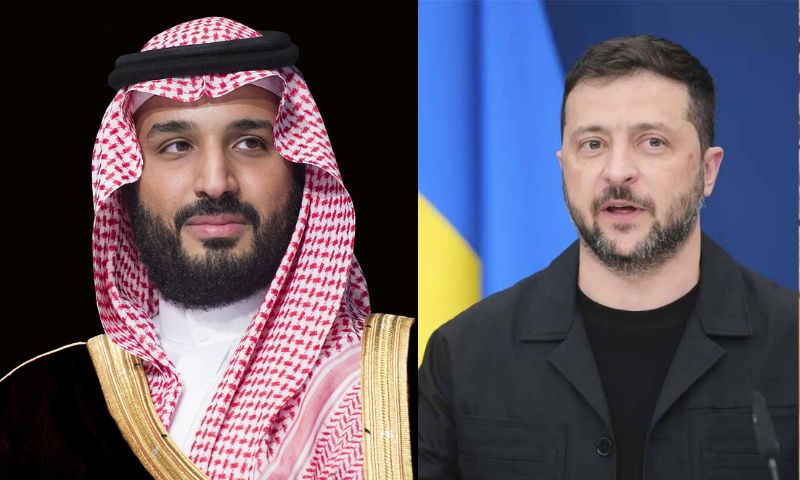
JEDDAH: Ukrainian President Volodymyr Zelenskyy has welcomed the recently signed Makkah Joint Defence Agreement in a phone call with Saudi Arabia’s Crown Prince and Prime Minister Mohammad bin Salman.
The Ukrainian president, while congratulating the Crown Prince, expressed his hope that it would contribute to achieving security and stability in the region, the Saudi Press Agency (SPA) reported on Monday.
The two sides also reviewed the latest regional and international developments and discussed areas of cooperation and ways to enhance them further.
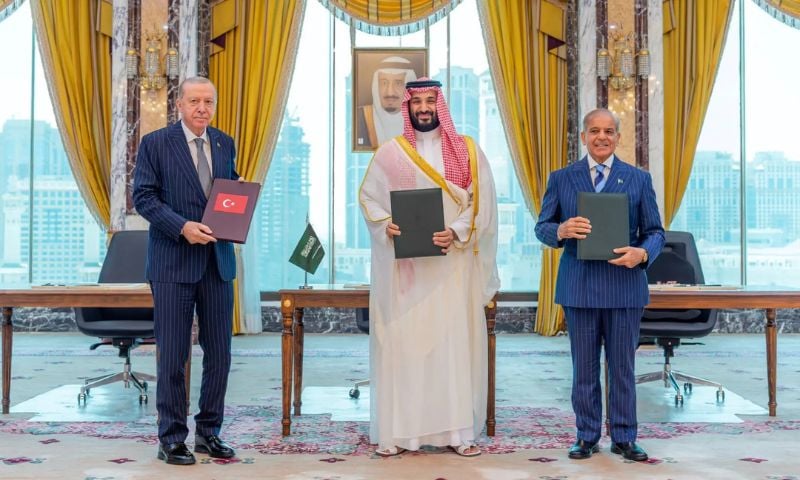
Pakistan, Saudi Arabia and Turkiye signed a joint defence pact on August 7, 2026, establishing a collective security framework under which an armed attack against any one member is considered an attack against all three.
HRH the Crown Prince, Ukrainian President Discuss Developments; Zelenskyy Welcomes Makkah Defence Agreement.https://t.co/F4BGoTmqdE#SPAGOV pic.twitter.com/Lyw5mqaDDA
— SPAENG (@Spa_Eng) August 10, 2026
Pakistan’s Prime Minister Shehbaz Sharif, Saudi Crown Prince and Prime Minister Prince Mohammed bin Salman and Turkish President Recep Tayyip Erdogan signed the pact during the “Makkah Al-Mukarramah Summit for Joint Defence”.
Many Muslim countries have welcomed the Makkah Joint Defence Agreement, describing it as an important step towards strengthening collective security, defence cooperation and regional stability.
Turkish President Recep Tayyip Erdogan said the agreement, based on collective defence, would strengthen cooperation in security and defence-related joint projects.
In a statement, Erdogan said the Makkah Joint Defence Agreement is not directed against any country and remains open to all brotherly countries that seek peace and stability.
Defence Pact entirely for defensive purposes
Earlier, Pakistan’s Prime Minister Shehbaz Sharif, addressing a federal cabinet meeting, said that the Joint Defence Agreement is entirely for defensive purposes, and not for any aggression.
The prime minister said the agreement is not intended to facilitate aggression against any country.
“Its purpose is definitely not that any aggression occurs. It is entirely for defensive purposes, for peace, tranquillity and progress in the region,” he affirmed.
HRH the Crown Prince, President of Türkiye, and Prime Minister of Pakistan sign the Makkah Joint Defence Agreement. pic.twitter.com/IGmuVbknl1
— Foreign Ministry 🇸🇦 (@KSAmofaEN) August 7, 2026
“I believe this agreement is a source of strength not just among these three countries, but for the entire Muslim ummah,” he noted.
Shehbaz said efforts to establish the trilateral defence framework had been under way for several years and had finally materialised with the signing of the pact in Makkah.
Joint Statement of the Makkah Al-Mukarramah Summit for Joint Defence between the Kingdom of Saudi Arabia, the Republic of Türkiye, and the Islamic Republic Pakistan. pic.twitter.com/94SOSdPi6X
— Foreign Ministry 🇸🇦 (@KSAmofaEN) August 7, 2026
He noted that Pakistan and Saudi Arabia had already signed a Strategic Mutual Defence Agreement in September 2025, while Pakistan and Turkiye had maintained defence and security arrangements for decades.
Iran says Defence pact not against Tehran
Meanwhile, Iran said there is “no reason to worry” that the new defence agreement between Pakistan, Saudi Arabia and Turkiye is directed against Tehran, pointing to its deep religious, historical and civilisational ties with all three countries.
Iranian Foreign Ministry spokesperson Esmaeil Baqaei made the remarks on Monday while commenting on the Makkah Joint Defence Agreement.
Also Read: Pakistan-Saudi-Turkiye Defence Pact ‘Entirely for Defensive Purposes’: PM Sharif
Baqaei said the agreement was also an indication of a changing perception among regional countries about how security should be achieved.
“Considering the developments of the last two to three years, the countries of the region have realised that security is not a commodity that can be bought from false security brokers,” Iran’s state media quoted him as saying in an apparent reference to the United States.
He said regional states appeared to be moving towards arrangements based on their own capabilities and regional perspectives rather than relying on security guarantees from powers outside the region.