
Key Points
- Scientists target Greenland glacier melt
- Mission focuses on climate tipping points
- Findings to improve climate forecasts
ISLAMABAD: An international team of scientists has embarked on a British-led research mission to Greenland to investigate how rapidly melting glaciers could affect a critical Atlantic Ocean current system.
The high-tech mission would also study how this rapid melting could reshape climate patterns across Europe and beyond.
The five-to-six-week expedition is being conducted aboard the British polar research vessel RSS Sir David Attenborough and forms part of the £20 million Greenland Ice Sheet to Atlantic Tipping Points (GIANT) programme.
The project seeks to understand how Greenland’s accelerating ice loss is interacting with the ocean and whether the resulting freshwater influx could disrupt the Atlantic Meridional Overturning Circulation (AMOC), a vast system of currents that helps regulate temperatures in Europe.
Researchers from Britain, Europe and North America will deploy an array of advanced technologies, including autonomous underwater vehicles, robotic submarines, drones, sonar systems and artificial intelligence-powered monitoring tools.
These instruments will gather unprecedented data from some of Greenland’s most hazardous glacier fronts, where conventional scientific observations are difficult and dangerous, according to the National Oceanography Centre.
Greenland research mission to use robotics
Among the mission’s most notable tools is the autonomous submersible “Boaty McBoatface,” which will dive as deep as 1,500 metres beneath dense fields of ice and icebergs.
The mission would map underwater terrain and study how warm ocean waters are eroding glaciers from below. Other robotic platforms, including DriX, Gavia, and EcoSub vehicles, will measure ocean temperatures, salinity, currents and glacier movement in real time.
Scientists say the data collected will help improve climate models and contribute to the development of an early-warning system capable of detecting signs of rapid glacier destabilisation and climate tipping points.
ALSO READ: Trump: Greenland Is Strategically Vital for the United States
The findings will also feed into the next generation of the United Kingdom’s Earth System Model, which is used to forecast long-term climate change.
The mission coincides with Europe’s experience of increasingly frequent heatwaves and extreme weather events.
Researchers warn that continued melting of Greenland’s ice sheet could significantly alter ocean circulation patterns, potentially leading to rising sea levels, stronger storms and shifts in regional weather systems.
Greenland is losing ice roughly six times faster than it did three decades ago, according to scientists involved in the project.
The island’s ice sheet contains enough frozen water to raise global sea levels by several metres if it were to melt completely.
Freshwater released from glaciers is already entering the North Atlantic at accelerating rates, raising concerns that key climate-regulating ocean currents could weaken over the coming decades, according to the British Antarctic Survey.
The GIANT programme, funded by the United Kingdom’s Advanced Research and Invention Agency (ARIA), will conduct major field campaigns in 2026 and 2027 as part of a broader effort to understand and anticipate climate tipping points before they become irreversible.
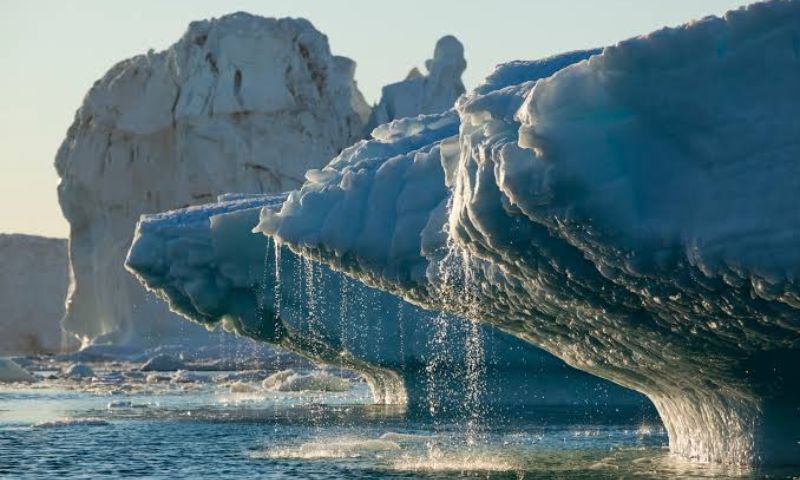
Greenland has become one of the world’s most closely watched climate hotspots as rising global temperatures accelerate the loss of its vast ice sheet.
According to scientific estimates, Greenland has lost trillions of tonnes of ice since the 1990s, contributing significantly to global sea-level rise.
The island’s ice sheet contains enough frozen water to raise global sea levels by about seven metres if it were to melt entirely.
Scientists are particularly concerned about the growing flow of freshwater into the North Atlantic, which could weaken the Atlantic Meridional Overturning Circulation (AMOC), a major ocean current system. It helps regulate weather patterns across Europe, North America and parts of Africa.
Scientists hope the mission will provide crucial insights into Greenland’s rapidly changing ice sheet and help improve forecasts of future climate and sea-level risks worldwide.