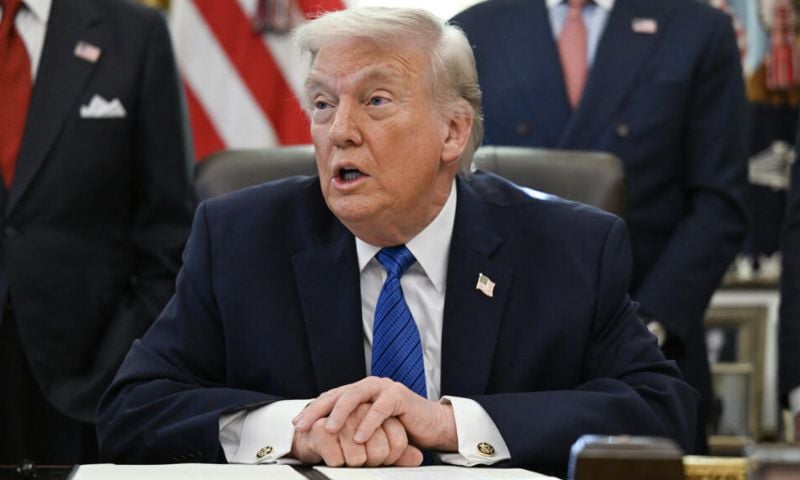
WASHINGTON: US President Donald Trump on Thursday accused China of seeking his defeat in the 2020 presidential election, alleging that Beijing carried out the largest compromise of US election data in history and illegally obtained millions of American voter records.
In a nationally televised primetime address from the White House, Trump announced that he would declassify intelligence which he said exposed “shocking vulnerabilities” in the US electoral system. He also renewed his longstanding claim that the 2020 election was stolen, despite years of investigations, court rulings and audits finding no evidence of fraud that altered the outcome.
PRESIDENT TRUMP: Newly declassified documents show that over a period of years starting during the 2020 election cycle, the People’s Republic of China carried out what is believed to be the largest compromise of election data in history — resulting in China’s illicit acquisition… pic.twitter.com/gVEhsFfXbs
— Breaking911 (@Breaking911) July 17, 2026
A spokesperson for the Chinese Embassy in Washington said Beijing “has never and will never interfere in the presidential elections of the U.S.”
Trump Alleges Chinese Election Interference
Trump said the alleged cyber operation began during the 2020 election cycle and resulted in China gaining access to sensitive US election data.
“Over a period of years, starting during the 2020 election cycle, the People’s Republic of China carried out what is believed to be the largest compromise of election data in history, resulting in China’s illicit acquisition of 220 million US voter files.”
President Trump announced that his administration is declassifying intelligence that reveals “shocking vulnerabilities in our election infrastructure,” including “hacking, exploitation and foreign interference.”
FACT CHECK RATING: False.
Officials have repeatedly said election… pic.twitter.com/CVmy4wFeMA
— CBS News (@CBSNews) July 17, 2026
Trump linked the alleged operation to the 2020 election and again maintained that his loss to Democrat Joe Biden was the result of a “stolen election.”
“We can never watch a stolen election again.”
Trump also claimed that more than 250,000 non-US citizens were registered to vote in four states.
He then attacked US broadcasters that refused to interrupt programming to carry his speech live, naming ABC and NBC and baselessly implying they were involved in election-rigging attempts.
“They and others in the media are part of a plot,” Trump said. “Fraud like this should mean a revocation of their licenses.”
Trump’s claim that the 2020 election was “rigged” has never been substantiated. More than 60 lawsuits produced no ruling establishing fraud capable of changing the outcome, while recounts, audits and his own Justice Department found none.
Unsupported’ claims
The 25-minute primetime address underscored Trump’s effort to make election security a central political issue ahead of November’s midterm elections, when Republicans will be defending their congressional majorities amid the prospect of losing control of one or both chambers.
“Our purpose in disclosing this information is not to weaken confidence in election, but to earn that confidence by confronting vulnerabilities and correcting them very, very quickly.” – President Donald J. Trump 🇺🇸https://t.co/bRU2jrdsI4 pic.twitter.com/oRyxeSE6s5
— The White House (@WhiteHouse) July 17, 2026
Trump used the speech to renew his call for Republicans in Congress to pass legislation requiring proof of citizenship to register to vote and stricter voter identification rules, despite longstanding findings that voter fraud in US elections is rare. The proposed legislation has stalled in the Senate amid strong Democratic opposition.
The address came at a politically difficult time for Trump and his Republican Party, with his approval ratings weighed down by the unpopular Iran war and persistently high energy prices. Trump devoted only brief remarks to the conflict, saying the United States was “winning big,” before highlighting what he described as key domestic achievements, including tax cuts and his immigration crackdown, and then shifting his focus to election security.
Trump had promised “big news” on election security, but analysts said much of the address repackaged old or unsupported material.
Rick Hasen, an election law expert at UCLA in California, called it the “same old unsupported, and surprisingly weak, claims of American election vulnerabilities.”
“It was a tired speech with recycled and debunked claims,” Hasen said. “I don’t think it changes anything with how American elections will be run.”
Dangerous Attempt
Trump devoted little time to issues voters appear more focused on, including the Iran war and the economy.
Democrats accused Trump of trying to undermine confidence ahead of November’s midterms, in which Republicans fear his unpopularity could cost them control of Congress.
Senate Democrat Dick Durbin called the speech “a dangerous attempt to resurrect disproven lies to undermine future elections before a single vote is cast.”
Former Trump White House lawyer Ty Cobb said the speech appeared intended to build a case for declaring an election emergency.
“I think tonight’s speech is intended to add to the predicate that he needs to declare an emergency at or about the time of the elections,” Cobb told PBS, adding that he believed immigration officers at polling places were a “virtual certainty.”
Trump has been pushing lawmakers to pass the SAVE America Act ahead of the midterms, but the measure has little appetite even in his own party.
The bill would require proof of citizenship to register to vote — already required under existing law in federal and state elections — and photo identification at polling places, while imposing new limits on mail-in ballots.
He has never accepted his 2020 defeat. Months after the election, he urged supporters to Washington before a mob stormed the US Capitol on January 6, 2021.
Trump could face a third impeachment trial if Democrats seize control of the House of Representatives. He was impeached twice in his first term, including for alleged incitement of the January 6 attack.
His last major televised address to the nation came on April 1, when he gave his first full public justification of the Iran war more than a month after the US-Israeli military campaign began.