KEY POINTS
- Trump says he plans to travel to Egypt for the signing of the Gaza ceasefire deal.
- He expects Hamas to release hostages on Monday or Tuesday under the agreement.
- Trump says the next phase of the deal will involve Hamas’s disarmament and Israeli withdrawal.
WASHINGTON: US President Donald Trump said on Thursday he would try to travel to Egypt for the signing of a Gaza ceasefire deal, adding that he expected Hamas to free hostages on Monday or Tuesday under the US-brokered agreement.
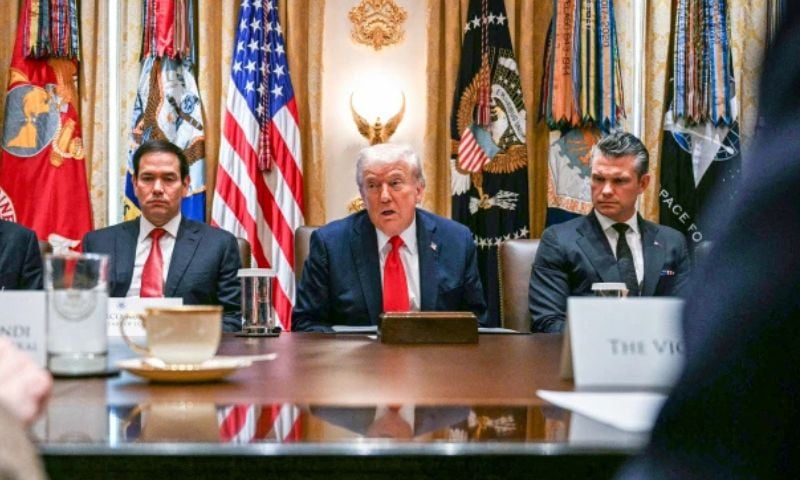
Speaking at a cabinet meeting, Trump said the agreement between Israel and the Palestinian group had “ended the war in Gaza” and would lead to broader Middle East peace.
“We secured the release of all of the remaining hostages, and they should be released on Monday or Tuesday,” Trump told his assembled cabinet secretaries at the White House.
But Trump said that the bodies of some of the dead hostages would be “hard to find.”
Trump announced plans to travel to the Middle East even before he unveiled the first phase of the peace deal on Wednesday, but said arrangements were still being made for a possible stop in Egypt.
“I’m going to try and make a trip over. We’re going to try and get over there, and we’re working on the timing, the exact timing,” Trump said Thursday.
Egyptian President Abdel Fattah al-Sisi said earlier that he had invited his US counterpart to take part in a “celebration to be held in Egypt” for the agreement for the first phase of a ceasefire.
Trump said he also expected to visit Israel, adding that he had been invited to address the Israeli parliament.
“They asked me to speak at the Knesset and… I’ve agreed to, if they would like me to, I will do it,” Trump said in response to a question from a reporter.
Trump falsely claimed that he would be the first president to do so. The Knesset website lists US presidents George W. Bush, Bill Clinton and Jimmy Carter among foreign leaders who have addressed the parliament in the past.
Hamas’s ‘disarming’ in next phase
The Republican gave few details about the second phase of the peace deal and the future of Gaza.
Trump said “there will be disarming, there will be pullbacks,” in apparent reference to Israel’s demand that Hamas disarm and calls by the Palestinian group for Israel to withdraw its forces, but did not elaborate.
He added that Gaza would be “slowly redone” and indicated that Arab states with “tremendous wealth” would help it rebuild, as well as possibly taking part in peacekeeping efforts.
Trump did not comment on whether he now expected to achieve his long-held dream of winning the Nobel Peace Prize.
But his cabinet officials lined up to praise him, led by Secretary of State Marco Rubio, who had on Wednesday handed the US president a note during an event saying a deal was imminent.
“Frankly, I don’t know of any American president in the modern era that could have made this possible,” Rubio said.
Rubio also hinted at the tough negotiations that led to the agreement, which saw Trump pressure Israeli Prime Minister Benjamin Netanyahu and rally Arab and Muslim states to lean on Hamas.
“One day, perhaps the entire story will be told,” Rubio said.
“The president had some extraordinary phone calls and meetings that required a high degree of intensity and commitment and made this happen.”
Sisi tells Trump he ‘deserves Nobel Peace Prize’
Egyptian President Sisi told Trump in a phone call that he “deserves the Nobel Peace Prize” for bringing about a deal to end the war in Gaza.
He invited Trump to “participate in the celebration to be held in Egypt to mark the conclusion of the agreement for a ceasefire in the Gaza Strip”, the first phase of which has been signed during talks in Egypt.
The statement from Sisi’s office said the president “stressed the need to move forward toward implementing the ceasefire agreement in the Gaza Strip in all its stages”.