Key Points
- Chairmanship offers a platform to raise developing countries’ financing concerns
- Islamabad seeks stronger multilateral cooperation and private investment
ISLAMABAD: Pakistan will chair the Boards of Governors (BOG) of the World Bank Group (WBG) and International Monetary Fund (IMF) in 2027, returning to the leadership position for the first time since 1953.
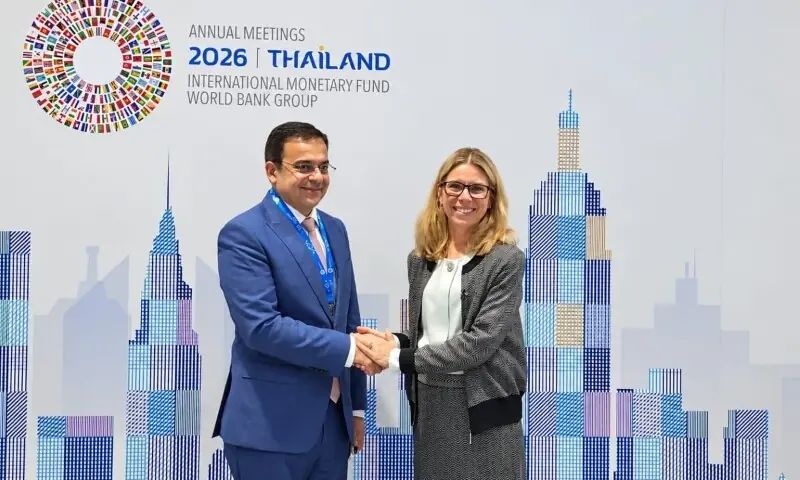
The announcement was made during the plenary session of the 2026 WBG–IMF Annual Meetings in Bangkok on Friday, formally naming Federal Minister for Economic Affairs Ahad Khan Cheema, Pakistan’s governor to the World Bank Group, as the incoming chair.
The appointment allows Pakistan to contribute to discussions on global economic challenges, development financing and the role of multilateral financial institutions at a critical time for the international financial system.
The Boards of Governors are the highest decision-making bodies of the World Bank Group and the IMF.
Each member country appoints a governor, generally a finance minister or central bank governor, to represent its interests.
The boards consider major institutional issues, including membership, financial resources and other strategic matters.
Pakistan’s 2027 chairmanship will enable the country to facilitate dialogue among member countries and highlight the financing needs of developing economies.
The BOG chairs of Bretton Woods Institutions matter to developing countries as they seek resources for sustainable growth, infrastructure and economic resilience.
Immediately after the announcement, Cheema received a briefing from the World Bank Group’s Corporate Secretariat on the responsibilities of the chairmanship.
READ ALSO: Pakistan To Attract $2 Billion of World Bank’s Critical Mineral Finance
He also met Aradhana Kumar-Capoor, the group’s vice president and corporate secretary, to discuss institutional support and coordination for Pakistan’s term.
Cheema subsequently met Carlos Carvallo Spalding, governor of Paraguay’s central bank and outgoing chair of the Boards of Governors.
He congratulated Spalding on completing his tenure and discussed the responsibilities and priorities for the chairs for the coming year.
Pakistan’s incoming chair had an opportunity to draw on the outgoing chair’s experience in managing the role and coordinating with member countries.
During the meetings, Cheema outlined Pakistan’s priorities, including strengthening the representation of developing countries.
Promoting effective and predictable development financing, improving coordination among multilateral development institutions and mobilising private capital for sustainable and inclusive growth would also be a priority.
Pakistan’s commitment to the World Bank and IMF
He reaffirmed Pakistan’s commitment to working with the World Bank Group, the IMF and member countries to encourage constructive dialogue and help build a more responsive international development and financial system.
Pakistan gets such a high-profile chairmanship as developing economies continue to press for more reliable access to development resources. Evolving geopolitics raises the need for greater coordination among international financial institutions.
Pakistan’s term in 2027 will also provide an opportunity to build consensus on development financing and international economic cooperation.