WASHINGTON: The White House said on Thursday that US President Donald Trump remained open to diplomacy with Iran despite the renewed military escalation, while claiming that Tehran continued to seek negotiations with Washington to make a peace deal.
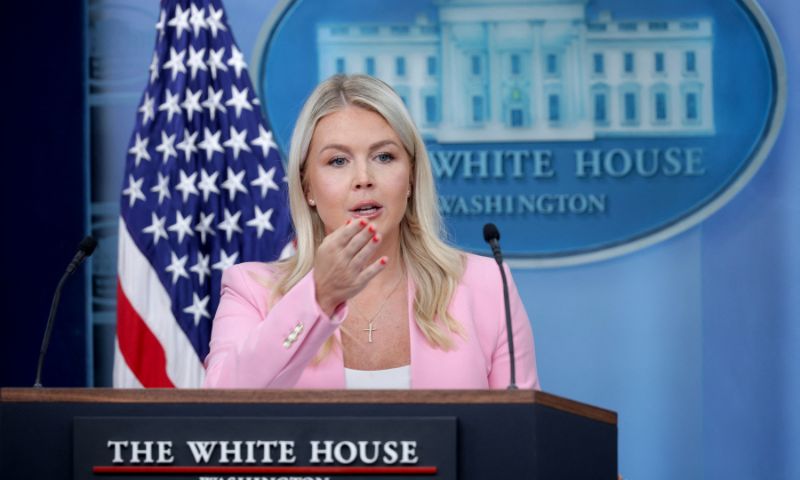
White House Press Secretary Karoline Leavitt said Iran had suffered significant military and economic setbacks but was still expressing a desire to reach an agreement with the United States.
“The president is always open and willing to diplomacy,” Leavitt told reporters at a White House briefing.
“After Operation Epic Fury … we did move forward into a diplomatic phase, if you will, but unfortunately, Iran has violated that,” she said.
Leavitt added that Trump had demonstrated the United States could strike Iran whenever necessary and that Tehran was unable to defend itself effectively.
The White House Press Secretary said the latest US military action followed Iran’s violation of the Islamabad Memorandum of Understanding (MoU), which was brokered by Pakistan to halt hostilities between the two countries.
Press Secretary Karoline Leavitt Briefs Members of the Media, Jul. 16, 2026 https://t.co/ChE0Q1d6kU
— The White House (@WhiteHouse) July 16, 2026
The Islamabad MoU was signed on June 18 by US President Donald Trump, Iranian President Masoud Pezeshkian, and Pakistan’s Prime Minister Shehbaz Sharif, following Islamabad brokered a ceasefire between Washington and Tehran.
Under the Islamabad MoU, the US and Iran committed to halt military operations, reopen the Strait of Hormuz to commercial shipping, and negotiate a comprehensive agreement covering Iran’s nuclear programme, US sanctions, and a permanent ceasefire within 60 days.
“I’ve spoken with the president about this … Iran very much continues to talk to the United States of America and express that they want to make a deal with us because they are suffering devastating blows on behalf of our United States military,” Leavitt said.
She said Washington decided to resume military operations after Iran targeted commercial shipping in the Strait of Hormuz.
“The reason for the recent strikes over the course of the last several days is because Iran violated the memorandum of understanding that we struck with them,” Leavitt said.
“Specifically … they were not to fire on commercial vessels moving through the Strait of Hormuz, and unfortunately, they have made the tragic decisions for them to do that.”
Leavitt said Trump would not tolerate attacks on commercial shipping.
“President Trump is not going to sit by and allow these active acts of terrorism to take place in the strait without ensuring Iran pays consequences for that,” she said.
Trump, Vance on ‘exact same page’ about talks
Asked about contradictory statements on negotiating with Iran by President Trump and Vice President JD Vance, Leavitt said they are “on the exact same page”.
“I can tell you that the president and the vice president are on the exact same page about where we are right now in this conflict,” she told reporters.
Leavitt added that US military action was effective because it has left Iran’s leadership divided and unable to communicate with each other.
Speaking on a podcast with host Joe Rogan, posted on Wednesday, Vance said some members of the Israeli government had tried to influence US public opinion to oppose a deal between the US and Iran to end the Middle East war.
“I know beyond a shadow of a doubt that there have been people within the Israeli government who are trying to actually shift us away from that policy because they want to continue the military campaign,” Vance said.
Vance defended the Islamabad MoU between the US and Iran reached last month to end the war.
He said his concern arose when such influence campaigns affected US decision-making.
“What does bother me is when those operations, those influence campaigns, actually affect American political judgment,” he said.
Pakistan urges restraint
Meanwhile, mediator Pakistan renewed its appeal for restraint and called on both sides to return to dialogue under the Islamabad MoU.
Speaking at the Foreign Office’s weekly media briefing in Islamabad, spokesperson Tahir Andrabi said the agreement is “an enduring framework for promoting peace, mutual respect and shared prosperity”.
Andrabi acknowledged that implementation of the agreement had encountered difficulties but said Pakistan remained committed to encouraging both sides to end hostilities and resume technical-level negotiations in accordance with the Islamabad MoU and the Pakistan-Qatar Joint Statement issued on 22 June.
The spokesperson said Pakistan had remained actively engaged with regional and international partners to support de-escalation and warned that continued instability around the Strait of Hormuz was disrupting global energy supplies, trade and food security, particularly for countries in the Global South.
He also expressed hope for the early restoration of normal maritime traffic through the strategically important waterway.
Also Read: Pakistan Urges Restraint amid US-Iran Tensions, Reaffirms Commitment to Regional Peace
Iran signals readiness for diplomacy
Iran’s senior negotiator and Parliament Speaker Mohammad Bagher Ghalibaf said on Wednesday that Tehran remained committed to diplomacy despite warning that it could abandon the agreement if necessary.
“We have never sought war and we are not seeking it now, but we must always be prepared for confrontation,” Ghalibaf said in a statement.
“At the same time, we must also use diplomacy and negotiation tools to advance and consolidate our national interests.”
His comments came after Trump said in an interview with Fox News on Tuesday that the United States would target key Iranian infrastructure next week if negotiations failed to produce a breakthrough.
“Next week it gets really bad for them because next week comes the power plants,” Trump said.
“Next week comes the bridges. We’re going to knock out all their power plants. We’re going to knock out all their bridges unless they get to the table and negotiate.”
Iran responded on Thursday by warning that it would retaliate forcefully against any further US military action.
In a statement published on Telegram, a spokesperson for Iran’s top military command said that if Trump’s threats were carried out, “everything that is still intact … that is, all the infrastructure in the region – will be crushed under the steel blows of the powerful armed forces of the Islamic Republic of Iran”.
US, Iran exchange fresh military strikes
The US and Iran exchanged fresh military strikes on Thursday.
The US military said it had completed another wave of precision strikes against military targets in Iran, with the Pentagon saying the operation was aimed at further degrading Tehran’s ability to threaten international shipping in the Strait of Hormuz.
According to the US Central Command (CENTCOM), the latest phase of the operation concluded at 9 p.m. Eastern Time on Wednesday, following a series of coordinated strikes ordered by President Donald Trump.
CENTCOM said American forces targeted Iranian command and control centres, air defence installations, missile and drone capabilities, as well as coastal surveillance facilities.
The military said the strikes were designed to weaken Iran’s capacity to endanger commercial vessels and their crews transiting one of the world’s most strategically important maritime chokepoints.
The operation included precision strikes on multiple locations, including the southern port city of Bandar Abbas, a key hub for Iran’s naval and military activities.
Pakistan continues efforts for de-escalation
Pakistan’s Foreign Office spokesperson Andrabi said Islamabad remained actively engaged with regional and international partners to support de-escalation efforts and a peaceful resolution of the crisis.
He also warned that continued tensions around the Strait of Hormuz were affecting countries across the Global South by disrupting global energy supplies, trade and food security.
He expressed hope for the early normalisation of the security situation in the waterway and stressed the importance of ensuring the continued safety and freedom of international maritime navigation.
Islamabad MoU framework
The Islamabad MoU was signed on June 18 by US President Donald Trump, Iranian President Masoud Pezeshkian and Prime Minister Shehbaz Sharif after Pakistan brokered a ceasefire between Washington and Tehran.
Under the Islamabad MoU, the US and Iran committed to halt military operations, reopen the Strait of Hormuz to commercial shipping and negotiate a comprehensive agreement covering Iran’s nuclear programme, US sanctions and a permanent ceasefire within 60 days.
Pakistan and Qatar subsequently co-mediated the first round of high-level negotiations in Lucerne, Switzerland, on June 21.
The talks were attended by US Vice President JD Vance and Iranian Parliament Speaker Mohammad Bagher Ghalibaf.
Pakistan’s diplomatic efforts
Pakistan is the principal mediator between the US and Iran after it secured a ceasefire on April 08 and hosted the highest level of talks between the two nations on April 12 and 13 in Islamabad.
Pakistan, which brokered the ceasefire and has continued to mediate between Washington and Tehran, has urged all parties to honour the agreement.
The first round of Pakistan and Qatar mediated US-Iran talks, led by US Vice President JD Vance and Iran’s Parliament Speaker Mohammad Baqer Ghalibaf, was held in Switzerland a week ago, and Washington waived sanctions on Tehran.
After the talks, Pakistan and Qatar announced significant progress in diplomatic efforts between the US and Iran following the conclusion of the first round of high-level talks in Switzerland.