ANKARA, Turkiye: US President Donald Trump said on Wednesday he expected the latest military flare-up between the United States and Iran to end “very quickly”, despite earlier statements that the US-Iran ceasefire was effectively over after both sides exchanged fresh military strikes.
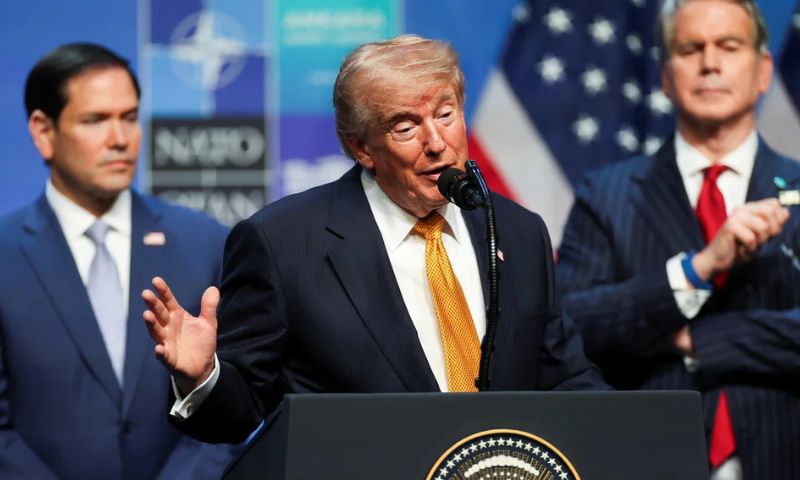
“I think anything that happens is going to be over very quickly and will only make it safer, including for oil… Anything that happens is going to happen very fast. We’re not looking for long-term,” the US President said at the end of a two-day NATO summit in Ankara.
Trump said he does not think a full-fledged conflict with Iran will erupt in the wake of military strikes from both sides.
“I don’t think it’s going to start again. I think it’s going to go very quickly. They hit a couple of ships, and so we hit them much harder,” Trump told reporters in Ankara after the NATO summit.
The US President also reiterated his previous comments that he is a target of Tehran. “I’m number one on the kill list for Iran,” Trump said.
.@POTUS: “I’m number one on the kill list for Iran… but I don’t really care because I’m doing my job, and I’m doing it, I hope, better than anybody’s ever done it.” 🇺🇸 pic.twitter.com/P47VkauTnq
— Rapid Response 47 (@RapidResponse47) July 8, 2026
Earlier, Trump said the US would carry out more strikes on Iran, declaring, “We’re probably going to hit them hard again tonight.”
However, his statement changed after mediator Pakistan urged the US and Iran to exercise restraint and uphold the Islamabad memorandum of understanding.
Pakistan urges US and Iran to exercise restraint
On Wednesday, mediator Pakistan urged the United States and Iran to exercise restraint and uphold the Islamabad MoU commitments to permanently end the Middle East conflict.
The Islamabad MoU was signed on June 18 by US President Donald Trump, Iranian President Masoud Pezeshkian and Prime Minister Shehbaz Sharif after Pakistan brokered a ceasefire between Washington and Tehran.
Under the Islamabad MoU, the US and Iran committed to halt military operations, reopen the Strait of Hormuz to commercial shipping and negotiate a comprehensive agreement covering Iran’s nuclear programme, US sanctions and a permanent ceasefire within 60 days.
“Pakistan urges all sides to uphold their respective commitments under the Islamabad Memorandum of Understanding (MoU),” the foreign office said in a statement, which also called on “all parties to exercise restraint.”
“Pakistan expresses its deep concern at the escalation in tensions in the region. A renewed conflict is in no one’s interest,” the foreign office stated.
🔊PR No.1️⃣6️⃣7️⃣/2️⃣0️⃣2️⃣6️⃣
Press Release https://t.co/8BcND3LSHM
🔗⬇️ pic.twitter.com/sDWaaOFYQ6
— Ministry of Foreign Affairs – Pakistan (@ForeignOfficePk) July 8, 2026
“Pakistan calls on all parties to exercise restraint and refrain from any actions that may further undermine regional peace and stability. There is no alternative to continued engagement, dialogue and diplomacy to achieve the shared goal of peace in the region,” the foreign office added.
Pakistan urged all sides to uphold their respective commitments under the Islamabad Memorandum of Understanding (MoU), which remains an enduring foundation for understanding, mutual respect and shared prosperity for the region and beyond.
“Pakistan remains ready to continue playing its role in this regard,” the foreign office said.
US, Iran trade strikes
Earlier today, the US and Iran traded fresh military strikes, with Tehran saying it launched missile and drone attacks on US military facilities in Bahrain and Kuwait after Washington struck more than 80 targets across Iran.
Iran’s Islamic Revolutionary Guard Corps (IRGC) said it had targeted US military sites in Bahrain and Kuwait in an initial response to American attacks.
“In an initial response to this aggression, the IRGC Navy and Aerospace Force carried out a joint missile and drone operation, striking 85 key US military facilities” in Bahrain and Kuwait, while also shooting down a US MQ-9 drone, the IRGC said in a statement carried by state broadcaster IRIB.
The United States had earlier launched a new wave of strikes against Iran and revoked a licence allowing Tehran to sell oil after three tankers were hit by projectiles in the Strait of Hormuz, further straining the ceasefire reached last month.
The US Central Command (Centcom) said it struck more than 80 targets to impose what it described as “heavy costs” on Iran, including attacks on over 60 small boats belonging to the Islamic Revolutionary Guard Corps (IRGC) aimed at reducing Tehran’s ability to threaten commercial shipping.
Islamabad MoU framework
The Islamabad MoU was signed on June 18 by US President Donald Trump, Iranian President Masoud Pezeshkian and Prime Minister Shehbaz Sharif after Pakistan brokered a ceasefire between Washington and Tehran.
Under the Islamabad MoU, the US and Iran committed to halt military operations, reopen the Strait of Hormuz to commercial shipping and negotiate a comprehensive agreement covering Iran’s nuclear programme, US sanctions and a permanent ceasefire within 60 days.
Pakistan and Qatar subsequently co-mediated the first round of high-level negotiations in Lucerne, Switzerland, on June 21.
The talks were attended by US Vice President JD Vance and Iranian Parliament Speaker Mohammad Bagher Ghalibaf.
The next round of negotiations is intended to advance the Islamabad MoU framework. The technical talks were delayed because of the state funeral ceremonies for Iran’s late Supreme Leader, Ayatollah Ali Khamenei.
The planned meeting follows indirect technical discussions held in Doha earlier this week.
Pakistan eyes US-Iran peace deal in two months
Last week, Pakistan’s Prime Minister Shehbaz Sharif expressed optimism that the US and Iran could reach a lasting peace agreement within the next two months.
PM Sharif said technical-level negotiations between the US and Iran were progressing under the Pakistan-brokered Islamabad MoU between Washington and Tehran.
In an interview with TRT World during his official visit to Istanbul, Prime Minister Sharif said Pakistan would continue to facilitate the peace process after helping mediate the ceasefire agreement signed between Washington and Tehran last month.
“We hope and pray to Allah Almighty that long-lasting peace will come in place, Inshallah, in the next two months or so,” the prime minister said.
Prime Minister Sharif acknowledged that mediation between the United States and Iran had been a difficult and complicated task. “While it was a very noble undertaking, at the same time it was a very difficult and complicated task.”
PM Sharif said Pakistan had maintained an honest and balanced approach while engaging Washington and Tehran throughout the negotiations.
The prime minister also thanked Turkiye, Saudi Arabia, Qatar and Egypt for supporting the diplomatic initiative for regional peace. “Without their support, it wouldn’t have been possible,” he said.
Prime Minister Sharif noted that the Islamabad Memorandum of Understanding had now been signed and technical discussions had begun following the high-level negotiations in Switzerland.
On Thursday, Pakistan’s Foreign Office spokesperson Tahir Andrabi said Pakistani and Qatari mediators had concluded separate meetings with US and Iranian delegations in Doha, building on the outcomes of the Lake Lucerne Summit and advancing implementation of the Islamabad MoU.
“The parties have agreed to continue discussions over the coming period, with the next meeting to be scheduled at the earliest possible time following the funeral processions of Iran’s former Supreme Leader,” Andrabi said in a post on X.
The latest diplomatic progress helped reassure markets that commercial shipping through the Strait of Hormuz would continue to normalise.
Pakistan continues diplomatic efforts
Pakistan is the principal mediator between the US and Iran after it secured a ceasefire on April 08 and hosted the highest level of talks between the two nations on April 12 and 13 in Islamabad.
Pakistan, which brokered the ceasefire and has continued to mediate between Washington and Tehran, has urged all parties to honour the agreement.
Pakistan’s Deputy Prime Minister and Foreign Minister Ishaq Dar last week stressed the need for all parties to the Middle East conflict to uphold the ceasefire agreement.
On June 18, Prime Minister Shehbaz Sharif, President Donald Trump and Iranian President Masoud Pezeshkian signed the Islamabad Memorandum of Understanding to end hostilities and launch further negotiations.
On June 21, Pakistan and Qatar mediated the high-level US-Iran talks in Switzerland.
The first round of Pakistan and Qatar mediated US-Iran talks, led by US Vice President JD Vance and Iran’s Parliament Speaker Mohammad Baqer Ghalibaf, was held in Switzerland a week ago, and Washington waived sanctions on Tehran.
After the talks, Pakistan and Qatar announced significant progress in diplomatic efforts between the US and Iran following the conclusion of the first round of high-level talks in Switzerland.
Pakistan likely to host next round of US-Iran technical talks
Pakistan is expected to host the next round of technical negotiations between the US and Iran as diplomatic efforts continued to consolidate a regional peace framework, diplomatic sources said.
The talks are expected to focus on Iran’s nuclear programme, sanctions relief and Iranian assets frozen abroad, while also addressing regional security issues, including stability in the Strait of Hormuz and the preservation of the ceasefire in Lebanon.
“There are two possible venues for the technical talks — Islamabad and the Burgenstock resort in Switzerland,” a diplomatic source told Dawn. “Islamabad, however, is the more likely option.”
Although July 11 has been proposed for the meeting, a final decision on the venue has yet to be announced.