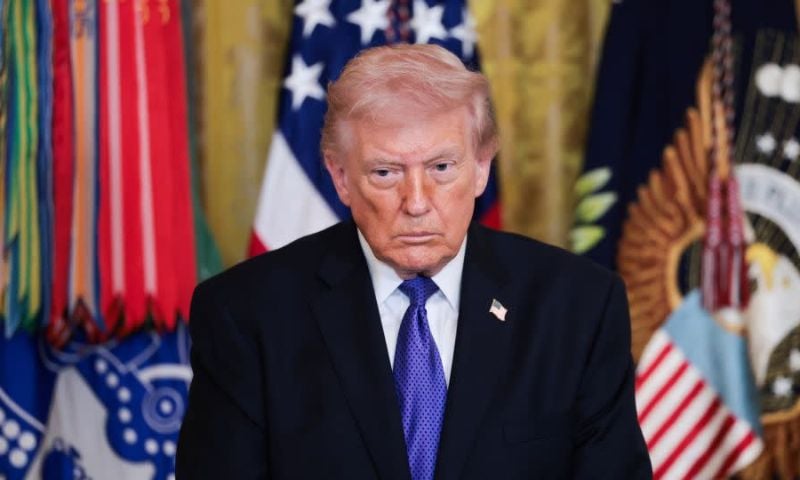



WASHINGTON: US President Donald Trump said on Monday the war against Iran could end “very soon”, even as some of his advisors privately urged him to outline a strategy for exiting the conflict amid rising oil prices and concerns that a prolonged war could trigger political backlash in the United States.
Speaking to reporters in Florida, Trump said the military operation against Iran was progressing faster than expected and claimed that the mission had largely achieved its objectives.
“We’re way ahead of schedule,” Trump said, adding that he believed the war could be over “very soon”.
His remarks come as advisors within his political and economic circle push for a clearer plan to disengage from the conflict, according to a report by The Wall Street Journal published on Tuesday.
Advisors push for Iran exit strategy
The newspaper reported that several advisors have encouraged Trump to publicly frame the campaign as largely successful and begin preparing an exit strategy.
“Some of Trump’s advisors in recent days have encouraged him to articulate a plan to extract the US from the war and make the case that the military had largely achieved its objectives,” the report said.
However, senior figures within the administration reportedly believe a rapid withdrawal is unlikely under current conditions.
Trump administration officials, cited by The Wall Street Journal, said that continuing Iranian attacks on US facilities and regional targets, along with Israel’s readiness to continue striking Iranian sites, could complicate any attempt by Washington to disengage.
Trump has also indicated that further military action remains possible.
He warned that the United States could intensify strikes if Iran attempted to disrupt global oil shipments through the Strait of Hormuz, a strategic waterway for global energy supplies.
Political concerns
Concerns within Trump’s political circle have intensified as oil prices surged above $100 per barrel, raising fears about the economic impact of the conflict ahead of upcoming elections.
Stephen Moore, an outside economic advisor to Trump, said rising energy costs could have broad economic consequences.
“When the price of gas and oil rise, so does everything else,” Moore said, adding that affordability was already a major issue for many Americans.
According to people familiar with internal discussions cited by The Wall Street Journal, polling data reviewed by the administration indicate that a majority of Americans oppose the war.
“Public polls released in recent days show that most Americans oppose the war,” the report said.
Despite the concerns, a senior administration official told the newspaper that Trump intends to continue the military campaign until he can claim a clear victory.
“Trump won’t stop fighting until he can claim a satisfactory victory,” the official said.
White House rejects reports of divisions
Meanwhile, the White House dismissed suggestions of internal disagreements over the war.
Press Secretary Karoline Leavitt rejected the reporting and said Trump’s advisors remain focused on the military operation.
“This story is full of crap from anonymous sources who, I can guarantee, are not in the room with President Trump,” she said.
“The president’s top aides are focused 24/7 on ensuring Operation Epic Fury continues to be a tremendous success, and the end of these operations will ultimately be determined by the commander in chief,” she added.
Trump claims Iran’s military weakened
Meanwhile, in remarks to CBS News on Monday, Trump suggested the war was largely over and claimed Iran’s military capabilities had been severely degraded.
“I think the war is very complete, pretty much,” he said.
Trump claimed Iran now had “no navy, no communications, they’ve got no air force”.
“Their missiles are down to a scatter. Their drones are being blown up all over the place,” he added.
“If you look, they have nothing left. There’s nothing left in a military sense.”
However, speaking at a House Republican gathering in Miami, Trump adopted a more combative tone.
“Together, with our Israeli partners, we’re crushing the enemy in an overwhelming display of technical skill and military force,” he said.
He added that the United States “will not relent until the enemy is totally and decisively defeated”.
Trump also described the conflict as a “short-term excursion”, suggesting Washington expects the campaign to conclude quickly.
At the same time, he warned Iran against interfering with shipping through the Strait of Hormuz.
“We could do a lot,” Trump said, warning that if Iran attempted to disrupt the waterway, “that would be the end of Iran and you’d never hear the name again”.
Iran rejects talks
Iranian officials, however, said the war was far from over and ruled out renewed negotiations with Washington.
Iranian Foreign Minister Abbas Araghchi said Tehran no longer trusted diplomatic talks with the United States after Washington launched attacks during previous negotiations.
“We negotiated with them last year… and they attacked us in the middle of negotiations,” Araghchi said in an interview with PBS NewsHour on Monday.
“And again this year… they promised us that they don’t have any intention to attack us… but after three rounds of negotiation… they decided to attack us,” he said.
“I don’t think talking with Americans anymore would be on our agenda anymore,” Araghchi added.
He also argued that the US and Israeli war objectives had failed.
“They thought that, in a matter of two or three days, they can go for a regime change… but they failed,” he said.
Iranian government spokeswoman Fatemeh Mohajerani said Tehran had not initiated the conflict.
“Iran did not start the war but will end it,” she said.
She added that mediation efforts should focus on preventing further aggression rather than negotiating a temporary ceasefire.
“The Strait of Hormuz is a strategic resource for Iran, and it is natural to invest all resources in the war,” Mohajerani said.
She also said the election of Mojtaba Khamenei as the third leader of the Islamic Republic had strengthened unity within Iran and “thwarted the enemies’ plans”.
Global markets shaken
The conflict has already rattled global financial markets.
Benchmark oil prices briefly climbed above $100 per barrel for the first time since 2022 amid fears that fighting could disrupt shipments through the Strait of Hormuz, a narrow passage that carries roughly one-fifth of the world’s oil supply.
The spike in energy prices has fuelled volatility in global equity markets and raised concerns about renewed inflation and slower economic growth.
Analysts warn that prolonged disruption to Gulf energy exports could push oil prices even higher, increasing costs for consumers and businesses worldwide.
Iranian officials say the coming weeks could prove critical in determining the course of the conflict.
Mohammad Akbarzadeh, political assistant to the commander of Iran’s Revolutionary Guard naval forces, said Tehran expected “three crucial weeks ahead”.
He said Iran’s strategy regarding the Strait of Hormuz had already placed pressure on global energy markets.
“The policy of preventing passage through the Strait of Hormuz… has created an energy crisis and a rise in prices, and the global economy cannot withstand such pressure,” he said.
Iran’s military capabilities
Akbarzadeh also said Iran’s military capabilities had surprised its adversaries.
“The Iranian armed forces surprised the enemies and confused many American analysts and generals,” he said.
“If Iran can maintain the upper hand as it did last week, which is entirely possible, then we should expect to hear a new tone from America demanding a ceasefire,” he added.
Despite the escalating rhetoric, Iranian officials say Washington has attempted to communicate privately with Tehran to end the conflict.
A senior Iranian political official told Al-Mayadeen that the United States had tried to send messages through intermediaries.
“Trump is trying to communicate to end the war,” the official said.
However, Tehran rejected the outreach.
“Tehran has informed the mediators categorically that it does not receive any message from the American side and will not respond to it,” the official said.
The official added that Trump’s public statements appeared to contradict what was being conveyed through diplomatic channels.
“He claims otherwise at the same time,” the official said.