ISLAMABAD: Pakistan and China’s top diplomats have underlined the urgent need to de-escalate tensions in the region, emphasising that lasting peace can only be achieved through dialogue and diplomacy in line with the principles of the United Nations Charter.
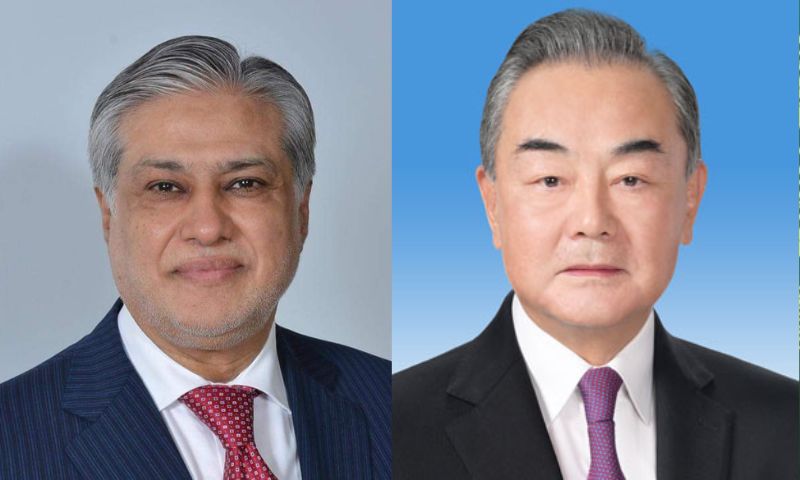
This came during a telephonic conversation between Deputy Prime Minister and Foreign Minister Mohammad Ishaq D with the Foreign Minister of China, Wang Yi, a Foreign Office statement said on Tuesday.
They discussed the evolving regional situation as well as broader global developments. Pakistan’s Deputy Prime Minister and Foreign Minister shared the country’s perspective, stressing the urgent need to reduce tensions in the Middle East and across the wider region.
Deputy Prime Minister and Foreign Minister Senator Mohammad Ishaq Dar @MIshaqDar50 held a telephonic conversation today with the Foreign Minister of China, H.E. Wang Yi.
They exchanged views on the evolving regional situation and broader global developments. DPM/FM shared… pic.twitter.com/40eF0ohVFL
— Ministry of Foreign Affairs – Pakistan (@ForeignOfficePk) March 10, 2026
Foreign Minister Wang Yi commended Pakistan’s constructive role in promoting de-escalation and regional stability, the statement said.
“Both sides also reaffirmed the enduring strength of the Pakistan-China All-Weather Strategic Cooperative Partnership, reiterated their shared commitment to further deepening bilateral cooperation, and agreed to remain in close contact,” it added.
China proposes five-point plan to resolve Iran conflict
China has outlined a comprehensive five-point approach to address the escalating conflict involving Iran, urging an immediate ceasefire and a return to political dialogue.
Speaking at the Fourth Session of the 14th National People’s Congress, Foreign Minister Wang Yi emphasised the need to respect sovereignty, avoid military escalation, and involve major powers constructively to prevent further regional instability.
Wang described the Middle East as “engulfed in flames,” warning that continued military action would exacerbate divisions and prolong the crisis.
He stressed that China’s stance is objective and impartial, prioritising the cessation of hostilities and the protection of civilians while calling on all sides to seek political solutions rather than rely on force.
The five-point plan outlined by Wang Yi calls for all countries to respect the national sovereignty, security, and territorial integrity of Iran and other Gulf nations.
He stressed that the use of force must be avoided and civilians should not become victims of armed conflict.
The plan also emphasised the principle of non-interference, allowing regional countries to determine their own future without external intervention.
Wang urged all parties to pursue political solutions through dialogue and negotiation instead of military confrontation.
Finally, he called on major global powers to play a constructive role in stabilising the region rather than intensifying tensions.