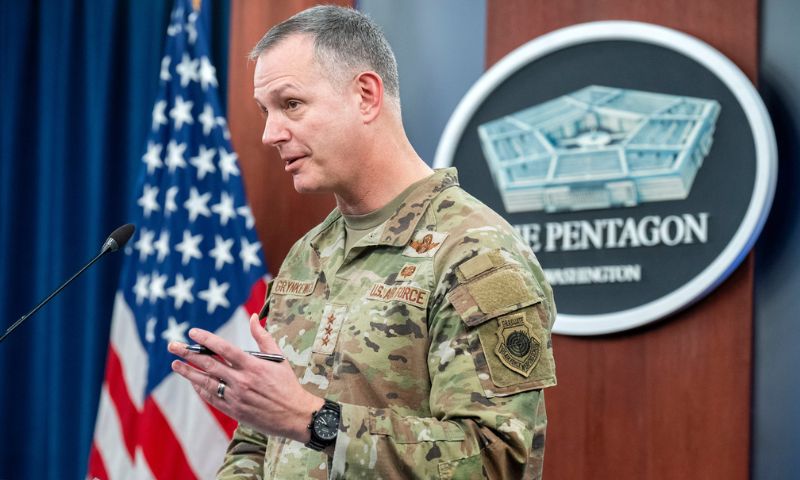
WASHINGTON: The head of the US military’s European Command (EUCOM) has warned the Pentagon that current naval resources are insufficient to defend Israel against Iranian ballistic missile attacks, The Washington Post reported.
According to The Washington Post, General Alexis Grynkewich informed senior Pentagon officials in writing this week that EUCOM lacked the naval assets required to provide adequate missile defence for Israel amid the escalating conflict with Iran.
According to the newspaper report, the commander warned that unless the US Navy deployed an additional aircraft carrier, he would have to prioritise the defence of the United States over protecting Israel.
Exclusive: The top U.S. general in Europe privately warned the Pentagon that he lacks sufficient naval forces to continue protecting Israel from incoming ballistic missiles, illustrating how the ongoing Iran war has imposed constraints on the military. https://t.co/hdXm5NkjMm
— The Washington Post (@washingtonpost) August 1, 2026
A US defence official, cited by The Washington Post, said that such written warnings from military commanders are not unusual when operational demands exceed available resources.
BIG: Gen. Alexus Grynkewich, the top U.S. commander in Europe, has warned the Pentagon that he no longer has enough Navy destroyers to keep protecting Israel from Iranian ballistic missile attacks while also meeting U.S. defense needs.
The destroyers, which have intercepted… pic.twitter.com/RkM3fwCiqg
— Clash Report (@clashreport) August 1, 2026
The US official said commanders routinely notify the Pentagon of capability gaps so policymakers can make informed decisions on force allocation.
Growing strain on US military resources
The warning comes as the five-month conflict between Washington and Tehran has entered a critical phase, with hostilities resuming after the ceasefire agreement.
The renewed fighting has placed increasing pressure on US missile defence systems and military stockpiles.
US aircraft carriers operating in the eastern Mediterranean have long supported Israel’s missile defence network, using advanced radar systems and interceptor missiles to help counter threats from Iran and the Houthi militia in Yemen.
The report said the Trump administration’s decision to blockade Iranian ports in response to Tehran’s closure of the Strait of Hormuz has further stretched US naval resources.
Multiple theatres and limited assets
EUCOM oversees US military operations in the Mediterranean and is also responsible for monitoring potential threats from Russia against NATO allies, adding to the command’s operational burden.
According to the US Department of Defence, five US Navy destroyers are based in Rota, Spain, with a sixth expected to arrive later this year. However, ongoing operations related to the Iran conflict have delayed maintenance schedules, affecting the availability of naval assets.
As of Friday, the report said the USS Paul Ignatius and USS Roosevelt were deployed in the eastern Mediterranean, while the USS Arleigh Burke, USS Bulkeley and USS Oscar Austin remained stationed at Rota.
In the Arabian Sea, the United States has deployed the USS George W. Bush, USS Abraham Lincoln and at least 15 other warships, including 11 aircraft carriers, to protect commercial shipping and enforce the blockade of Iranian ports around the Strait of Hormuz.