Every time a Pakistani motorist pays Rs345.87 for a litre of petrol, nearly Rs130 does not go towards the fuel itself. It goes to taxes, government levies, transport costs and the margins earned by companies and dealers.
In other words, about 38% of the price at the pump comes from charges added along the way.
So what exactly are consumers paying for, and why does a fall in international oil prices not always mean a similar drop in petrol prices in Pakistan?
The answer lies in how the price of every litre is built up, from the cost of imported fuel to the taxes added before it reaches the pump.
The latest Oil and Gas Regulatory Authority (OGRA) price build-up, effective September 5, provides a clear picture of how the price is constructed.
Of the Rs345.87 paid for a litre of petrol, Rs215.95 represents the fuel cost at Karachi port, based on the international refined-product benchmark and associated import costs.
Customs duty, domestic freight equalisation, industry margins and government levies then take the price to the final retail level.
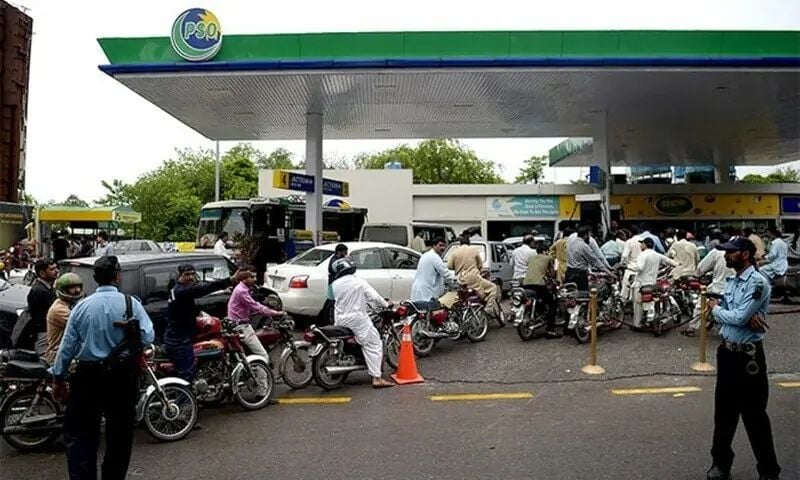
Government taxes and levies alone amount to Rs104.47 per litre, comprising Rs19.47 in customs duty, Rs80 in petroleum levy and Rs5 in Climate Support Levy.
This represents 30.2 per cent of the final pump price. Yet, the General Sales Tax is currently zero.
When the Rs 7.60 Inland Freight Equalisation Margin (IFEM), Rs 7.87 Oil Marketing Company (OMC) margin and Rs 9.98 dealer commission are included, the total amount accounted for by taxes, levies, margins and other charges rises to Rs 129.92 per litre, or 37.6 per cent of the pump price.
READ ALSO: Pakistan Cuts Petrol Price by Rs0.58, Diesel by Rs0.17 Per Litre
In other words, only Rs 215.95, or 62.4 per cent of the amount paid by the consumer, represents the fuel at Karachi port and its international procurement costs. The taxes, duties, domestic distribution charges, and industry margins make up the remaining 37.6 per cent.
Even the Rs 215.95 product cost is not simply the international crude price converted into rupees.
OGRA’s September 5 calculation starts with a finished-product Platts Arab Gulf assessment of Rs 194.70 per litre.
A further Rs 20.59 is added for premium, including freight and Rs 0.68 for incidentals. There is no ocean-loss adjustment in the calculation. These components bring the cost at Karachi port to Rs 215.95.
Customs Duty of Rs 19.47 is then added, producing an ex-refinery/import price of Rs 235.42.
The pricing structure can therefore be presented simply as follows: Rs 194.70 international product value
- Rs 20.59 premium/freight
- Rs0.68 incidentals
= Rs 215.95 Karachi-port product cost
Then: Rs 215.95+ Rs 19.47 customs duty = Rs 235.42 ex-refinery/import price
Then: Rs 235.42 +Rs 7.60 IFEM+Rs 7.87 OMC margin+ Rs 9.98 dealer commission= Rs 260.87
Finally: Rs 260.87 + Rs 80 petroleum levy + Rs 5 Climate Support Levy = Rs 345.87 pump price.
This structure exposes an important misconception in the public debate over petroleum prices: a fall in international oil prices cannot automatically translate into an equivalent fall in petrol prices in Pakistan.
Pakistan’s pump price is not mechanically linked to Brent crude. Its more immediate external-market reference is the price of the refined petroleum product in the Arab Gulf market.
Brent indicates the international crude price, whereas the Platts product assessment is closer to the price of finished petrol.
The two can move together, but they do not necessarily move by the same percentage or at the same speed.
The distinction is important because the government’s fiscal decisions can materially affect how international price movements are transmitted to consumers.
Petroleum Levy Alone Takes 23%
The Rs 80 petroleum levy alone represents 23.1 per cent of the retail price. Together with the Rs 5 Climate Support Levy and Rs 19.47 customs duty, government taxes and levies amount to Rs 104.47 per litre.
If the international product price falls and the levy remains unchanged, consumers only receive the benefit of the decline in the underlying product cost.
If the government increases the levy at the same time, however, part or all of that relief can be absorbed through adjustment in taxation.
The opposite is also possible. If international petroleum prices rise, a reduction in the levy can theoretically cushion the increase in the consumer price.
The current structure therefore makes the petroleum levy a significant fiscal policy instrument. At Rs 80 a litre, it is more than ten times the OMC margin of Rs 7.87 and more than eight times the dealer commission of Rs 9.98.
The September 5 comparison with high-speed diesel further illustrates how the different components interact.
Petrol fell by Rs 3.13 to Rs 345.87, even as high-speed diesel rose by Rs 3.74 to Rs 378.05. Petrol’s ex-refinery price fell from Rs 238.17 to Rs 235.42.
But the high-speed diesel ex-refinery price rose from Rs 267.50 to Rs 271.18. Yet the major policy charges remained unchanged, including the Rs 80 petroleum levy and Rs 5 Climate Support Levy.
The lesson is that the international component is important, but it is not the full price.
The appropriate way to analyse Pakistani petrol prices is therefore to examine three separate elements: what happened to the international refined-product benchmark; what happened to the rupee cost of importing the product, including freight, premiums and the exchange rate; and what the government did with taxes, levies and other domestically determined components.
That is ultimately the anatomy of Pakistan’s petrol price: international market exposure at the base, domestic costs and industry margins in the middle, and fiscal policy at the top.