


Key Points
- Visit comes ahead of expected Donald Trump–Xi Jinping meeting
- Internal divisions deepen within Kuomintang over defence spending
- Mainland Affairs Council warns of Beijing’s political motives
- Public opinion in Taiwan remains sharply divided over China engagement
- Proposal for multi-billion dollar US arms purchases faces opposition hurdles
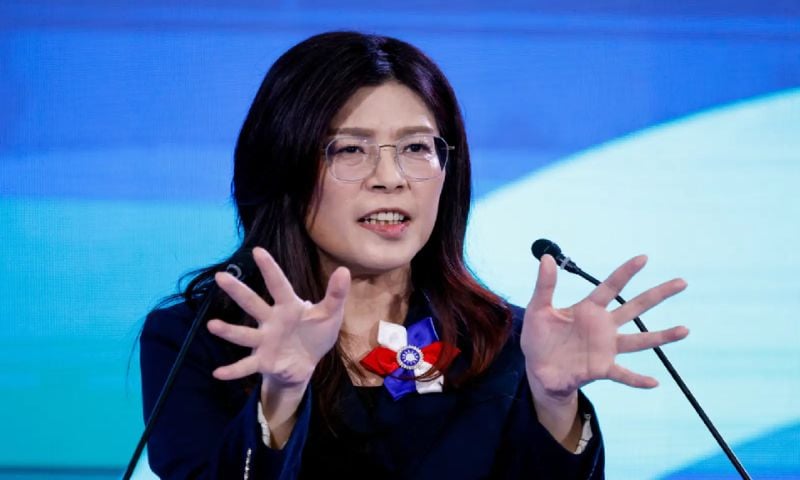
TAIPEI: Taiwan’s main opposition leader, Cheng Li-wun, is set to embark on a rare and politically sensitive visit to China on Tuesday, marking the first such trip by a sitting head of the Kuomintang (KMT) in nearly ten years.
The visit comes at a critical juncture in regional geopolitics, with rising military tensions across the Taiwan Strait and increasing pressure from the United States over defence cooperation with Taipei.
Cheng, who recently assumed leadership of the KMT, has framed the visit as an effort to promote “peace and stability” between Taiwan and China, according to AFP.
She has expressed willingness to meet Chinese President Xi Jinping, signalling an attempt to revive dialogue at a time when official cross-strait communication remains largely frozen.
However, the planned trip has triggered concern among Taiwanese officials and analysts, who warn that Beijing may seek to leverage the visit to strengthen its political influence within Taiwan.
Critics argue that China could use the engagement to bolster Cheng’s position domestically while simultaneously discouraging closer defence ties between Taipei and Washington.
China, which regards Taiwan as part of its territory and has not ruled out the use of force to achieve unification, has significantly increased military pressure on the island in recent years. Near-daily incursions by Chinese aircraft and naval vessels, along with large-scale military exercises, have deepened security concerns in Taipei.
Against this backdrop, the KMT has continued to advocate for improved relations with Beijing, positioning itself as a pro-dialogue alternative to the ruling Democratic Progressive Party (DPP).
Cheng’s outreach reflects this long-standing party stance, though it has also exposed divisions within the KMT itself over how best to address China’s growing assertiveness.
The visit also coincides with intensifying US efforts to push Taiwan’s opposition lawmakers to support substantial defence spending, including multi-billion-dollar arms purchases.
While Cheng has endorsed a scaled-down defence budget proposal, some senior KMT figures are calling for a more robust allocation to counter potential threats from China.
Taiwan’s Mainland Affairs Council has cautioned that Beijing’s invitation may be aimed at influencing domestic policy, particularly by discouraging Taiwan from pursuing military cooperation with the United States and other partners.
Officials argue that China is attempting to frame cross-strait issues as an internal matter, limiting external involvement.
Cheng has rejected such claims, insisting that her trip is solely focused on reducing tensions and fostering dialogue.
She has also maintained that Taiwan can pursue peace with China while retaining strong defence capabilities, arguing that the island need not choose exclusively between Beijing and Washington.
Public reaction in Taiwan remains divided. While some view engagement with China as a pragmatic step towards stability, others fear it could undermine Taiwan’s sovereignty and democratic values.
Analysts note that the visit could become a defining moment for Cheng’s leadership, shaping both her domestic standing and Taiwan’s broader strategic direction.
The development comes ahead of an anticipated meeting between US President Donald Trump and Xi Jinping, adding another layer of complexity to an already fragile geopolitical landscape.
Observers suggest that Beijing may use Cheng’s visit to project an image of influence over Taiwan and to challenge the rationale for continued US arms support to the island.
As cross-strait tensions persist, Cheng’s visit underscores the delicate balancing act facing Taiwan — navigating between engagement with China and reliance on US security backing, while managing internal political divisions at home.