
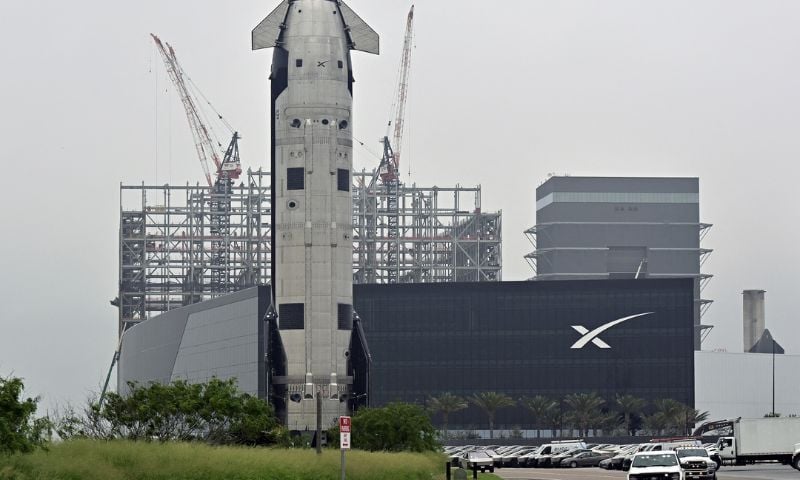
NEW YORK: A four-tonne upper stage of a SpaceX Falcon 9 rocket is believed to have crashed into the Moon on Wednesday in an unplanned impact that posed no threat to Earth but is expected to create a new lunar crater.
Although the impact had not been officially confirmed, the rocket stage was expected to strike the Moon’s northern hemisphere near the Einstein Crater at around 0635 GMT.
NASA’s Lunar Reconnaissance Orbiter and South Korea’s Pathfinder Lunar Orbiter are expected to image the impact site, although confirmation and photographs could take several days.
Scientists Await Impact Images
Astronomers had hoped to observe a plume of dust and debris produced by the collision, which occurred at an estimated speed of 8,690 kilometres (5,400 miles) per hour.
Benjamin Fernando, a researcher at Los Alamos National Laboratory and lead author of a recent study on the anticipated impact, said the event offered a rare scientific opportunity.
“It might be possible for people using telescopes to observe the plume of debris created by the impact,” Fernando said before the expected collision, adding that scientists were uncertain how bright the plume would be.
Researchers estimate the rocket stage weighed about 4,000 kilograms (8,800 pounds) after exhausting its propellant.
No Threat to Earth
NASA stressed that the impact posed no danger to Earth.
“There is no danger to Earth,” NASA spokesperson Jimi Russell said, adding that the agency would continue tracking the booster and later study the impact site for scientific purposes.
The Falcon 9 rocket launched in January 2025, carrying two lunar landers. While the first stage returned to Earth as planned, the upper stage remained in space after delivering its payload.
How the Collision Happened
SpaceX said the upper stage had initially been placed on a safe trajectory following standard procedures for high-energy missions.
Julianna Scheiman, Director of NASA Science and Dragon Programs at SpaceX, said the unexpected lunar impact resulted from a combination of solar activity and gravitational forces that gradually altered the rocket’s orbit.
She described the event as an unusual opportunity for scientific observation.
Rare Scientific Opportunity
Scientists say the impact could improve understanding of lunar surface processes, dust dynamics and the effects of artificial objects striking the Moon.
Researchers also hope the event will help refine techniques for locating future lunar impacts and contribute to preparations for sustained human exploration under NASA’s lunar programme.
Unlike natural meteoroid impacts, artificial collisions with the Moon are relatively rare. During the Apollo programme in the 1970s, NASA intentionally crashed spacecraft components into the lunar surface to collect seismic data.
Growing Concern Over Space Debris
The incident has also renewed attention on the increasing amount of space debris orbiting Earth.
According to the European Space Agency, more than 46,000 tracked pieces of space debris, with a combined mass of around 17,000 tonnes, are currently in orbit.
Scientists have warned that the continued accumulation of orbital debris could eventually trigger a chain reaction of collisions, known as the Kessler syndrome, posing a growing risk to future space missions.