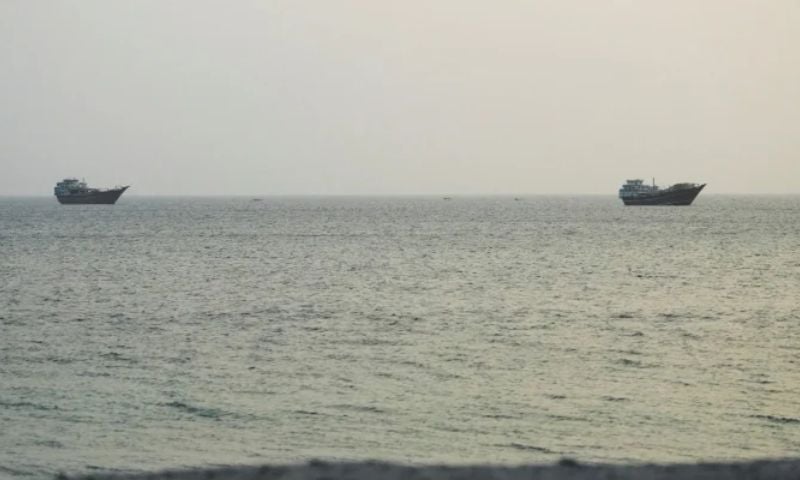
LONDON: Shipping companies are increasingly avoiding a US military-guided transit route through the Strait of Hormuz after a string of Iranian attacks on commercial vessels heightened concerns over crew safety and the security of global energy supplies.
According to maritime security and shipping industry sources, operators are reassessing the route along the Omani side of the strategic waterway following several attacks on vessels in recent days. Many companies now believe the US-backed arrangement no longer offers sufficient protection against escalating threats.
For decades, commercial vessels transited the Strait of Hormuz through internationally recognised shipping lanes established by the United Nations’ maritime agency in 1968 under the Traffic Separation Scheme.
However, since the outbreak of the Iran war on February 28, Iranian forces have reportedly mined parts of the central shipping corridor, forcing vessels to rely on alternative routes closer to the Iranian or Omani coastline.
The United States introduced a military-assisted transit system last month to help safeguard commercial shipping. The operation involved naval assets, helicopters, aerial drones and maritime surveillance to escort vessels through the narrow waterway while ensuring Gulf oil exports continued despite the conflict.
Although the initiative enabled the movement of millions of barrels of oil and helped reduce pressure on global energy markets, recent attacks have cast doubt over its effectiveness.
Iran’s Islamic Revolutionary Guard Corps (IRGC) claimed responsibility this week for attacks on two Emirati supertankers. Maritime incident data indicate that five commercial vessels — including three crude oil supertankers, one liquefied natural gas (LNG) carrier and one container ship — have come under attack in Omani waters since July 7. It remains unclear whether all were travelling under the US-coordinated transit scheme.
Several shipping companies have since decided to suspend voyages through the Strait, citing growing risks to crews. One industry source said operators no longer believed the security situation was under control and had chosen to avoid the passage altogether.
Torbjorn Solvedt, Principal Middle East Analyst at risk intelligence firm Verisk Maplecroft, said Iran’s ability to strike vessels using the Omani route suggested Washington’s strategy to maintain commercial traffic was unlikely to reassure the shipping industry.
Despite the attacks, the White House insisted the Strait of Hormuz remains open for international navigation. White House spokeswoman Olivia Wales accused Iran of targeting civilian shipping and described the attacks as acts of international terrorism, while maintaining that the United States continued to respond decisively.
A US defence official said more than 100 vessels had coordinated directly with the US military to transit the Strait over the past week, while more than 300 ships had passed through the wider region. Although shipping volumes remain below pre-war levels, the official argued the escort operation was still enabling commercial traffic to move.
Tensions escalated further after the United States reimposed a naval blockade on Iranian-linked shipping. Tehran subsequently warned it could disrupt additional regional energy exports and signalled it might employ its Houthi allies in Yemen to threaten shipping through the Bab el-Mandeb Strait, another vital maritime gateway linking the Red Sea with international trade routes.
Shipping sources also said around nine Greek-operated LNG carriers that recently entered the Gulf remained unable to depart because of security concerns. Two additional tankers have reportedly been attacked in waters outside the Strait since July 7.
US President Donald Trump said on Tuesday that the Strait of Hormuz remained open to all commercial shipping except vessels linked to Iran. Last week, the US Navy-led Joint Maritime Information Center raised its threat assessment for shipping in the Strait to “severe”, one level below its highest warning of “critical”, following repeated attacks on commercial tankers.
Maritime security companies have also urged extreme caution. Greek security firm Diaplous advised shipping companies to postpone voyages through the Strait until at least Saturday, while MARISKS warned there was currently no assurance that transits could be conducted with an acceptable level of safety.
Industry experts say the latest attacks have intensified uncertainty across the global shipping sector, raising fresh concerns over the resilience of international energy supply chains if the conflict continues to expand.