
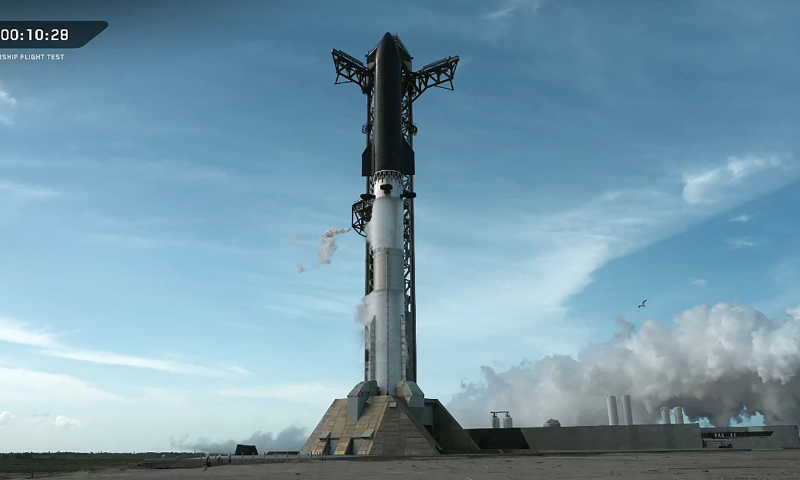
ISLAMABAD: SpaceX on Thursday scrubbed what was to have been its first Starship flight since the company went public, abruptly calling off the launch moments before liftoff after an automatic abort was triggered during booster ignition.
The launch was halted at SpaceX’s Starbase facility in Texas when some of the rocket’s Raptor engines failed to start properly, prompting onboard systems to terminate the countdown automatically.
“Some of the engines didn’t start, triggering an automatic launch abort. Now offloading propellant,” SpaceX founder and chief executive Elon Musk said in a post on X.
Musk later said engineers had identified the problem and would replace two Raptor engines before attempting another launch.
SpaceX reschedules launch for next week
“To be confident of a good flight, 2 Raptors will be removed & replaced. Most probable launch timing is early next week,” he wrote.
The mission would have marked the 13th overall test flight of Starship, the world’s largest and most powerful rocket system. It was also set to be the first Starship launch since SpaceX completed its highly anticipated stock market debut in June.
When it eventually flies, the objectives are expected to mirror those of the previous test mission conducted in May, which featured the latest third-generation version of Starship.
That flight was largely successful, demonstrating several design improvements, although it encountered issues with the Super Heavy booster during its return phase.
ALSO READ: Elon Musk’s SpaceX Starship Soars in Successful Test Flight
Engine-related problems during the May mission prevented a precision recovery of the booster, forcing it to splash down in the Gulf of Mexico rather than complete its intended landing sequence.
SpaceX said engineers have since introduced “several modifications to hardware and software” to address shortcomings observed during the earlier test.
The company aims to complete a full launch profile on the next attempt, including ascent, stage separation, boostback burn and booster landing operations without anomalies.
Success would further validate upgrades made to both the Super Heavy booster and the Starship upper stage.
The upper-stage spacecraft is scheduled to deploy 20 Starlink Version 3 satellites into orbit, advancing SpaceX’s rapidly expanding satellite internet network.
The mission will also test the relight of a Raptor engine in space, a capability considered critical for future deep-space missions.
In addition, engineers plan to evaluate upgrades to Starship’s heat shield, an essential component for surviving atmospheric re-entry and enabling the vehicle’s long-term reusability.
The test was an important moment for SpaceX following its public listing. Investors have closely watched the company’s progress as it expands beyond satellite communications and pursues ambitious plans involving artificial intelligence infrastructure and space-based data services.
Thursday’s setback also carries significance for NASA, which has contracted SpaceX to develop a modified Starship vehicle for use as a lunar lander under the Artemis programme.
The spacecraft is expected to play a central role in returning astronauts to the Moon later this decade.
Although the latest delay is unlikely to significantly alter SpaceX’s overall development timeline, the aborted launch underscores the technical challenges involved in building a fully reusable heavy-lift rocket capable of supporting commercial, scientific and human exploration missions beyond Earth orbit.
Starship is central to SpaceX’s long-term ambitions of dramatically lowering the cost of access to space through a fully reusable launch system.
Standing about 123 metres tall when combined with the Super Heavy booster, the rocket is designed to carry larger payloads than any existing launch vehicle and eventually transport astronauts to the Moon and Mars.
Since its first integrated test flight in 2023, the programme has recorded a series of successes and setbacks, with each mission aimed at validating technologies needed for routine deep-space operations.