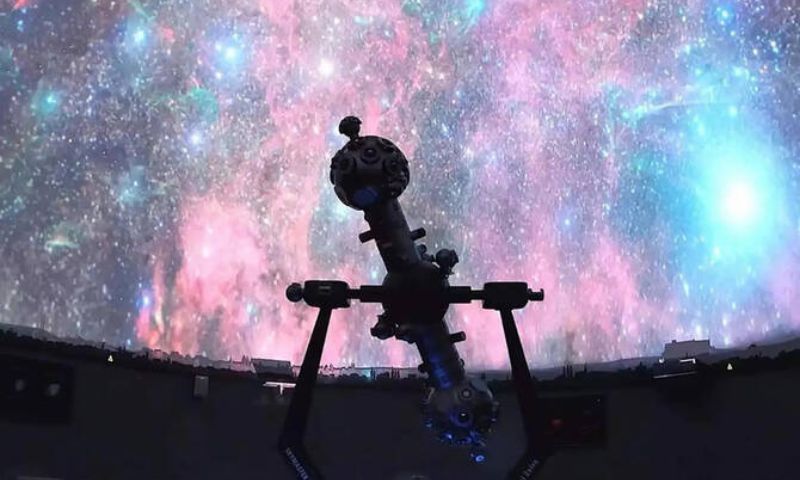
RIYADH: Saudi Arabia is strengthening its reputation as one of the region’s leading destinations for stargazing, with a packed calendar of celestial events and some of the Middle East’s clearest night skies drawing increasing interest from astronomy enthusiasts.
According to the Jeddah Astronomy Society, August will offer a series of notable astronomical events, including the annual Perseid meteor shower, a deep partial lunar eclipse and excellent opportunities to observe several bright planets, making it one of the busiest months of the year for skywatching.
Although the total solar eclipse on August 12 will not be visible from Saudi Arabia, as its path of totality will pass over parts of Russia, Greenland, Iceland and Spain, astronomers noted that the Kingdom is preparing for a spectacular total solar eclipse on August 2, 2027, when some regions are expected to experience more than six minutes of total darkness.
The main attraction for observers in Saudi Arabia this month will be the Perseid meteor shower, which is forecast to reach its peak on the nights of 12 and 13 August. With little or no moonlight expected to interfere, skywatchers in remote desert locations could witness as many as 100 meteors per hour under favourable weather conditions.
The month will conclude with a deep partial lunar eclipse on August 27–28, during which approximately 93 per cent of the Moon’s diameter will pass through Earth’s shadow. The initial phases of the eclipse are expected to be visible from western parts of the Kingdom.
Astronomy enthusiasts will also have opportunities throughout the month to observe Venus, Jupiter, Saturn and Mars, while the night sky gradually transitions from the summer constellations to those associated with the approaching winter season.
READ ALSO: Saudi Arabia Wins Three International Awards at European Physics Olympiad 2026
Saudi Arabia’s growing appeal as a destination for astronomical tourism has been reinforced by a series of observations reported during July. In the Northern Borders Region, observers recorded the Milky Way’s spiral arm stretching prominently across the night sky above Umm Al-Asafir, south of Rafha, where exceptionally dark skies allowed thousands of stars and dense stellar clouds to be seen with remarkable clarity.
Experts say the Kingdom’s vast desert landscapes, characterised by minimal light pollution and dry atmospheric conditions, provide ideal settings for astronomical observation throughout the year.
Meanwhile, AlUla continues to combine science with cultural heritage by offering guided telescope-viewing sessions alongside traditional Bedouin storytelling that explains how ancient communities relied on the stars for navigation, agriculture and marking the changing seasons. These experiences are helping preserve centuries-old astronomical knowledge while promoting the region as a unique destination for astro-tourism.

Recent observations across the Northern Borders Region have also included sightings of the Summer Triangle, a close approach between the Moon and the bright star Antares, and clear views of the constellations Ursa Major and Capricornus. In Rafha, observers witnessed a rare alignment involving the Pleiades and Hyades star clusters alongside Mars and the bright star Capella.
Officials believe the combination of world-class observing conditions, expanding public interest in astronomy and the preservation of traditional celestial knowledge is positioning Saudi Arabia as a year-round hub for both scientific observation and astro-tourism.