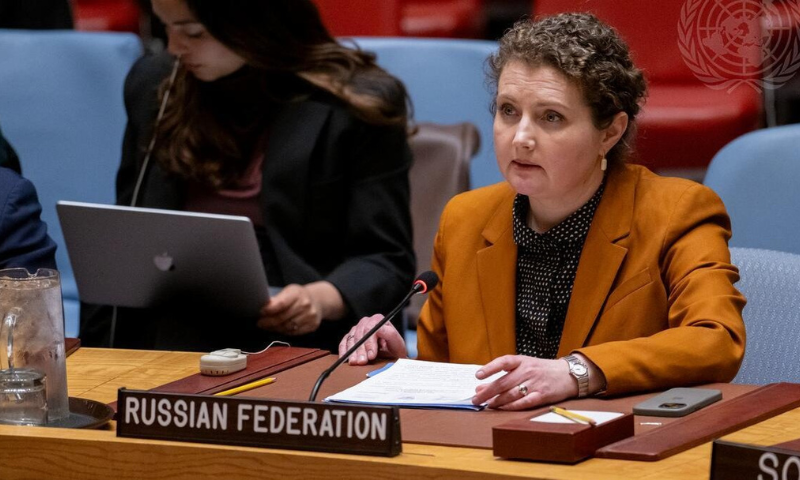
UNITED NATIONS: Russia has voiced concern over the security situation in Afghanistan, warning the United Nations Security Council that terrorist groups, including ISIS-Khorasan (ISIS-K), the Tehreek-e-Taliban Pakistan (TTP) and other foreign militants, continue to pose a serious threat to regional stability.
Addressing a Security Council briefing on Afghanistan, Russia’s Deputy Permanent Representative Anna Evstigneeva said efforts by the Afghan authorities to counter terrorism remained insufficient, allowing extremist groups to strengthen their capabilities and expand their activities.
“Another source of concern is the continued presence of ISIL-Khorasan in Afghanistan,” she told the council. “Unfortunately, the efforts undertaken by the authorities to combat terrorist threats are currently insufficient.”
Concerns over ISIS-K and TTP
The Russian diplomat warned that ISIS-K was consolidating its position by recruiting new members and securing financial support, while continuing efforts to destabilise Afghanistan and the wider region.
She said the group was exploiting the presence of militants belonging to the TTP and the East Turkestan Islamic Movement (ETIM), also known as the Turkistan Islamic Party, to advance its objectives.
“Terrorists are exploiting every opportunity to destabilize the situation in the country and the region as a whole,” Evstigneeva said.
She added that Moscow remained concerned about foreign terrorist fighters who had gained combat experience in Syria and Iraq and could contribute to regional insecurity.
“It is clear that ISIL has not abandoned its plans to establish a Caliphate 2.0,” she warned.
Weapons left behind by NATO
Russia also highlighted concerns over the fate of military equipment left behind following the withdrawal of US-led NATO forces from Afghanistan in 2021.
Evstigneeva said the “unclear status” of weapons abandoned by NATO troops continued to aggravate the security situation and could potentially benefit militant groups operating in the country.
Drug trafficking remains a major challenge
Alongside terrorism, Russia identified narcotics trafficking as another major challenge facing Afghanistan and the wider region.
While acknowledging what she described as Taliban successes in reducing opium poppy cultivation, Evstigneeva warned that the production of synthetic drugs was emerging as an even greater threat.
“The drug issue is another pressing problem, and it is closely linked to terrorism,” she said.
She called for intensified efforts to combat synthetic narcotics and urged broader regional and international cooperation, including through the United Nations Office on Drugs and Crime (UNODC).
Regional stability at stake
Russia’s remarks underscore growing international concerns about Afghanistan’s security landscape nearly five years after the Taliban returned to power.
The statement also reflects Moscow’s continued focus on the risks posed by extremist organisations operating from Afghan territory, particularly those with the potential to threaten neighbouring countries and fuel instability across Central and South Asia.