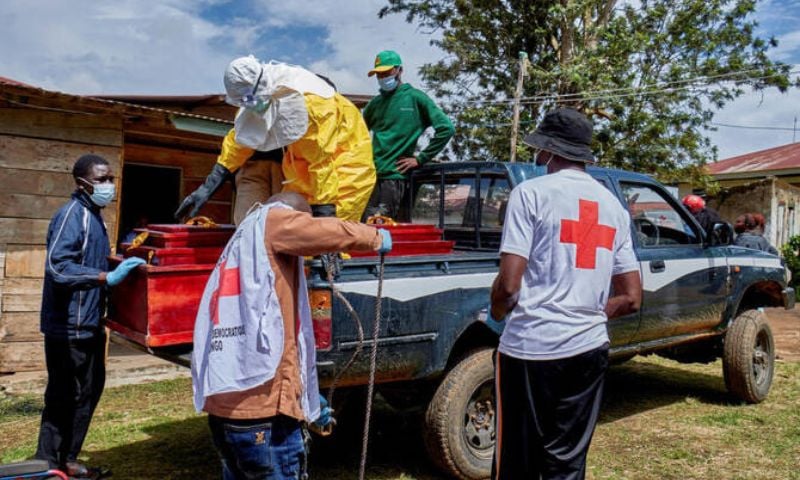
GENEVA: The Red Cross announced on Saturday that three volunteers had died in the Democratic Republic of Congo after apparently contracting Ebola while on duty in March.
The central African country has been gripped by an outbreak of the deadly viral disease which the World Health Organization (WHO) has declared an international public health emergency.
The International Federation of Red Cross and Red Crescent Societies (IFRC) said the volunteers were from the DR Congo Red Cross in the northeastern Ituri province.
They worked for the branch in Mongbwalu, considered the epicentre of the outbreak.
“Alikana Udumusi Augustin, Sezabo Katanabo and Ajiko Chandiru Viviane are believed to have contracted the Ebola virus on duty, while carrying out dead body management activities on March 27 as part of a humanitarian mission unrelated to Ebola,” the IFRC said in a statement.
“At the time of the intervention, the community was not aware of the Ebola virus disease outbreak, and the outbreak had not yet been identified. They are among the first known victims of the outbreak.”
The IFRC said one had died on May 5 and the other two on May 15 and 16.
“These volunteers lost their lives while serving their communities with courage and humanity,” the Geneva-based federation said.
“Their commitment reflects the extraordinary dedication shown every day by Red Cross volunteers working in complex and high-risk environments.”
Window for action ‘narrow’
The IFRC, which has more than 17 million volunteers in more than 191 countries, is the world’s largest humanitarian network.
It said it remained committed to supporting communities affected by Ebola and to strengthening efforts to respond to the outbreak.
There are 82 confirmed cases and seven confirmed deaths in the DR Congo, with almost 750 suspected cases and 177 suspected deaths, the WHO said on Friday.
The outbreak, which experts suspect was circulating under the radar for some time, is due to the less common Bundibugyo strain of Ebola, for which there are no approved vaccines or treatments.
The IFRC has launched an emergency appeal for 29 million Swiss francs ($37 million).
Gabriela Arenas, the IFRC’s Africa regional operations coordinator, said that in Mongbwalu, volunteers were knocking on doors, advising communities on how to protect themselves.
“Community reactions remain mixed,” she told reporters in Geneva on Friday, speaking from Nairobi.
“For some people, the outbreak is very real, and they are seeking information on how to protect themselves and their families. For others, there is still suspicion and misinformation with claims that Ebola is fabricated.”
She said that during an Ebola outbreak, trust and community acceptance could mean the difference between containment and wider transmission.
“This outbreak can still be contained, but the window for action is narrow. What happens in the coming days — in homes, in communities and across borders — will matter enormously,” she said.