
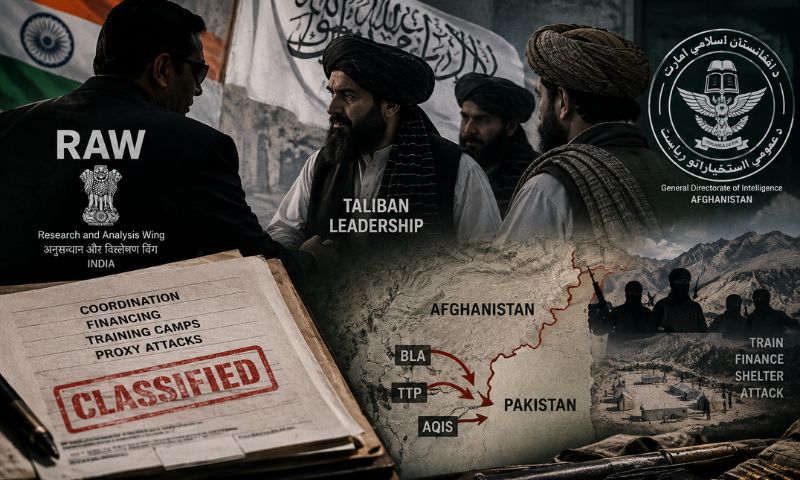
ISLAMABAD: Pakistani intelligence officials said India’s Research and Analysis Wing (RAW) and senior Taliban figures in Afghanistan are working through a network involving the Balochistan Liberation Army (BLA), Tehreek-e-Taliban Pakistan (TTP) and Al-Qaeda in the Indian Subcontinent (AQIS) to support attacks inside Pakistan.
The revelations are contained in a classified document reviewed by The News, which describes what Pakistani intelligence sources say is an operational arrangement involving training, financing, weapons and shelter for Terrorist groups operating against Pakistan.
According to the document, the BLA-TTP cooperation began taking shape around 2025, with Pakistani intelligence agencies saying Afghan training camps were being supported by Afghanistan’s General Directorate of Intelligence (GDI).
The document said senior Taliban leadership directed efforts to bring the BLA together with the TTP and other terrorist organisations, while Indian RAW helped facilitate contacts and external financing.
The News report identifies BLA and TTP as the principal Pakistani terrorist groups involved, while also placing AQIS within the same network.
The finding comes days after Pakistan told the UN Security Council that it had identified what its ambassador described as a “deep nexus” between the Afghan Taliban and terrorist groups including the TTP and BLA, while also referring to external actors supporting proxies in Afghanistan.
Meetings Detailed
The classified document provides dates and locations for several meetings that Pakistani intelligence officials say demonstrate the coordination.
It says a meeting took place in Kandahar on May 26 involving Mullah Shireen, the Taliban-appointed governor of Kandahar, and representatives of AQIS and TTP.
The document further describes three meetings in July, including a meeting at a TTP compound in Kandahar where money was transferred to Jamaat-ul-Ahrar.
It also disclosed that a subsequent meeting between RAW and the GDI chief, held outside Afghanistan, resulted in an agreement to finance coordinated BLA-TTP attacks in Balochistan.
According to the document, RAW provided more than $7.8 million for the operation.
Kandahar Summit
The document also describes an August 26 meeting in Kandahar involving senior figures associated with the BLA, TTP and AQIS.
According to Pakistani intelligence sources cited by The News, BLA representatives raised concerns about manpower shortages and were assured that TTP and AQIS fighters, weapons and logistical support would be made available for operations in Balochistan.
The document also cites a Taliban administrative directive ordering the release of weapons and ammunition to an organisation called the “Baloch Refugee Coordination Office”, which Pakistani intelligence sources describe as a front for the BLA.
Shared Operations
One of the document’s most serious findings is that TTP and AQIS fighters are carrying out some attacks publicly claimed by the BLA.
As an example, it cites the September 4 attack in Ziarat, which was claimed by the BLA but which Pakistani intelligence officials allege was actually carried out by TTP operatives.
The document names Mullah Merajuddin Farahi as a coordinator responsible for moving personnel, weapons and financing, while also alleging that recruits were being trained at an AQIS facility.
Islamabad’s Concerns
The new details emerged as Pakistan said that terrorist groups operating from Afghan territory are carrying out attacks inside the country.
At the UN Security Council this week, Pakistan said more than 4,700 Pakistanis had been killed in terrorism it attributed to Afghanistan over the previous three years and called for concrete action against terrorist groups operating from Afghan soil.
Pakistan has also repeatedly raised concerns over cooperation between terrorist organisations operating in Afghanistan and attacks in Khyber Pakhtunkhwa and Balochistan.
The latest disclosure emerges amid a sharp increase in terrorist violence in Pakistan’s north-western regions.
The Kohat Police Lines attack on Friday, which killed 31 people and injured more than 100, was followed by a more than 20-hour security operation in which all seven attackers were killed by Pakistani security forces.
Pakistan has increasingly linked the broader terrorist threat to sanctuaries and logistical networks inside Afghanistan.