
Key Points
- Oregon State researchers detected damage using satellite radar analysis
- Targets included an air base, intelligence centre, and logistics site
- IDF declined to comment on missile damage or interception rates
- Thirty-six other strikes hit Israeli residential and industrial zones
- Interception rate dropped as Iran used better missile tactics
- US fired 36 costly THAAD interceptors during the conflict
- Israel’s ‘impenetrable’ defences breached
- Iran used drones with missiles to overwhelm defence systems
- Only 25–30 per cent of Iran’s missile arsenal reportedly used
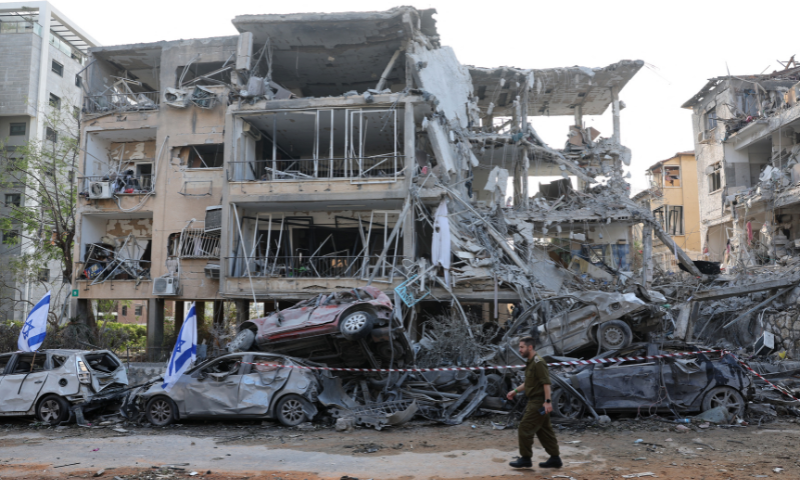
ISLAMABAD: Iranian missiles appear to have directly struck five Israeli military facilities during the recent 12-day conflict, according to a detailed report published by The Telegraph, which cites radar data shared by American researchers.
The strikes, which reportedly include hits on a major air base, an intelligence centre, and a logistics site, have not been publicly acknowledged by Israeli authorities. As The Telegraph notes, strict Israeli military censorship laws prohibit such information from being reported domestically.
The data were provided to The Telegraph by academics from Oregon State University who specialise in analysing satellite radar imagery to detect structural damage in conflict zones. Their assessment suggests that six Iranian missiles successfully hit five undisclosed military targets spread across northern, central, and southern Israel.
When contacted by The Telegraph, the Israel Defence Forces (IDF) declined to comment on specific interception statistics or the extent of damage to military facilities. However, a spokesperson did state that “all relevant units maintained functional continuity throughout the operation.”
According to The Telegraph, these military strikes are in addition to 36 known successful Iranian missile impacts on residential and industrial sites across Israel. While widespread property damage was reported, only 28 Israeli casualties occurred — largely due to the country’s advanced early-warning systems and widespread public adherence to shelter protocols.
The Telegraph’s analysis indicates that although the majority of Iranian missiles were intercepted, the success rate of Israel’s defence systems diminished over the first eight days of the conflict. Experts cited by the outlet suggest several potential factors, including the rationing of interceptor missiles and Iran’s use of more advanced or better-coordinated attack strategies.
Israel’s layered air-defence system includes the Iron Dome (for short-range threats), David’s Sling (for medium-range), and the Arrow system (for long-range ballistic missiles). These were bolstered during the conflict by US-operated Terminal High Altitude Area Defence (THAAD) missile-defence systems and ship-based interceptors in the Red Sea. According to The Telegraph, the US launched at least 36 THAAD interceptors during the war, each costing approximately $12 million.
Despite these defences, the notion that Israeli systems are impenetrable has been challenged. The Telegraph reports that by the seventh day of fighting, about 16 per cent of incoming Iranian missiles were breaching the joint US-Israeli shield — a figure roughly in line with the IDF’s own stated 87 per cent success rate.
Public suspicion within Israel has grown regarding possible military damage. Prominent journalist Raviv Drucker of Channel 13 stated last week, as quoted by The Telegraph, “There were a lot of [Iranian] missile hits in IDF bases, in strategic sites that we still don’t report about to this day… It created a situation where people don’t realise how precise the Iranians were and how much damage they caused in many places.”
Corey Scher of Oregon State University told The Telegraph that his team was preparing a comprehensive damage report for both Israel and Iran, expected to be released within two weeks. He added that while satellite radar can indicate blast damage, confirmation of specific military site hits would require ground verification or high-resolution imagery.
Iran, meanwhile, has used the footage of missile strikes for domestic propaganda, claiming it successfully pierced Israel’s defences. The Telegraph notes that Iranian media has broadcast cartoons mocking the Iron Dome, set to revolutionary songs and footage of missiles landing in Israeli cities.
Iranian officials claim their success relied on the combined use of drones and ballistic missiles to overwhelm defence systems. One Iranian official told The Telegraph: “The main goal of firing [suicide drones] at Israel is always to keep their systems busy… Many don’t even get through – they’re intercepted – but they still cause confusion.”
On Iranian state television, Major General Ali Fazli of the Islamic Revolutionary Guard Corps (IRGC) claimed that the Islamic Republic had reached its highest-ever level of military readiness. However, The Telegraph notes that despite this rhetoric, Israel managed to inflict serious damage on Iran’s military leadership and nuclear infrastructure during the conflict.
Still, Iran’s missile arsenal remains largely intact. According to an Israeli military official quoted by The Telegraph, about half of Iran’s estimated 400 missile launchers were destroyed, though many operational missiles remain.
The official stated, “We assessed that Iran had approximately 2,000 to 2,500 ballistic missiles at the beginning of this conflict. However, they were rapidly moving towards a mass-production strategy, which could see their missile stockpile grow to 8,000 or even 20,000 missiles in the next few years.”
Meanwhile, Gen Fazli claimed that Iran’s network of underground “missile cities” remains untouched. “We have not yet opened the doors of even one of our missile cities,” he said, adding that Iran had only used about 25 to 30 per cent of its missile capabilities during the war and that production was ongoing.