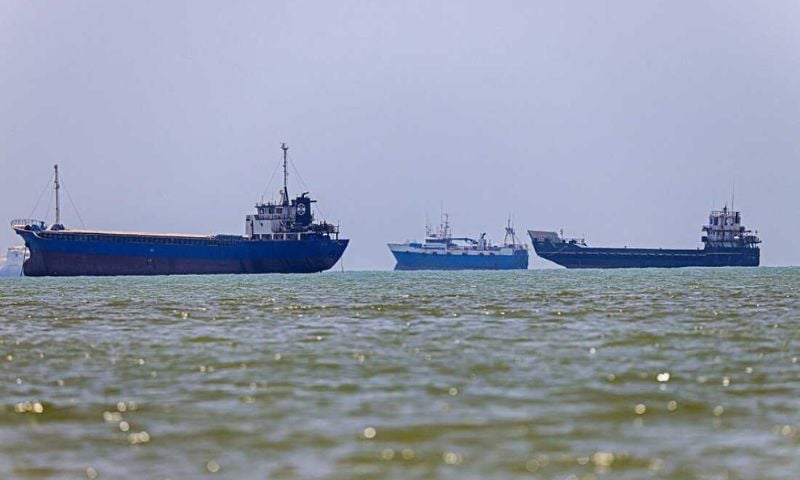
WASHINGTON: The International Monetary Fund (IMF) warned on Wednesday that the global economy has become increasingly vulnerable to prolonged energy supply disruptions as renewed escalation between the United States and Iran threatens oil shipments through the Strait of Hormuz, a critical artery for global energy trade.
The IMF said the world economy had so far weathered the conflict better than initially feared because oil prices had not risen as sharply as expected.
However, it cautioned that depleted global oil inventories have left markets with limited capacity to absorb any prolonged disruption.
“The impact of the conflict on the global economy has been smaller than feared when it began in late February,” Christian Mumssen, the IMF’s Director of Strategy, said.
Asked whether the renewed fighting between Washington and Tehran could force the Fund to revise its forecast of 3% global growth in 2026, Mumssen said it was too early to determine the impact.
“Internally, we will have to continue to think in scenarios. And for some countries, the question of energy prices… is, of course, extremely important,” he said.
Oil buffers running low
In a blog published on Wednesday, IMF economists Jean-Marc Natal and Azim Sadikov said the global economy had been shielded from a severe oil price shock by a combination of weaker demand, higher oil production outside the Gulf and substantial drawdowns in global oil inventories.
Before the conflict began, global oil supply exceeded demand by around two million barrels per day, allowing markets to absorb the initial shock, the IMF said.
The economists noted that the closure of the Strait of Hormuz had disrupted approximately 20 million barrels of crude oil and refined petroleum products per day, making it the largest disruption to global oil markets in decades.
Despite the scale of the disruption, benchmark crude prices have remained within a range of about $90 to $100 per barrel, well below levels seen during previous oil crises.
“The success, however, has a cost,” the IMF said in its analysis.
“With buffers now depleted, the system is more exposed if disruptions persist or escalate anew, and rebuilding stocks will keep the market tight even as supply recovers.”
Three factors softened the shock
According to the IMF, three factors prevented a more severe impact on the global economy.
First, demand weakened, particularly in Asia, where consumers shifted towards coal and renewable energy as oil prices rose.
The Fund noted that transport fuel demand remained comparatively resilient because many governments introduced subsidies, tax rebates and fuel price caps.
Second, oil production outside the Gulf increased by nearly two million barrels per day compared with 2025 levels, led by the United States alongside Venezuela, Guyana and Russia.
Third, the remaining supply shortfall was largely covered by drawing down commercial and strategic oil reserves.
The IMF estimated that a market deficit averaging around four million barrels per day between March and May was almost entirely met through inventory withdrawals.
The Fund warned that this strategy had sharply reduced global oil stockpiles.
According to the IMF, global reserves had fallen to an estimated 1.2 billion barrels by the end of May, around half the level recorded before the conflict began.
“That cushion, however, has been spent,” the Fund said.
“If the disruption were to persist at current rates, that lower bound would be reached by early 2027.”
It warned that well before inventories reached critically low levels, oil prices would likely rise sharply because markets would effectively be operating without a safety net.
The IMF also estimated that more than 1.1 billion barrels of crude had failed to reach global markets by the end of May.