
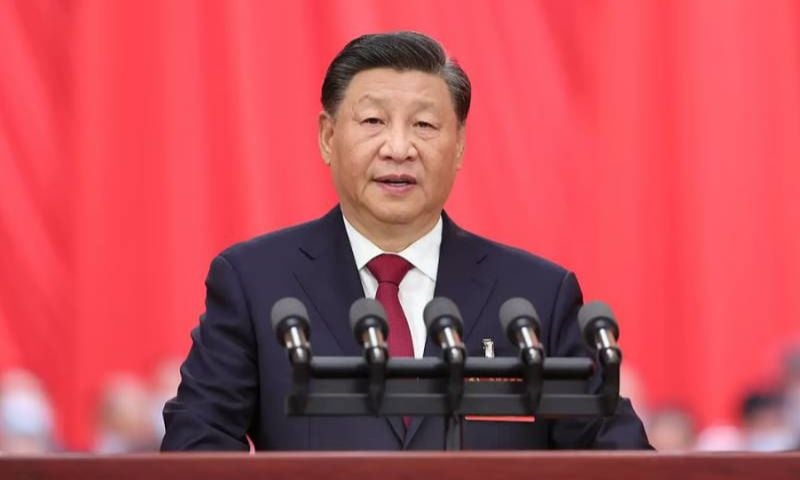
SHANGHAI: Chinese President Xi Jinping on Friday called for greater international cooperation in the development and governance of artificial intelligence (AI), warning that the technology should not be controlled or dominated by any single country.
Addressing the opening session of the World Artificial Intelligence Conference (WAIC) in Shanghai, Xi said AI should be developed through collective global efforts rather than unilateral dominance, as competition between China and the United States over advanced technologies continues to intensify.
“AI development should not be a solo performance by a single country, but a symphony of international cooperation,” Xi said. He also cautioned against expanding the concept of national security in ways that restrict technological collaboration or place one nation’s security interests above those of others.
His remarks come amid ongoing US and European restrictions on exports of advanced semiconductor and AI technologies to China over national security concerns. At the same time, debates within the United States over regulating powerful AI systems have highlighted growing concerns about who controls the world’s most advanced technologies.
Xi emphasised the need for a balanced regulatory framework to address the risks posed by AI, including its potential use in military operations, cyberattacks and terrorism.
“We should establish sound laws and regulations, technological monitoring, early warning mechanisms and emergency response systems to ensure AI always remains under human control,” he said, advocating a people-centred approach to AI governance.
The four-day WAIC has brought together more than 1,000 Chinese technology companies, government officials, researchers and industry leaders, with around 3,000 AI-related products on display. Exhibits range from advanced semiconductor platforms for AI computing to autonomous smartphones capable of independently operating applications.
A day before Xi’s address, foreign ministers and representatives from 29 countries, including Pakistan, Russia and Indonesia, agreed to establish the World Artificial Intelligence Cooperation Organization, an intergovernmental body headquartered in Shanghai. According to Chinese state media, the organisation aims to promote the healthy, orderly and inclusive development of AI through international collaboration.
AI entrepreneur and Praxis Advisory founder Shengyun Lu said China is seeking to lead not only in AI innovation but also in shaping global governance standards.
He argued that AI should be regulated with safeguards comparable to those applied to nuclear technology, while noting that Western countries were absent from the new initiative because the European Union has already introduced its own AI regulatory framework and the United States is developing separate rules.
Arun Sundararajan, a professor of business and technology at New York University, said recent signs of improved engagement between Chinese and US leaders were encouraging but suggested that a single global framework for AI governance remains unlikely in the near future.
The conference also showcased the rapid progress of China’s AI industry. Beijing-based startup Moonshot AI unveiled its flagship Kimi K3 model, claiming frontier-level performance, while companies including MiniMax and Huawei presented new AI systems designed for large-scale deployment.
Industry analysts said the focus of this year’s conference has shifted from developing AI models to deploying practical AI systems capable of supporting everyday applications across industries.
Chinese officials also reported that daily AI usage in the country, measured in processing tokens, has surged roughly a thousandfold over the past two years, reflecting the technology’s rapidly expanding adoption.
Meanwhile, Chinese open-source AI models are gaining traction internationally. Companies such as Germany’s Siemens are increasingly adopting them, citing lower costs, strong performance and greater flexibility compared with the closed AI systems offered by leading US firms.
The debate over AI governance has intensified globally after some advanced AI models developed by US companies were temporarily withheld from public release due to concerns that they could be exploited to assist cyberattacks on critical infrastructure.
Researchers attending the conference argued that broader international cooperation could help prevent AI capabilities from becoming concentrated in the hands of a small number of governments or companies, while encouraging wider access to the technology under responsible oversight.