


ISLAMABAD: Pakistan has recorded a significant 9-percentage-point decline in child stunting rates over the past six years, offering compelling evidence that the country’s fight against malnutrition is gaining ground even as challenges remain overwhelming.
The decline, from 36 percent in 2018 to 27 percent currently in Punjab province alone, represents millions of children spared from the lifelong consequences of stunted growth and cognitive impairment.
This progress, highlighted at a major international conference in Islamabad this week, signals that Pakistan’s nutrition interventions are working and that accelerated progress is achievable with sustained commitment.
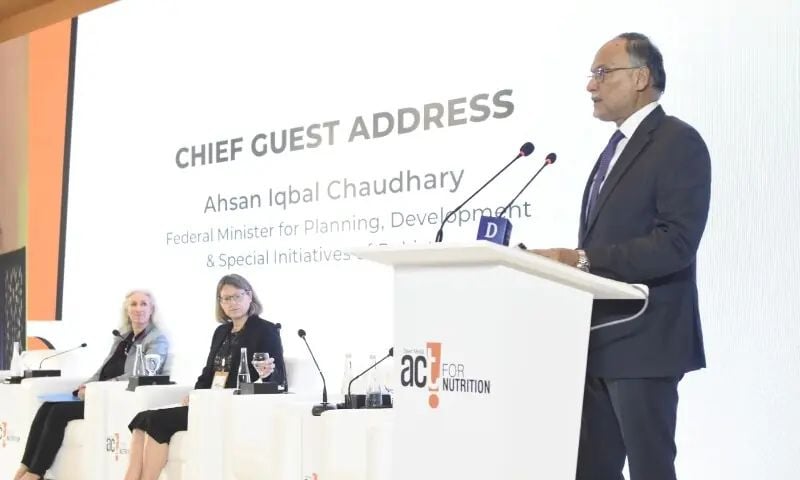
The ‘Act for Nutrition: The Emergency We Can No Longer Ignore’ conference brought together policymakers, international development leaders, and health experts from around the world.
Pakistan Planning Minister Ahsan Iqbal declared that Pakistan’s future is being built today, not in infrastructure projects, but in the health of mothers, the nutrition of infants, and the developing minds of young children.
Honored to represent Prime Minister Shehbaz Sharif this morning at the opening of the landmark #ACTForNutrition conference.
The Pakistan of 2047 is being built today—in the health of our mothers, the nutrition of our infants, and the developing minds of our youngest children.… pic.twitter.com/Uuc5dUUoIi
— Ahsan Iqbal (@betterpakistan) September 2, 2026
“Investment in nutrition is not charity, it is economic policy,” he said, stressing that Pakistan cannot win the 21st-century economic race if millions of children begin life several steps behind.
“Investment in nutrition is not charity, it is economic policy,” he declared, conveying Prime Minister Shehbaz Sharif’s firm commitment to addressing malnutrition as a national priority. “Every child nourished is protected, every child given a fair start brings Pakistan one step closer to the future we seek,” Iqbal said, calling on civil society and all stakeholders to work collectively toward this goal.
With 90 percent of brain development occurring by age five, chief guest of the conference Ahsan Iqbal urged collective action, calling on civil society to take up the issue. “Every child nourished is protected, every child given a fair start brings Pakistan one step closer to the future we seek,” he said, conveying Prime Minister Shehbaz Sharif’s firm commitment to making stunting reduction a national development priority.
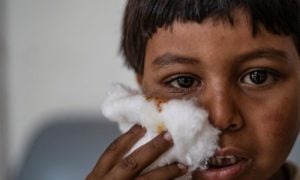
While the gathering did not shy away from the severity of the crisis, with 40 percent of children under five still stunted and malnutrition costing Pakistan $17 billion annually, it also celebrated tangible successes, declining rates, and a growing political consensus that the time for action is now.
“The situation is serious, but we are not without solutions,” declared Dawn CEO Nazafreen Saigol Lakhani in her closing statement. “Across Pakistan, we are seeing proven interventions that work, and they are already making a difference.”
Stunting rates showing steady decline
Punjab government’s special secretary Aurangzaib Haider Khan revealed that stunting among children under five in the province had fallen from 36 percent in 2018 to 27 percent currently, a significant 9-percentage-point improvement in just six years.
“Let me be direct on what has moved in this scenario: Stunting among children under five has fallen from 36pc in 2018 to 27pc now,” Khan told the conference. “This shows that when we invest in nutrition, when we prioritize it, we see results.”
While he acknowledged that approximately 5.5 million children across the province remained stunted, the downward trend demonstrates that Pakistan’s nutrition interventions are working.
Benazir Nashonuma Programme: A blueprint for success
The Benazir Nashonuma Programme (BNP) emerged as a standout success story, demonstrating that nutrition can be effectively integrated into national social protection systems. World Food Programme’s Country Director for Pakistan Anita Hirsch highlighted the programme’s achievements.
“BNP showed that nutrition can be integrated into national social protection. As we look ahead, one priority is to sustain those gains, continue to scale up and integrate services for millions of Pakistani women and children,” Hirsch said.
Tehmina Gulzar, deputy director of nutrition at the Benazir Income Support Programme, added that BISP had trained doctors, paramedical staff, and teachers on adolescent nutrition. “Social protection programmes can play a significant role in improving nutrition outcomes,” she said.
Political will and cross-government commitment
The conference witnessed unprecedented political engagement across party lines. Information Minister Attaullah Tarar declared that malnutrition was “not simply a health issue” but “a moral challenge, an economic imperative and a national emergency.”
“Behind every stunted child is potential that may never be fully realised. Behind every malnourished mother is a family at greater risk. And behind every year of inaction is another generation beginning life at a disadvantage,” Tarar said.
Khyber Pakhtunkhwa Chief Minister Sohail Afridi confirmed that facilitation centres were being established across the province to address malnutrition among pregnant women and young children.
Punjab government’s special secretary presented three actionable priorities: establishing common nutritional indicators for provincial comparison, recognizing nutrition as a provincial budgetary question, and integrating birth spacing into the nutritional agenda.
Multisectoral approach gaining traction
A recurring theme throughout the conference was Pakistan’s movement toward a coordinated, multisectoral response. Mian Muhammad Junaid, country director for WaterAid, acknowledged the challenge while expressing optimism.
“We are working in silos,” Junaid said. “But a child does not experience these boundaries. This is where Pakistan needs to move from talking about a multisectoral approach to actually financing and delivering one.”
Dr Saima Khan, a WASH policy specialist, called for targeting the 36 districts contributing most significantly to stunting. “Water quality was a big issue for Pakistan. The country’s northern areas had no infrastructure for sanitation or sewerage, deteriorating drinking water quality,” she said.
Read Also: Stolen Childhoods: How Stunting Shapes Lives in Pakistan
Knowledge gaps being addressed
Dr Farhana Memon, programme director of Reproductive, Maternal, Neonatal and Child Health, offered promising evidence that malnutrition is not solely a poverty issue.
“Whenever I ask a woman what she has eaten for breakfast, she will tell me she had tea and rusk. We have failed to convince her that she can get an egg for the same cost,” Dr Memon said. “Breastfeeding and micronutrient deficiencies — these are not poverty-related; it’s knowledge-related.”
This insight offers hope: if knowledge gaps can be filled through targeted awareness campaigns, nutrition outcomes can improve without requiring massive new financial investments.
Development partners pledge support
The conference heard strong commitments from international partners. Sara Shahzad, senior health specialist from the World Bank, confirmed that the organization had a 10-year partnership framework focused on stunting reduction.
“So the way the World Bank looks at population stabilisation and nutrition, specifically the stunting agenda, is through a human capital lens,” Shahzad said.
Communicating for change
Actress Sarwat Gilani emphasized the use of “intelligent marketing” to address societal issues. “If we have all the right creative minds along with experts, we can all sit down and come up with a strategic marketing campaign,” she said.
Journalist Zarrar Khuhro called for creating “critical mass at the family level” to generate public buy-in. “Malnutrition is a silent crisis,” Khuhro said. “You will see a press release perhaps, but that does not cause a conversation at the household level.”
Read Also: Asia-Pacific Houses Half of the World’s Hungry People
A framework for investment
Adnan Pasha Siddiqui, adviser to the minister of finance, offered a powerful reframing: “Every rupee that is withheld from a pregnant woman’s diet is a deduction from the country’s gross domestic product in the future.”
Adnan Pasha advisor to finance minister says Pakistan should declare nutrition a national emergency and make it an integral part of population planning, with dedicated nutrition-linked budgets at federal and provincial levels. Investing in nutrition is essential to building a… pic.twitter.com/WUHOTJxUIX
— Pakistan TV (@PakTVGlobal) September 3, 2026
He called for nutrition to be reclassified as a capital expenditure rather than an expense. “This single accounting decision suppresses the investment narrative permanently. These are fundamental flaws we need to correct,” Siddiqui said.
A message of hope
While Pakistan’s nutrition crisis remains severe, the conference offered compelling evidence that progress is possible. WHO Representative in Pakistan Dr Dapeng Luo stressed that while malnutrition remained the “greatest barrier” to development, solutions were within reach.
As WFP’s Hirsch concluded: “It takes a village; it is our collective responsibility, and it is also a national emergency and one that we must collectively address.”
Information Minister Tarar captured the conference’s hopeful tone: “This should not be a one-off event. It should be an action plan which we can implement throughout the year.”
With continued commitment, sustained investment, and coordinated action, the goal of eliminating malnutrition in Pakistan is achievable. The 9-percentage-point decline in stunting rates stands as proof that Pakistan can make progress, and with momentum building, the nation is poised to accelerate its fight against one of the most devastating crises of our time.