
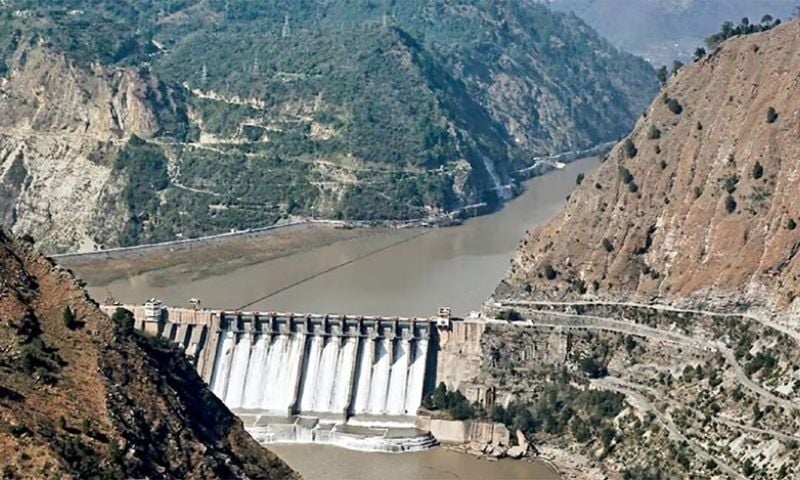
ISLAMABAD: Pakistan on Monday welcomed the unanimous ruling by a Hague-based Permanent Court of Arbitration that India’s unilateral act of holding the Indus Waters Treaty (IWT) in abeyance was not permissible and that the treaty remains fully in force.
The Court of Arbitration on Monday rejected India’s unilateral act of holding the Indus Waters Treaty in abeyance and reaffirmed that the Treaty between Pakistan and India remains fully in force.
The court ordered New Delhi to fully uphold the treaty and halt work on a controversial hydroelectric project in Indian Illegally Occupied Jammu and Kashmir.
The Permanent Court of Arbitration issued an award on the status of the Indus Waters Treaty between Pakistan and India. In a unanimous decision, the Court found that none of the grounds presented by India could justify suspension or termination of the Treaty.
The Arbitration Court said India had no grounds to suspend or terminate the 1960 water-sharing treaty with Pakistan and must continue to fulfil its obligations under the agreement.
The Government of Pakistan said it had taken note of a press release issued by the Court of Arbitration concerning its award on the status of the Indus Waters Treaty and its decision on interim measures in the dispute between Pakistan and India.
*Ministry of Information and Broadcasting, Government of Pakistan*
*Press Release*
The Government of Pakistan takes note of the Press Release issued a short time ago by the Court of Arbitration in The Hague in the Indus Waters dispute noting that it has today issued to the…
— Ministry of Information & Broadcasting (@MoIB_Official) August 31, 2026
Pakistan’s Ministry of Information and Broadcasting said the Arbitration Court had issued its award and decision to the parties.
Indus Waters Treaty Remains Fully in Force
According to the ministry, the Arbitration Court unanimously concluded that India’s decision on ‘abeyance’ of the Treaty is not permissible under the Treaty or other applicable rules of international law.
The court consequently determined “that the Treaty has not been terminated or its operation suspended and rather remains fully in force”, the ministry said.
The court ruled that “India remains bound by and must observe its obligations under the Treaty, including those relating to the design and operation of hydro-electric projects on the Western Rivers and associated dispute settlement,”.
“Pakistan welcomes this finding by the Court,” the ministry said.
The ministry stated that the Arbitration Court’s Press Release also made clear that the Court also decided unanimously to impose measures prohibiting India from concreting the RHEP dam wall and power intake structure above certain levels until 90 days after the Neutral Expert’s final decision, which is expected in July 2027.”
Further, the Court also “imposed a reporting measure relating to the Construction Schedule until shortly after the Neutral Expert’s final decision.”
The ministry stated that Pakistan welcomes this finding by the Court that interim Measures are warranted, as well as the measures ordered by the Court.
“The Government of Pakistan will now be giving careful consideration to the detail of the Award and Decision, pending their publication, and how these may best assist in finding a pathway back to the Parties’ engagement under the Treaty in a manner that reflects the binding legal obligations of both sides under the Treaty.”
Arbitration Court ruling rejects India’s unlawful act
Pakistan’s Deputy Prime Minister and Foreign Minister Ishaq Dar said Pakistan welcomes the unanimous award of the Court of Arbitration.
In a post on X, Deputy PM Dar said the award decisively rejects India’s unlawful attempt to place the Indus Waters Treaty “in abeyance” and reaffirms that the Treaty remains fully in force and binding on both parties.
Pakistan welcomes the unanimous Award of the Court of Arbitration today, which decisively rejects India’s unlawful attempt to place the Indus Waters Treaty “in abeyance” and reaffirms that the Treaty remains fully in force and binding on both parties.
The Award vindicates…
— Ishaq Dar (@MIshaqDar50) August 31, 2026
Ishaq Dar said it vindicates Pakistan’s consistent position that a binding international treaty cannot be unilaterally suspended or set aside.
He said India must fully comply with its obligations under the Treaty and with the binding decisions of its dispute settlement mechanisms.
The Deputy Prime Minister said Pakistan remains firmly committed to safeguarding its rights under the Indus Waters Treaty.
Court of Arbitration Ruling Deals Blow to India’s Unilateralism: Sherry Rehman
Meanwhile, Pakistan Peoples Party Vice President and Chairperson Senate Standing Committee on Climate Change Senator Sherry Rehman welcomed the latest ruling of the Permanent Court of Arbitration (PCA), terming it a strong reaffirmation of the continued validity of the Indus Waters Treaty (IWT) and Pakistan’s legitimate water rights.
Sherry Rehman said the ruling once again established that India cannot unilaterally suspend, disregard or reinterpret a binding international agreement. “The Permanent Court of Arbitration has once again reaffirmed Pakistan’s principled position that the Indus Waters Treaty remains in force. There is no provision in the Treaty that allows either party to unilaterally suspend or terminate it. International agreements cannot be held in abeyance at political convenience,” she said.
Serious win for Pakistan at the Permanent Court of Arbitration which unanimously ruled that India cannot unilaterally suspend, terminate or place the Indus Waters Treaty (IWT) “in abeyance.” All judges at The Hague ruled that The Treaty remains fully in force and binding on… pic.twitter.com/ByQe0sD1or
— SenatorSherryRehman (@sherryrehman) August 31, 2026
She said the decision was particularly significant in the context of India’s ongoing hydroelectric projects on the Western Rivers. “The PCA has made it clear that India’s hydroelectric projects must remain strictly within the parameters and exceptions provided under the Indus Waters Treaty. The Treaty is not subject to unilateral interpretation or discretion. Its provisions have to be respected in letter and spirit.”
Welcoming the direction limiting work on the Ratle hydroelectric project pending the determination of the Neutral Expert, Senator Rehman said Pakistan would continue to pursue its rights through established international legal mechanisms. “Pakistan has consistently chosen the path of law, diplomacy and institutional processes. We will continue to defend our water rights at every international forum, with a firm and unequivocal stance.”
Senator Rehman said the ruling also carried significance beyond the immediate dispute over individual hydropower projects. “The Indus is the lifeline of Pakistan. Water security is food security, economic security and increasingly climate security. At a time when Pakistan is already facing severe water stress and the region is on the frontlines of climate change, the weaponisation of water is neither sane nor acceptable.”
She said the IWT had survived wars and decades of political tensions because it provided a rules-based framework for managing a shared river system. “The Treaty has endured for over six decades because transboundary waters cannot be governed through unilateralism. Any attempt to politicise water or use it as a tool of diplomatic pressure threatens not only bilateral cooperation but regional peace and stability.”
Senator Sherry Rehman said India’s rejection of the ruling could not alter its obligations under international law. “A unilateral declaration cannot erase a binding international treaty. Pakistan has taken the legal route because the Treaty itself provides mechanisms for resolving such disputes. The repeated affirmation of its validity strengthens Pakistan’s position and demonstrates the importance of international law in protecting the rights of lower riparian states.”