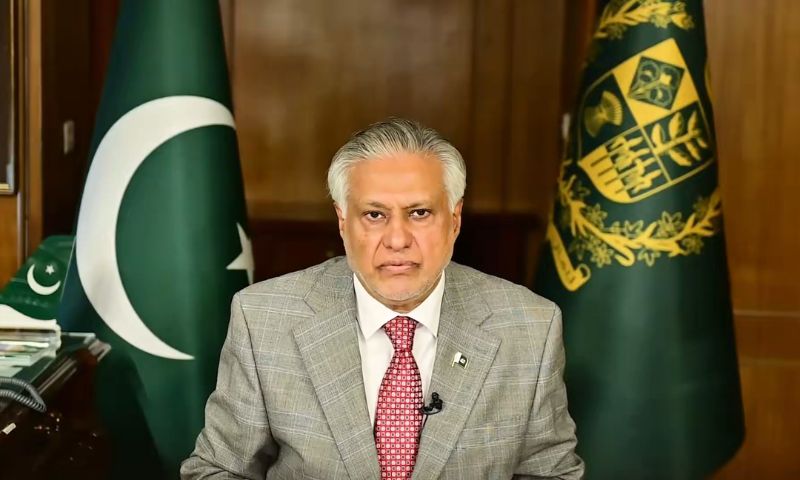
ISLAMABAD: Pakistan’s Deputy Prime Minister and Foreign Minister, highlighting India’s continuous violations of the Indus Waters Treaty, has said that water must never be viewed as an instrument of coercion.
Addressing virtually as a keynote speaker at the seminar titled “Transboundary Water Resources: A Weaponised Global Common,” the Deputy PM said water is a shared resource, a common responsibility, and ultimately a prerequisite for human dignity and sustainable development, according to the Foreign Office on Thursday.
Deputy PM Dar noted the future of transboundary water governance must therefore be anchored in cooperation and respect for international law.
The Deputy Prime Minister further added that Pakistan has consistently upheld the values enshrined in the UN Charter and has remained committed to its principles and relevant UN resolutions.
“It was in this spirit that Pakistan signed the Indus Waters Treaty with India in 1960, establishing a framework for the utilisation of the six rivers of the Indus River System,” he said.
He went on to say that the treaty envisages the peaceful resolution of disputes within its own framework. It is a testament to the enduring quality of the treaty that it survived three major conflicts and several other challenges over the decades.
“It is important to acknowledge that Pakistan has previously voiced concerns over certain actions by India under the Treaty. Consistent with the Treaty’s provisions, we sought settlement through international mechanisms and respected decisions even when they fell short of our expectations,” Ishaq Dar added.
Deputy Prime Minister/Foreign Minister, Senator Mohammad Ishaq Dar @MIshaqDar50 delivered a keynote address via a recorded video message at the Seminar “Transboundary Water Resources: A Weaponised Global Common”, organized by the Embassy of Pakistan in Brussels @PakinBrussels,… pic.twitter.com/ZEUEto9OCH
— Ministry of Foreign Affairs – Pakistan (@ForeignOfficePk) June 18, 2026
Pakistan’s top diplomat said that at no stage was the outright unilateral abrogation of the Treaty considered a viable course of action by either side.
“It is important to underscore that our concerns are not merely based on Indian statements. India has followed up its belligerent statements with illegal actions; these include projects to create reservoirs such as Sawalkot, Kirthai, Kwar, etc.; the expansion of existing structures such as Baglihar and Salal; and, most alarmingly, diversion projects on the Indus, Chenab and Ravi rivers,” he said.
Ishaq Dar said in total, at least 17 such projects that will drastically alter the river system as a whole, giving India the tools for “hydro-hegemony” that it so desires.
“Water must never be viewed as an instrument of coercion. It is a shared resource, a common responsibility, and ultimately a prerequisite for human dignity and sustainable development,” he remarked.
The Deputy Prime Minister, in his remarks, said transboundary waters are a shared heritage that requires cooperative management and sustained dialogue. In the absence of agreed mechanisms and mutual trust, competing interests can transform these shared resources into sources of tension, conflict, and even weaponisation.
He stated that the sanctity of treaties constitutes a cornerstone of the international order. Across the world, and particularly in Europe, there are compelling examples of how the faithful implementation of transboundary water agreements has enabled states to manage shared resources cooperatively, strengthen regional stability, and promote collective prosperity. Respect for treaty obligations is therefore not merely a regional concern but a global imperative.
Ishaq Dar said the water crises confronting many regions today are often less a consequence of absolute scarcity and more a reflection of shortcomings in management, governance, and cooperation.
He noted that peaceful coexistence can only be sustained through adherence to treaties, agreements, and multilateral frameworks that allow states to address differences through cooperation rather than conflict.
He said Pakistan remains committed to resolving all issues through dialogue, diplomacy, and the mechanisms provided under international law.
“Our position is guided not by confrontation, but by the conviction that lasting solutions can only emerge through cooperation and respect for mutually agreed obligations,” he concluded.