
Key Points
- KSE-100 jumps 5,305.88 points in midday trade
- Asian and U.S. markets rebound on easing tensions
- Falling oil prices improve investor sentiment
- Investors eye central bank meetings and earnings
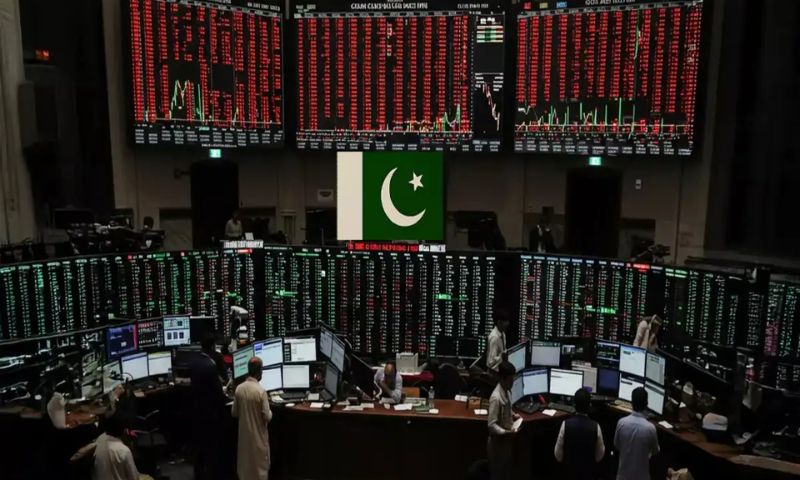
ISLAMABAD: Pakistan’s benchmark stock index staged a powerful comeback on Monday, rising more than 5,300 points or over three per cent in intraday trading as improving global sentiment, lower oil prices, and broad-based buying in heavyweights lifted the market after a turbulent week.
The benchmark KSE-100 Index of the Pakistan Stock Exchange (PSX) gained 5,305.88 points, or 3.10 per cent, to reach 176,327.08 points as of midday, recovering a significant portion of the losses recorded during the previous week.
The index touched an intraday high of 176,378.01 points and a low of 175,153.16 points, while trading volumes stood at 189.88 million shares. The market had closed at 171,021.20 points in the previous session.
Broad-Based Recovery
Market participants said the rally reflected a combination of bargain hunting and renewed confidence following signs of easing geopolitical tensions in the Middle East.
ALSO READ: Pakistan Stocks Post Weekly Loss Amid Geopolitical Jitters
Last week, the KSE-100 came under intense pressure as investors reacted to concerns over potential escalation involving the United States, Iran, and key shipping routes in the Arabian Gulf.
The uncertainty triggered a flight from equities globally, with Pakistan’s market among the worst affected due to its sensitivity to oil prices and external developments.
Monday’s recovery was led by buying in banking, energy, fertiliser, and cement stocks, with investors taking positions in blue-chip companies that had experienced sharp declines in recent sessions.
Analysts noted that the market’s fundamentals remain relatively supportive. They cited improving macroeconomic indicators, inflation declining from historical highs, and expectations of continued economic reforms under Pakistan’s ongoing engagement with international financial institutions.
Regional markets gain momentum
Pakistan’s gains mirrored an overall rebound across Asian markets, where investors welcomed the absence of fresh military escalation over the weekend.
Japan’s Nikkei index traded higher, supported by gains in technology and export-oriented stocks. Likewise, South Korea’s Kospi advanced on improved semiconductor sentiment. Australia’s S&P/ASX 200 also posted gains as lower energy prices boosted sectors exposed to domestic consumption.
Chinese equities were mixed but received support from the highly anticipated listing of ChangXin Memory Technologies. CXMT made a strong market debut following Asia’s largest initial public offering of the year. The company’s performance was viewed as a positive signal for investor appetite across regional markets.
Elsewhere, Hong Kong’s Hang Seng Index also moved higher as investors assessed the outlook for Chinese economic stimulus measures and global trade conditions.
Wall Street sets the tone
Internationally, U.S. equity futures pointed to a positive opening on Wall Street.
Nasdaq futures rose approximately 1.3 per cent, while S&P 500 futures gained about 0.8 per cent, reflecting growing optimism among investors ahead of a pivotal week for financial markets.
Investors are closely watching policy decisions from the U.S. Federal Reserve, the Bank of Japan, and the Bank of England. Any indications regarding the future path of interest rates could have significant implications for global capital flows, including investments in emerging markets such as Pakistan.
The week is also expected to be dominated by earnings reports from major technology companies, including Microsoft, Amazon, Apple, Meta Platforms, Nvidia, and Alphabet. Their results are likely to influence sentiment across global equity markets.
Oil prices ease
A major factor supporting equities worldwide was the sharp decline in crude oil prices.
Brent crude fell nearly 5 per cent, while U.S. West Texas Intermediate (WTI) dropped by a similar margin after reports suggested a pause in military activity involving Iran and a reduced likelihood of immediate disruptions to energy supplies.
Lower oil prices are generally viewed positively for Pakistan, which imports a significant portion of its energy requirements. A sustained decline in crude prices could ease pressure on the country’s import bill, inflation outlook, and external account position.
Outlook for Pakistan’s market
Despite recent volatility, the KSE-100 remains up 26.67 per cent over the past 12 months and has gained 1.31 per cent since the beginning of 2026. The benchmark continues to trade below its 52-week high of 191,032.73 points but remains well above its 52-week low of 137,636.37 points.
Analysts expect trading activity to remain elevated in the coming days as investors monitor global developments, corporate earnings announcements, and any signals from major central banks.
For now, Monday’s rally has provided investors with a measure of relief, underscoring the close relationship between Pakistan’s equity market and broader international trends at a time when geopolitical developments continue to shape financial markets worldwide.