ISLAMABAD: World T20 Champions India’s narrow two-run victory over Japan has been overshadowed by a controversial final over in which two consecutive deliveries were called wides before Indian players protested and the second umpire intervened, raising questions over whether the conduct crossed the line from disagreement into dissent under the ICC Playing Conditions.
Today Japan almost defeated India in a home match. India only won by just two runs. Our batter failed measurably. See at the last over. #INDvsJPN pic.twitter.com/rMcViJ0BP1
— Rosesh (@roseshpoet) September 22, 2026
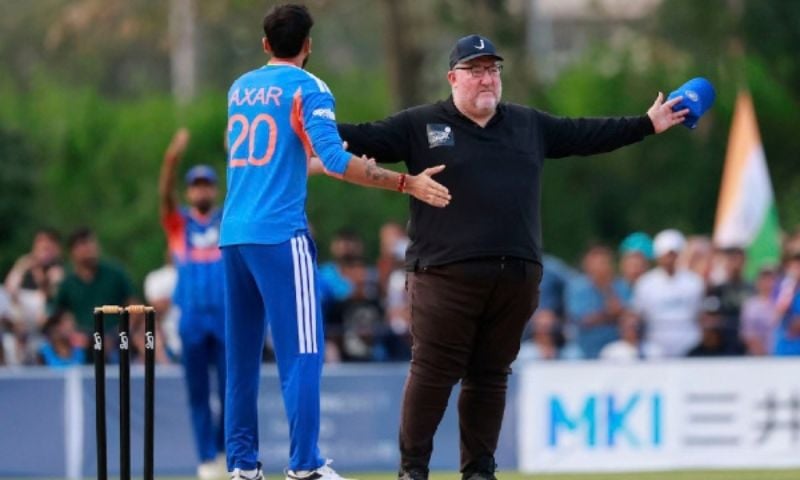
The controversy began when Axar Patel bowled the third ball of the final over with Japan needing eight runs from four deliveries. Umpire Chris Thurgate called the delivery a wide after Japan batter Alexander Shirai-Patmore attempted a reverse hit. Indian players immediately expressed their disagreement with the decision.
India bullied the umpire into overturning the wide decision. Japan were robbed here.
World champion India with top team won against #Japan by pressurising Umpires. pic.twitter.com/4eGuOLzCyk
— Abu Zaid Sarooji (@Sarooji_) September 22, 2026
The very next delivery produced another wide call in similar circumstances, with Shirai-Patmore again attempting a reverse stroke. The back-to-back decisions intensified the Indian players’ protests, with the disagreement continuing before leg umpire Chris Brown intervened and advised Thurgate to reconsider the second call.
Thurgate subsequently reversed the decision, meaning Japan’s equation changed from six runs off four balls to seven off three. India eventually held on to win the rain-reduced five-over contest by two runs, with Japan finishing on 30 after India posted 32.
India just stole the match from Japan.
With 5 needed off 4 for the biggest upset in cricket history, India bullied the umpires into overturning a clear wide call. It was wide. Plain and simple. Japan deserved that upset.
BCCI is the richest cricket board on the planet .. they…— Bobde Dada (@Bobde_dada) September 22, 2026
Two wides, repeated protests and Article 2.8
The sequence has prompted debate about whether the Indian players’ reaction could attract attention under Article 2.8 of the ICC Playing Conditions, which deals with showing dissent at an umpire’s decision.
Umpires overturning a wide decision without a review or replay, simply because Indian players asked for it.
What a low. This is more shameful than losing to Japan.pic.twitter.com/X2zhpsiSCf https://t.co/6OHZlMYcsH
— Ragav X (@ragav_x) September 22, 2026
The provision covers conduct including “excessive, obvious disappointment” with an umpire’s decision and “arguing or entering into a prolonged discussion with the Umpire about his/her decision.”
The important issue is therefore not simply whether the two wide decisions were correct, but how far the Indian players went in challenging them. A player can legitimately question or express disappointment over an umpiring decision, but repeated collective protests directed at an official can come under scrutiny if they become excessive or prolonged.
Shameful from Indian team to bully the umpire so that they could win against Japan who was literally playing their first game against a big team.
Absolute bullies. pic.twitter.com/byOEkEIbig
— yang goi (@GongR1ght) September 22, 2026
Was the umpire pressured into changing the call?
The fact that the second umpire intervened and the decision was subsequently changed has sparked debate on social media that the Indian players put excessive pressure on the official.
Cricket experts and social media users describing the incident as “bullying”; however, sooner or later, match referee or ICC will determine that the players’ conduct amounted to misconduct.
Read Also: Former Japanese Minister Names and Shames India’s Railway Chief Over Bullet Train Debacle
The Laws of Cricket allow an umpire to alter a decision promptly in circumstances permitted by the Laws. But the unusual sequence, first wide, strong Indian protest, second wide, further protest, intervention by the other umpire and reversal, makes the players’ conduct a legitimate subject for scrutiny under the ICC’s rules.
A bigger question for international cricket
The controversy also raises a broader question about the balance between players expressing their disagreement and maintaining respect for match officials.
See it’s clear indian players force umpire to change decision from wide to dot ball.
ICC should act against India and umpire. It’s unfair with Japan team.
If this ball was wide then Japan vs India match tied.pic.twitter.com/flgaAwUqUw
— M Farhan (@MFarhan1200) September 22, 2026
With only five overs per side because of rain, every delivery carried enormous significance. Japan were chasing 33 and ultimately fell just two runs short, making the disputed calls particularly consequential in the closing stages.
Read Also: Japan, Nepal Ban Indian Mango Imports
The two consecutive wide calls and the Indian players’ subsequent protests have sparked debate over who was right, but whether the players crossed the line or the umpire’s original decision was correct can only be determined by the ICC’s officials.