Key Points
- Pakistan seeks faster access to international climate funds for disaster response
- Aurangzeb says virtual-asset regulation should support remittances and small businesses
- Pakistan backs COP31 priorities focused on clean energy, resilient infrastructure and climate-smart agriculture
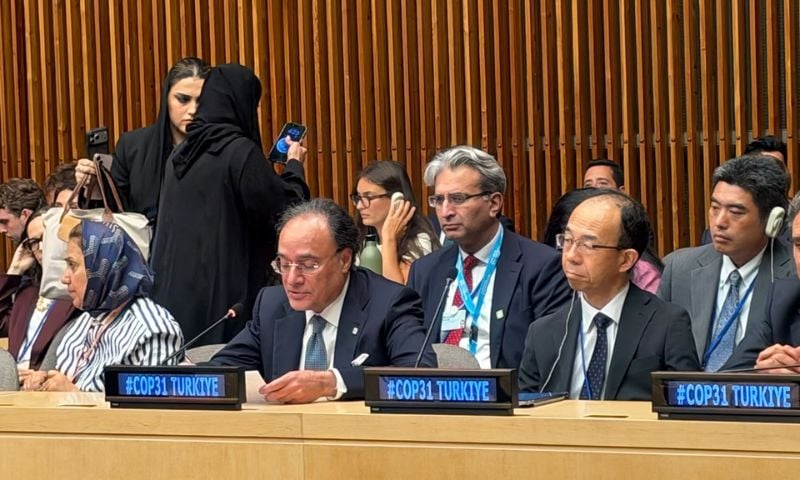
ISLAMABAD: Pakistan’s Finance Minister Muhammad Aurangzeb highlighted the country’s climate vulnerability, called for faster access to international climate financing and outlined the country’s transition towards a regulated virtual-assets framework.
He spoke at high-level engagements in New York on the first day of his visit to the United States, during the high-level week of the 81st session of the United Nations General Assembly.
At the World Economic Forum’s “Financing Planet and Prosperity” meeting, he highlighted Pakistan’s vulnerability to climate-related disasters, particularly floods affecting infrastructure and communities.
He outlined government efforts to strengthen disaster-response systems, early-warning mechanisms and costed climate-investment plans. He emphasised that domestic resources and fiscal buffers must be complemented by external assistance.
The finance minister said Pakistan had mobilised financing through the World Bank, Asian Development Bank and international capital markets for relief, climate adaptation and reconstruction.
He also called on international climate funds, including the Green Climate Fund and the Loss and Damage Fund, to simplify procedures and accelerate access to financing.
Aurangzeb also addressed digital transformation and financial inclusion at the United Nations Digital Cooperation Day 2026 session on blockchain, tokenisation and next-generation digital public infrastructure.
READ ALSO: Pakistan Finance Minister Calls for Private Sector Growth, Reforms
According to the Finance Minister, the government has been putting in place a regulated framework for virtual assets. Tokenisation should address practical economic needs, including cheaper remittances, financing for small and medium-sized enterprises, sovereign debt and wider access to financial services.
Strong government safeguards, inclusive digital infrastructure and international cooperation should support private-sector innovations, he said, adding that emerging economies must contribute to global standards.
Pakistan backs COP31
At the launch of the COP31 Action Agenda, Aurangzeb expressed Pakistan’s support for the initiative, saying it aligned with the country’s national climate priorities and Nationally Determined Contribution 3.0.
He identified clean energy and electrification, renewable-energy expansion, energy-efficient buildings, climate-resilient cities, climate education and public awareness, food security and climate-resilient agriculture among the government’s priorities.
Aurangzeb also welcomed the proposed Climate Implementation Bridge, describing it as a mechanism to transform national climate commitments into investable and bankable projects.