
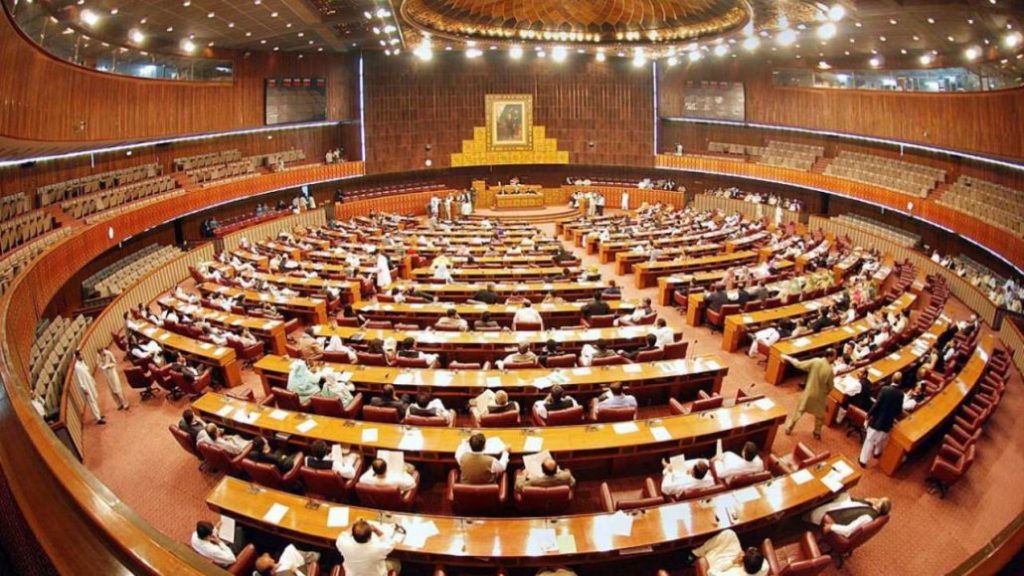
ISLAMABAD: Pakistan Senate body has declared that 25 federal ministries, divisions and bodies are operating unlawfully on provincial subjects and must be immediately abolished, in a sweeping ruling that challenges the very structure of the country’s federal governance.
The Senate Sub-Committee on Devolution, which met at Parliament House under the chairmanship of Convener Senator Barrister Zamir Hussain Ghumro, concluded that the federal government has deliberately ignored and violated the 1973 Constitution by retaining ministries on subjects that fall under provincial jurisdiction and the mandate of the Council of Common Interests (CCI).
Read Also: Political Leaders Urge for New Provinces with Empowered Local Governments in Pakistan
Senators Poonjo Bheel, Jan Muhammad Buledi and Nadeem Ahmed Bhutto participated in the proceedings, which examined the federal government’s compliance with the 18th Amendment and the recommendations of the Implementation Commission.
Ministries operating without constitutional authority
The Pakistan Senate body identified 25 bodies that are in serious and gross violation of the Constitution, including Health, Education, Railways, WAPDA, Petroleum, Industries, Water Resources, Climate Change, Housing, Narcotics, Police Service, and the Press Information Department, among others.
The Convener stated that the federal government has “consistently, periodically and brazenly ignored” constitutional provisions that clearly mandate that no ministry, institution or organization shall be created on provincial subjects or the erstwhile Concurrent Legislative List.
The committee noted that even before the 18th Amendment, the executive authority of the federal government did not extend to concurrent matters, and 17 ministries established on such subjects were unconstitutional from the outset.
CCI mandate must be restored
The Pakistan Senate body firmly asserted that under Article 154 of the Constitution, matters enumerated in the Federal Legislative List Part II fall exclusively under the authority of the Council of Common Interests.
These include Railways, Oil and Gas, Petroleum, WAPDA, Electricity, Major Ports, all Regulatory Authorities, National Planning, Public Debt Management, Census, Medical and Legal Professions, Standards in Higher Education and Inter-Provincial Coordination.
The rationale for placing these subjects under CCI authority, the committee explained, was to safeguard the interests of smaller provinces from the majority of one province in the National Assembly. Punjab holds 141 general seats, while all three smaller provinces combined hold only 122.
The Pakistan Senate body rejected the federal government’s reliance on the 1997 Gadoon Amazai Case judgment, noting that Parliament had already removed the rationale for that judgment through the 18th Amendment by mandating that the CCI must meet every three months.
List of unlawful bodies
The following ministries, divisions and bodies were declared unconstitutional and must be immediately shut down or devolved:
Health, Education, National Food Security, Water Resources, Climate Change, Housing, Special Initiatives, Culture and Heritage, Evacuee Trust Board, Zakat and Ushur (collection), Naya Pakistan Housing Authority, EOBI, Narcotics, Police Service, PMDC, Korangi Fish Harbour, Press Information Department, SIDCL, Railways, Industries, Statistics, Petroleum, Inter-Provincial Coordination, Planning and Development, and WAPDA.
Senate Committee declared that ministers and officers of these bodies are holding their positions without lawful authority and are a burden on the national exchequer.
Federal government must limit itself to nine ministries
The Pakistan Senate body directed that the federal government must limit itself to nine core ministries: Defence, Foreign Affairs, Finance, Commerce, Communication, Maritime Affairs on High Seas, Science and Technology, Law and Justice including Human Rights, and Parliamentary Affairs.
The Prime Minister must stop taking CCI subjects to the Federal Cabinet and instead convene frequent meetings of the CCI. The committee also called for the CCI to be reconstituted on the basis of equality of provinces rather than majority of one province.
Constitutional and security implications
The Senate body warned that not implementing its recommendations on an urgent and emergency footing would be “tantamount to a subversion of the constitution, which will have serious consequences for the security of the Federation of Pakistan.”
It noted that Pakistan’s youth is highly disgruntled, with insurgency in smaller provinces and the life of ordinary citizens becoming increasingly difficult.
The committee also reminded the federal government that Pakistan is a federation created by its four provinces and was never meant to be a unitary or centrist government that supersedes provinces.
The committee directed the federal government to amend the Rules of Business accordingly and for the CCI to frame its rules under Article 154 of the Constitution with immediate effect. All unlawful bodies must be shut down forthwith through government notifications, without affecting employees as per the procedure set out by the Implementation Commission.